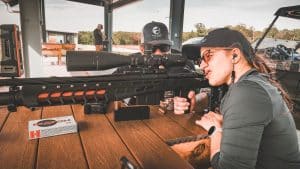





With a 4.8-pound platform, integrated self-retracting cocking system, and a serviceable dual-cable architecture, the Hawkwing challenges conventional thinking about what a modern hunting crossbow can be.

A Different Approach to Crossbow Engineering
For years, the crossbow industry has followed a familiar formula: increase arrow velocity, reduce axle-to-axle width, refine the trigger system, and introduce more sophisticated cocking mechanisms. The results have been impressive, but progress has often come with added mechanical complexity, specialized maintenance requirements, and increasingly premium price tags.
Ballista’s Hawkwing takes a different approach.
Rather than focusing exclusively on speed, the company has designed a crossbow around three interconnected priorities: compact dimensions, reduced cocking effort, and greater serviceability.
The result is a 27-inch crossbow weighing just 4.8 pounds, with a cocked axle-to-axle width of 5.9 inches and a manufacturer-rated maximum velocity of 500 feet per second.
Those specifications are noteworthy on their own. What makes the Hawkwing more interesting, however, is the engineering behind them.
Compact by Design, Not by Compromise
Crossbow dimensions matter most when space becomes limited. Hunters working inside ground blinds, navigating dense vegetation, or transporting equipment into remote locations understand the practical value of a smaller platform.
At just 4.8 pounds before accessories, the Hawkwing is designed to reduce the bulk associated with conventional full-size hunting crossbows.
Its reverse-limb configuration places the riser closer to the shooter, helping centralize the bow’s mass. The compact arrangement also creates a narrow profile without requiring an unusually long frame.
For hunters who prioritize mobility, the design offers several potential advantages: less equipment to maneuver, reduced carrying weight, and a more manageable footprint in confined spaces.
The distinction is particularly important when comparing a crossbow’s advertised bare weight with its fully equipped hunting weight. As with any hunting setup, optics, mounting hardware, arrows, and other accessories will increase the final carrying weight.
The 500 FPS Question: Understanding Speed and Arrow Energy
Speed is one of the most recognizable performance measurements in the crossbow market, but velocity alone does not tell the complete story.
The Hawkwing’s manufacturer-rated top speed of 500 FPS is achieved with its lightweight 150-grain arrow configuration. Heavier hunting arrows produce lower velocities while changing the amount of kinetic energy delivered.
Ballista publishes three representative configurations:
Hawkwing Arrow Speed & Kinetic Energy
150-grain, 14-inch arrow
Rated Speed: 500 FPS
Kinetic Energy: 83.3 ft-lb
250-grain, 16-inch arrow
Rated Speed: 425 FPS
Kinetic Energy: 100.3 ft-lb
363-grain, 16-inch arrow
Rated Speed: 340 FPS
Kinetic Energy: 93.2 ft-lb
Source: Ballista manufacturer specifications.
Manufacturer-published figures; not independently chronographed. Arrow weights and configurations should be confirmed against the current manufacturer’s specifications.
BALLISTA
These numbers illustrate a fundamental principle of crossbow performance: the fastest arrow is not necessarily the one delivering the greatest kinetic energy.
The 250-grain configuration, for example, has a lower rated velocity than the lightweight 150-grain arrow, yet its calculated kinetic energy is higher.
For hunters, that distinction matters. Arrow selection involves balancing trajectory, momentum, broadhead compatibility, accuracy, and the requirements of the intended application.
A meaningful field evaluation of the Hawkwing would therefore test multiple manufacturer-approved arrow configurations rather than relying on the headline velocity figure alone.
An Integrated Cocking System That Changes the Experience

A powerful crossbow is only as practical as its cocking system.
Traditional rope-cocking devices can reduce draw effort, but they introduce a separate accessory that must be carried, positioned, and managed during use.
The Hawkwing incorporates a self-retracting cord-based cocking aid directly into its design.
Despite the crossbow’s 200-pound limb draw-weight specification, Ballista rates the maximum force required at the cocking handle at approximately 72 pounds.
The built-in system eliminates the need to carry a separate cocking rope and keeps the cocking aid attached to the crossbow.
For hunters who regularly move between shooting locations or practice frequently, that integration is an important convenience.
Ballista also advertises a cocking cycle as short as three seconds. Actual cocking time will depend on the operator and conditions, and the figure should be evaluated independently rather than interpreted as a guaranteed field result.
What is more significant than the claimed speed is the underlying design philosophy: simplify the interaction between shooter and equipment without sacrificing the power of the bow.
Press-Free Maintenance: The Hawkwing’s Most Distinctive Feature
For many crossbow owners, string and cable maintenance is one of the less convenient aspects of ownership.
Conventional high-performance crossbows frequently require specialized presses or professional servicing for operations involving the string, cables, or limbs.
Ballista has approached this challenge through a dual-cable architecture that allows the system’s tension to be adjusted using the manufacturer’s prescribed procedure and standard tools.
According to Ballista, this design permits string, cable, and certain limb-related maintenance without a conventional crossbow press.
The system also incorporates cam-alignment references and an adjustment mechanism intended to help maintain proper synchronization.
This is potentially one of the Hawkwing’s most meaningful innovations.
It shifts some maintenance operations away from specialized workshop equipment and toward a more accessible service model.
That does not eliminate the need for careful handling. Crossbow limbs and cables store substantial mechanical energy, and all maintenance must follow the manufacturer’s instructions. Owners should never attempt unapproved adjustments or disassembly.
Nevertheless, the design raises an interesting question for the broader industry: should serviceability become as important a purchasing consideration as speed, weight, and accuracy?
Precision, Balance, and Construction

The Hawkwing uses a reverse-limb layout, dual-cable system, and a 10.51-inch power stroke.
Its construction includes a 6061-T6 aluminum riser, composite limbs, and reinforced polymer components. Dual limb dampers are intended to help control vibration.
An automatic anti-dry-fire mechanism is designed to inhibit firing when an arrow is not properly seated, although it does not replace standard crossbow safety practices.
The crossbow also features top and bottom 20 mm Picatinny rails for compatible accessories, including optics.
Ballista supplies the Hawkwing with a 4×32 scope and three bolts, giving owners a basic starting configuration.
An independent accuracy evaluation should examine repeatability at multiple distances, group size, point-of-impact consistency, and the relationship between field points and compatible broadheads.
These measurements would be particularly valuable given the Hawkwing’s compact frame and high advertised arrow velocity.
Built for a Different Kind of Crossbow Owner
Not every hunter wants the same thing from a crossbow.
Some prioritize the quietest possible shot. Others value a familiar stock configuration, maximum downrange energy, an established dealer-service network, or a highly refined trigger.
The Hawkwing’s strongest proposition is different: it combines an unusually compact profile with a built-in cocking aid and a design intended to simplify maintenance.
Its low bare weight may appeal to mobile hunters, while its narrow dimensions make it relevant to shooters working in restricted spaces.
The platform may also attract experienced crossbow owners who appreciate mechanical design and want greater access to routine servicing.
However, its compact construction and high-speed capabilities should not be mistaken for universal suitability. Prospective owners should consider trigger characteristics, compatible arrow requirements, noise, real-world accuracy, and local hunting regulations before selecting any crossbow.
Ballista Hawkwing: Technical Specifications
Performance
- Maximum Velocity: Up to 500 FPS
- Limb Draw Weight: 200 lb
- Maximum Cocking-Handle Force: 72 lb
- Power Stroke: 10.51 in
Dimensions & Weight
- Bare Weight: 4.8 lb
- Overall Length (with Stirrup): 27 in
- Overall Length (without Stirrup): 26.5 in
- Axle-to-Axle Width (Cocked): 5.9 in
- Axle-to-Axle Width (Uncocked): 8.5 in
The Bottom Line: Innovation Beyond the Speed Race
The Ballista Hawkwing enters a competitive market where manufacturers frequently compete over incremental improvements in speed, width, and weight.
Its more compelling story is not simply that it can reach a manufacturer-rated 500 FPS.
It is the combination of a 4.8-pound platform, a narrow reverse-limb configuration, integrated self-retracting cocking assistance, and a maintenance architecture designed to reduce reliance on specialized equipment.
At a listed price of $799, the Hawkwing presents an intriguing proposition for shooters seeking a compact, technically unconventional crossbow.
Independent chronograph testing, accuracy measurements, trigger evaluation, and long-term durability testing are still necessary to establish how its performance compares with established competitors.
But from an engineering perspective, the Hawkwing demonstrates that meaningful crossbow innovation does not have to begin and end with velocity.
Sometimes, the more interesting advancement is rethinking how the entire platform works.
Product information: Ballista Hawkwing — Official Product Page