






Let’s be honest: every shooter knows dry-fire practice is where fundamentals are reinforced, bad habits get exposed, and repetitions pile up without burning through a small mortgage in factory ammunition. The problem is that traditional dry-fire can get frustrating fast.
You establish your grip, present to the target, press the trigger and hear a click. Then the rhythm stops. You have to break your grip and cycle the slide before the next repetition. If you are working on follow-up shots, target transitions, reloads or a consistent presentation, that interruption changes the drill.
Standard dry-fire also leaves a lot to feel. You may think the sights stayed steady through the trigger press, but without feedback, it can be difficult to know exactly what happened at the break.


Mantis has spent years building training tools around that problem, from its MantisX sensor and Laser Academy to the Blackbeard system. The Mantis TitanX Smart Laser Training Pistol combines several of those ideas into one dedicated, inert training platform.
For this review, I wanted to do more than run through the features. I went to the range for a live-fire pre-test, spent seven days following a beginner training program in the Mantis app, and then returned to the range for the same live-fire test. The question was simple: Could one week of laser dry-fire training actually make me a better shooter?
After seven days of Mantis training, my average five-shot group at 8 yards shrank by roughly 50 percent in the post-test.
What Is the Mantis TitanX?
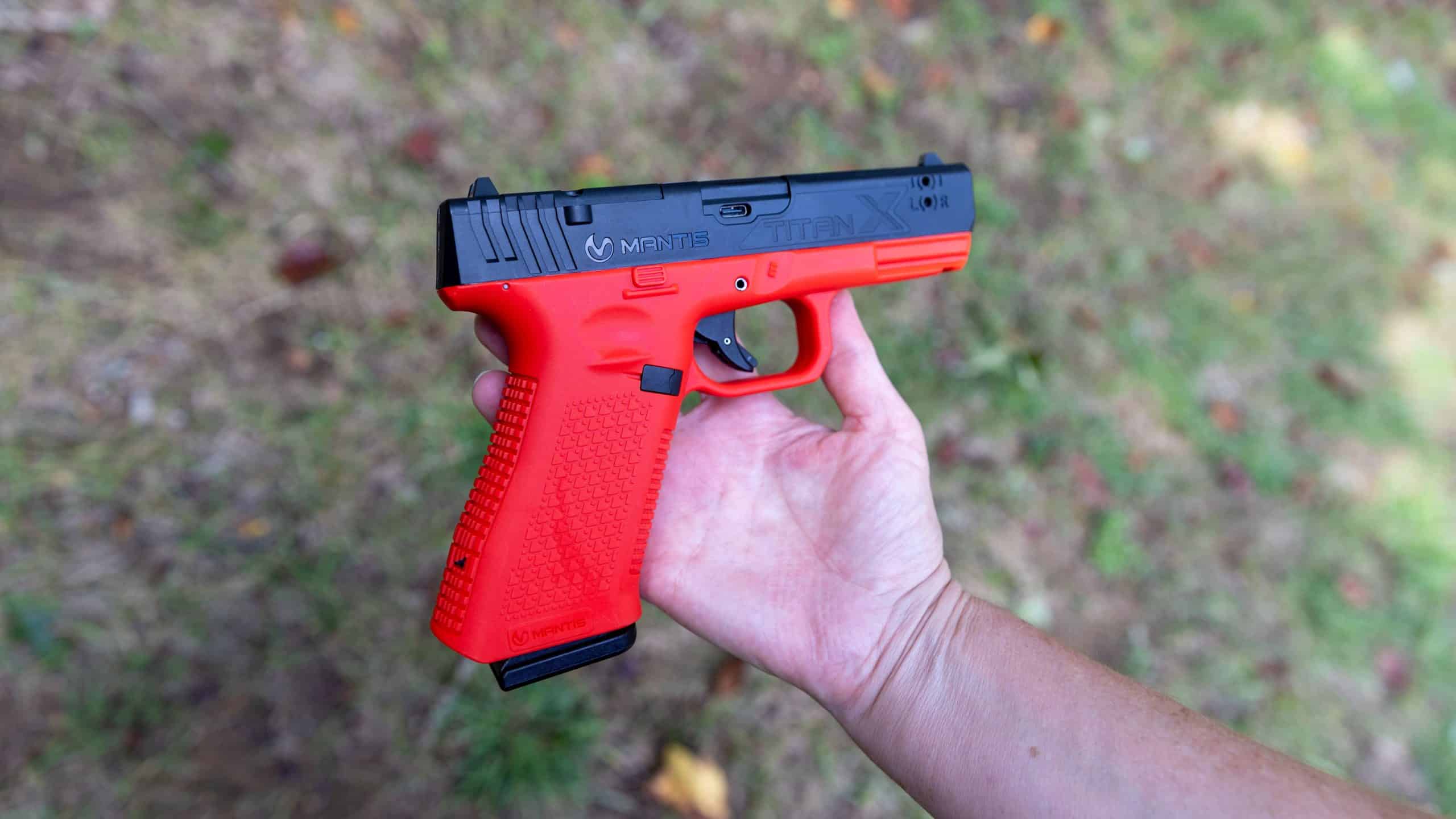
The Mantis TitanX is a completely inert, dedicated smart laser training pistol. It is not a barrel conversion or an insert for an existing handgun. Instead, it is a standalone training pistol with a high-visibility red body, functional controls, an automatically resetting trigger, an integrated MantisX sensor and a red point-of-impact laser.
That combination addresses two of the biggest limitations of conventional dry-fire practice: the need to manually reset the trigger between repetitions and the lack of objective feedback about what the gun was doing before, during and immediately after the trigger press.
- Auto-resetting electronic trigger: allows repeated trigger presses without cycling a slide.
- Integrated MantisX sensor: tracks movement of the pistol and feeds shot-by-shot data into the Mantis app.
- 650 nm red laser: provides visible point-of-impact feedback and compatibility with laser-based training systems.
The TitanX is offered in three current configurations designed around Glock-pattern dimensions: the TitanX 700 emulates the Glock 17, the 701 emulates the Glock 19 and the 702 emulates the Glock 45. Each model is designed to work with most corresponding holsters, which makes the system more useful for realistic presentations and gear-based practice.
That Glock-style form factor should also feel familiar to shooters who have spent time with other Glock-compatible designs, including the PSA Dagger 9mm handgun.
Because the TitanX is an inert training device, it cannot chamber or fire live ammunition. That makes it purpose-built for dry-fire practice rather than forcing the user to repeatedly verify and reconfigure a live handgun between drills.
Mantis TitanX Key Features


The electronic trigger resets immediately after each press, eliminating the need to cycle the slide between repetitions. That makes multi-shot strings and rhythm-based practice far more natural than conventional dry-fire.
Instead of attaching an external sensor to the accessory rail, MantisX technology is built into the TitanX. The app analyzes movement around the trigger break and provides shot scores, traces and diagnostic feedback.
The 700, 701 and 702 models are designed to fit most holsters made for their corresponding firearm profiles, letting you train with gear that closely matches your normal setup.
The slide is cut for RMR, Shield RMS and RMSc footprints. That gives red-dot shooters the ability to practice presentation and dot acquisition with a real optic mounted on the trainer.
Two weighted magazines are included, and Mantis says they approximate the weight of a fully loaded magazine. The system can detect magazine removal and insertion for compatible reload-analysis drills.
An internal rechargeable battery eliminates disposable batteries and charges through USB-C, which makes the TitanX easy to keep ready for short, frequent practice sessions.
Mantis TitanX Specs
TitanX 701: Glock 19-style dimensions
TitanX 702: Glock 45-style dimensions
How I Trained With the Mantis TitanX
Reading a spec sheet is one thing. Getting useful training value from the TitanX is another. The real advantage of the system is not simply watching a red laser flash on a wall; it is using the app’s data to identify patterns, then structuring practice around those patterns.
For this review, my actual seven-day program focused on the first phase below: trigger manipulation and muzzle trace. The later phases show how I plan to expand the system as I continue using it.
Trigger Manipulation & Muzzle Trace
The core Mantis score runs from 0 to 100 and reflects how stable the pistol remains around the trigger break. The trace view lets you see movement before, during and immediately after the shot.

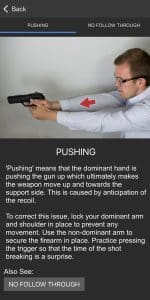
My basic routine: I connected the TitanX to the MantisX Pistol/Rifle app, ran the 10-shot Benchmark Drill, and then used Open Training for higher-volume repetitions. My focus was a straight rearward trigger press without adding movement from the rest of my hand.
The app’s diagnostic feedback was the useful part. Instead of simply knowing a shot felt wrong, I could see movement patterns and get feedback on errors such as disturbing the gun during the trigger press. During the week, I tried to keep my individual shot scores above 92 while maintaining a consistent grip and visual focus.
Draw Analysis & Multi-Shot Practice
The resetting trigger allows the TitanX to continue collecting useful data beyond the first dry-fire shot. For shooters who use holster-based training, that means the system can break the presentation into timed segments and track what happens through the first shot and subsequent split times.
The value is being able to compare repetitions and identify wasted movement in the presentation rather than relying only on a final time. Use an appropriate inert-training setup, follow the manufacturer’s guidance, and keep live ammunition outside the training area.
Target Transitions & Cadence
Target transitions are difficult to practice repeatedly at many indoor ranges, especially when multiple targets or wider angles are involved. With the TitanX, you can rehearse visual transitions and pistol movement in a dry-fire environment.
When paired with Laser Academy, the phone’s camera can recognize laser impacts on compatible targets and score them on screen. The Mantis data can then help show whether the gun is stopping smoothly or overshooting as you move between aiming points.
Magazine-Exchange Practice
The two included weighted magazines let the TitanX add magazine changes to dry-fire practice. The system can detect magazine removal and insertion, which allows compatible Mantis drills to break the exchange into measurable phases.

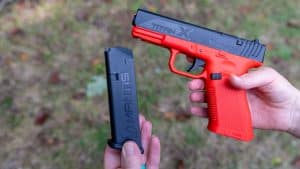
That makes it possible to work on smoother, more consistent mechanics while still getting data on the shot before and after the exchange.
Real-World Results: Did One Week Make a Difference?
For the live-fire portion of the test, I used a Taurus TX9 Compact because its overall size, weight and feel were reasonably comparable to the TitanX. I stood 8 yards from a steel target and fired five separate five-shot groups, measuring each group to establish a pre-training average.

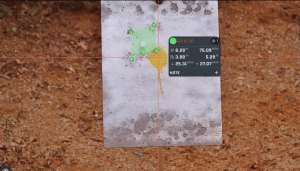
My pre-test average was 5.94 inches, or 70.86 MOA, with many shots landing high and left. I then completed seven days of the Basic Marksmanship program in the Mantis app, along with additional Open Training repetitions.
One thing that stood out was how the app’s diagnostics matched what I was seeing on the live target. During practice, Mantis repeatedly flagged movement patterns that could push shots high and left and offered feedback intended to correct those tendencies.
After the seven-day program, I returned to the same range, used the same 8-yard distance and repeated the same five-shot-group protocol. Bulk Munitions supplied the ammunition for the live-fire portion of the test.
The post-test average dropped to 2.94 inches, or 35.12 MOA, and a much larger share of the shots landed in the yellow center area I was aiming at.

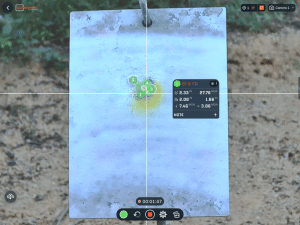
This was a one-shooter, one-week field test, not a controlled scientific study. I cannot say every shooter will cut group size in half. What I can say is that my measured groups were substantially tighter after a week of structured practice, and the Mantis feedback gave me specific movement patterns to work on rather than simply adding more repetitions.
Who Should Buy the Mantis TitanX?
At $199, the TitanX is not a throwaway dry-fire accessory, but it is also easy to compare against the cost of repeated live-fire practice. Depending on ammunition prices and how much you normally shoot, several high-round-count range trips can quickly approach the price of the trainer.
The stronger argument for me, though, is convenience. Most shooters cannot get to a live-fire range every day. A dedicated inert trainer makes it much easier to fit short, repeatable practice sessions into the week and get immediate feedback on each repetition.
Shooters who want frequent at-home dry-fire practice with measurable feedback instead of repetitions based only on feel.
Trigger-control work, presentation consistency, optic acquisition, movement analysis and magazine-exchange practice.
It does not simulate recoil, the red laser is difficult to see in direct sunlight, and the current form factors primarily mirror Glock-pattern pistols.
Mantis TitanX Pros and Cons
- No slide racking between shots: the resetting trigger keeps repetitions flowing.
- Useful training analytics: integrated MantisX feedback exposes movement around the trigger press.
- Completely inert: purpose-built for dry-fire training.
- Holster compatibility: designed to fit most holsters corresponding to its emulated firearm profile.
- Optic ready: supports RMR, Shield RMS and RMSc footprints.
- Two-app ecosystem: works with the MantisX app and is compatible with Laser Academy.
- USB-C charging: no disposable batteries to replace.
- No simulated recoil: it cannot replace live-fire work for recoil management or recovery.
- Red-laser visibility: the laser is difficult to see outdoors in direct sunlight.
- Limited current form factors: the 700, 701 and 702 mainly serve shooters using Glock-like ergonomics.
- Front sight visibility: I found the molded front sight difficult to pick up quickly and added a silver Sharpie mark to mine.
- Fixed slide: the non-cycling slide means some slide-manipulation practice still requires a different training setup.
Final Thoughts on the Mantis TitanX
The TitanX fills an interesting gap between basic dry-fire tools and more involved live-fire training. By combining an inert pistol, an automatically resetting trigger, an integrated MantisX sensor and a visible laser, it removes several of the friction points that make traditional dry-fire repetitive or difficult to measure.
It is not a replacement for live ammunition. You still need range time to experience recoil, confirm zero and validate that dry-fire improvements carry over when the gun actually fires. That is exactly why I wanted to use a pre-test and post-test rather than judge the TitanX entirely from the app.
In my case, the live-fire results moved in the right direction: my average five-shot group dropped from 5.94 inches before training to 2.94 inches after seven days. That does not guarantee the same improvement for everyone, but it showed me that a short block of structured, feedback-driven practice could translate to a measurable difference on target.
If you want to refine trigger control, make your dry-fire sessions more measurable and track progress over time, the Mantis TitanX gives you far more useful feedback than a basic click-and-reset routine.