





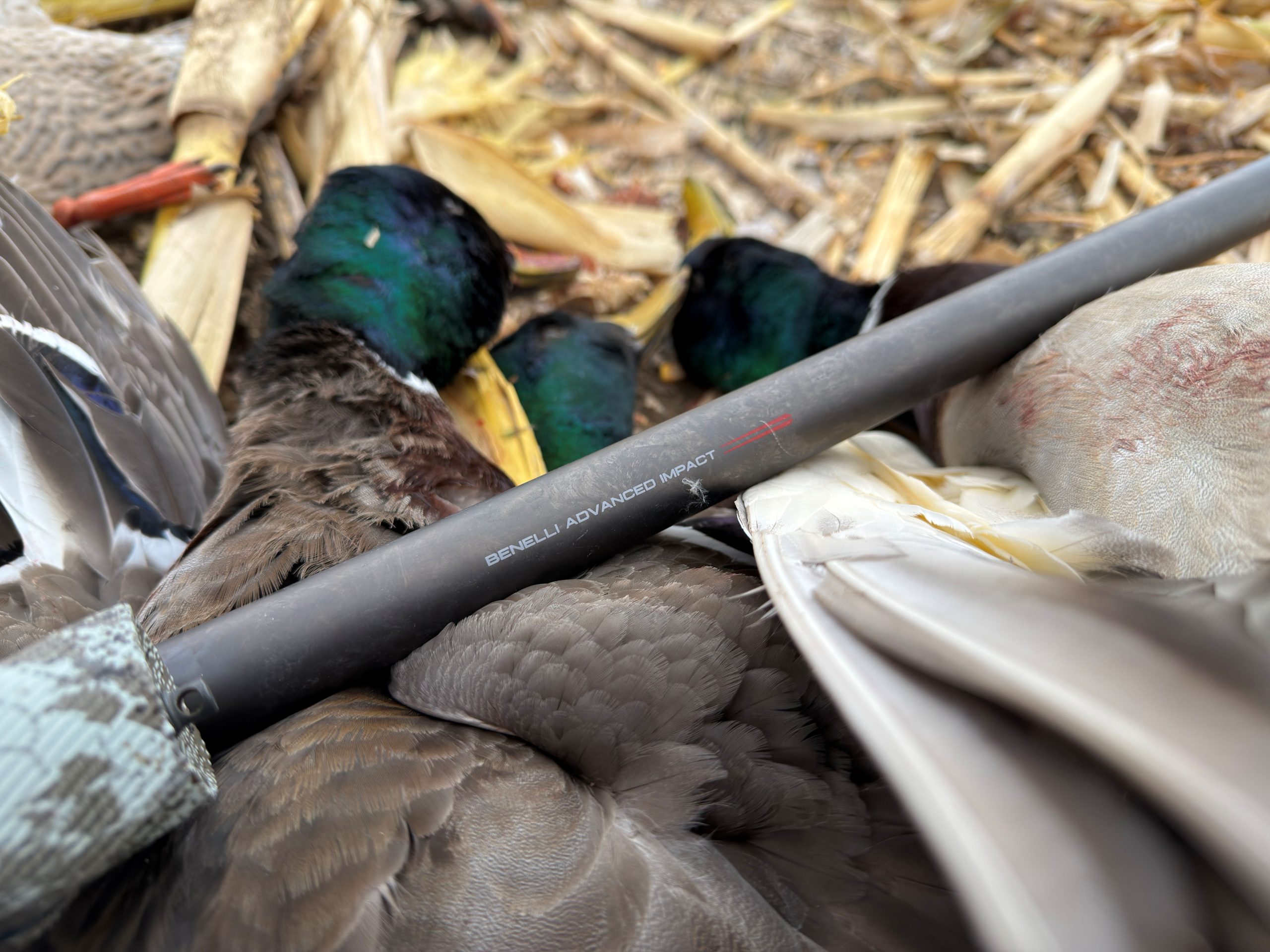
The Benelli Advanced Impact (AI) system is one of the most interesting shotgun developments I have seen in years because it challenges many of the beliefs hunters have traditionally held about shotgun barrels and choke selection. The Advanced Impact barrel system is no longer limited to the original Super Black Eagle 3 and Ethos Cordoba models. Benelli has expanded the technology across several shotgun platforms, including the SBE3, Ethos Cordoba, Ethos Upland, Ethos SuperSport, Ethos Sport, and 828 U SuperSport. The system is now available in 12-, 20-, and 28-gauge options, allowing waterfowl, upland, and clay target hunters to experience the benefits of the AI barrel design.
Traditional vs. Modern
Most shooters understand the basic concept of a choke. The tighter the choke, the tighter the pattern. If you want longer-range performance, screw in a Full choke and head to the field. The Benelli AI system proves things are no longer that simple, but understanding the changes provides benefits beyond expectation.


At first glance, the barrel looks different because it is different. The outside diameter is noticeably larger than a conventional 12-gauge barrel, but the real story is inside. The bore dimensions are much larger than a traditional 12-gauge, approaching those of a 10-gauge in several areas. In simple terms, the shot charge is traveling through a larger tunnel before reaching the choke.
Think of traffic moving down a highway. When vehicles are forced into a narrow lane too quickly, congestion occurs. Pellets behave similarly. Traditional bores can squeeze and deform pellets as they travel through the barrel and choke system. It can also slow them down. Every damaged pellet becomes unpredictable once it leaves the muzzle, causing flyers, partially blown patterns, and inconsistencies.
Benelli Advanced Impact (AI) in a Super Black Eagle 3 Pattern Test
The Benelli A.I. system is designed to reduce that disruption. It is traffic control for your shotgun and stabilization for shotshell pellets.
The barrel uses what many describe as an hourglass design. The bore starts oversized, narrows through the center section, and then expands again before reaching the choke tube. Combined with Benelli’s extended 4.5-inch choke tubes, the system gradually controls the shot charge rather than abruptly forcing it through a restriction. The result is maintained velocities, more uniform patterns, and better pellet integrity. Some have contributed the technology to increased velocity, but that is not the case. A shotshell powder charge cannot be changed by barrel reconfiguration, but less traffic congestion can mean maintained velocity at greater ranges or slightly higher velocities out of the barrel.
Testing showed the A.I. barrel consistently produced higher velocities than a conventional Super Black Eagle 3 barrel. A shotgun guru and good friend shared some of his data, which helped explain what I was experiencing and what I was seeing in the field. The data showed pellets leaving the barrel 30 to 50 feet per second faster, which may not sound dramatic, but speed translates directly into retained energy downrange. Allowing pellets to fly without congestion results in higher velocity with the same charge by reducing pellet traffic jams. More importantly, the pellets appear to stay round and more consistent, which improves pattern density at longer distances.
Hunting Experience with the Benelli Super Black Eagle 3 with AI


My hunting experiences showed the same results: I found myself reducing leads to stay on target, especially when the fowl was under 30 yards. Shooting decoying ducks became slow and methodical with incredible results. The same held true for large honkers pushing 50 yards. Less lead, more pellets on target, and the lethality quickly made a believer out of me.
Where things became truly interesting was during pattern testing. Conventional shotgun wisdom holds that tighter chokes produce tighter patterns. The A.I. system often delivered the opposite result. This is important to note to get the most out of the new technology and not feel like you just can’t make it work.

Why the SBE3 with an AI Barrel Improves Performance
Several loads that produced disappointing patterns through the Full choke quickly came alive when paired with more open constrictions, producing outstanding patterns. In some cases, an Improved Cylinder or an Improved Modified choke dramatically outperformed the tighter Full choke. The results are easier to understand when you think of less restriction in the barrel as free-flowing traffic without congestion. Fewer pellets hitting each other, often causing misshapen spheres and blown patterns, can be reduced by less constriction in the choke.
That seems backward until you understand what is happening. Because the oversized bore is already doing much of the work of controlling and organizing the shot charge, a very tight choke can sometimes over-constrict the payload. Instead of creating a tighter pattern, it can damage pellet alignment and cause the pattern to blow apart.
Think of squeezing eight lanes of traffic into two. A gentle lane reduction over a longer distance keeps everything organized. Too much constriction creates collisions and chaos.
Reviewing my friend’s testing and reflecting on my experiences during the fall and spring hunting seasons clearly demonstrated this effect. Loads that struggled through the Full choke often produced dense, highly effective patterns when switched to a more open choke. The barrel and choke work together, and the choke selection process differs from that of traditional shotguns.
Hunters moving to the A.I. platform should resist the temptation to immediately install the tightest choke available. Pattern testing becomes even more important because loads behave differently in non-conventional barrels.
More Pellets on Target with a Benelli SBE3 and AI Barrel
On a late-season pheasant hunt, I used a modified choke and a magnum load of #6 lead. Birds were flushing hundreds of yards ahead of us, so I worked the break of a coulee to come over the edge and surprise potential birds. It worked, and a big rooster burst from cover and I swung the bead in front of it and pulled the trigger. The pellets hit hard, and the bird landed 80 yards from where I stood. It was stone, cold, dead, letting me know my pattern was dense, the velocities were maintained over a longer range, and the advantages meant I was going home with some fresh proteins.
Getting more out of your Shotshells with Benelli AI Barrel Technology
The benefits become obvious when distances increase. Turkey hunters, waterfowl and upland hunters, predator hunters, and anyone shooting modern tungsten loads stand to gain the most. The combination of improved pellet condition, increased velocity, and more efficient pattern control extends the effective range without requiring larger payloads.


I was shooting snow geese using tungsten shot, which delivered devastating performance at ranges that would have been considered unrealistic for most shotguns only a few years ago. Other steel and blended loads showed similar improvements when matched with the correct choke. I hunted with a variety of shotshells, including Fiocchi, Federal, Winchester, and others, and they all performed beyond expectation when compared to my other shotguns and barrels. When I shot a triple on adult spring snow geese at over 85 yards, I became a believer. The birds were all dead before they hit the ground.
Trifecta – Why the Benelli AI Barrel works
What impressed me most is that the A.I. system does not rely on a single component. The oversized bore, unique internal dimensions, extended choke tubes, and choke selection all work together. Looking at one piece, without considering the others, misses the point. The combined benefits are a trifecta, which simply means a group of three successful outcomes, achievements, or elements that occur together.
For the average hunter, the takeaway is simple. The Benelli A.I. barrel is designed to treat the shot charge more gently, allowing pellets to leave the barrel in better condition. Better pellets fly straighter, carry more energy, and create more effective patterns.
For shotgun enthusiasts, the technologies represent another step forward in the ongoing effort to maximize smoothbore performance. It builds on concepts seen in back-bored barrels and large-bore systems while taking them in a new direction.


Don’t Assume
The biggest lesson from the testing is not to assume anything. Traditional choke rules do not always apply. Pattern your shotgun, test different loads, and experiment with choke combinations. Seeing is believing, and patterning a shotgun will show you more effective patterns at greater distances, and which shotshells the shotgun and barrel like the best. It was interesting that many of the average speed shotshells, like a Fiocchi Golden Waterfowl 3-inch #2 steel, were traveling at 1,350 fps.
Shotshell comparison:
Fiocchi Golden Waterfowl 3″ #2 Steel: 1,350 fps
Federal Speed-Shok 3″ #2 Steel: typically, 1,450 fps
Winchester Xpert 3″ #2 Steel: typically, 1,450 fps
Kent Fasteel 3″ #2 Steel: typically, 1,550 fps


The Fiocchi load is not the fastest waterfowl shell on the market, but what hunters may experience is that the 1,350-fps velocity produces a good balance of pattern quality, pellet energy, and manageable recoil. The Golden Waterfowl loads produced outstanding, lethal patterns at a variety of distances, proving that speed isn’t everything. Higher velocities can increase pellet deformation and sometimes open patterns, whereas moderate-speed loads often pattern exceptionally well, especially with quality chokes. Use a more open choke for faster loads.
Is the Benelli A.I. System Worth It?
If you’re the type of hunter who simply buys a box of shells, screws in a choke, and heads to the marsh without ever patterning your shotgun, you may not fully appreciate what the Benelli Advanced Impact system offers.
But if you’re constantly looking for an edge—more pellets on target, cleaner kills, greater effective range, and better performance from premium shotshells—the A.I. system is one of the most meaningful advancements in shotgun design in recent years.
The hunters who stand to benefit most include:
- Waterfowl hunters shooting steel or tungsten at varying distances.
- Turkey hunters looking to maximize pattern density.
- Pheasant hunters who regularly take longer crossing shots.
- Predator hunters stretching the capabilities of modern shotshells.
- Competitive shooters seeking every advantage possible.
The system rewards shooters willing to pattern their guns and experiment with choke combinations. Do that, and you’ll likely discover you can achieve tighter patterns with more open chokes, less recoil than ultra-fast loads, and greater confidence when the shot opportunity finally presents itself.
Check Current Pricing & Availability
- Benelli SBE3 Advanced Impact
- Benelli Ethos Cordoba Advanced Impact
- Benelli Ethos Upland Advanced Impact
Selecting the Right Choke for the Benelli AI Barrel
One thing I would recommend is patterning your load through multiple Benelli A.I. chokes. Based on my testing results, the more open Improved Cylinder and Improved Modified A.I. chokes often outperformed the tighter Full choke with steel and blended waterfowl loads. It also held true with the long-range rooster loads.

This long-range rooster folded clean with a well-placed pattern from a Benelli A.I. barrelThe Benelli A.I. system appears to reward shooters willing to do their homework, and the payoff can be tighter patterns, greater effective range, and more confidence when the moment of truth arrives in the field.
What the Nay Sayers are Saying
New technology is not always met with open arms or minds. I posted some photos and information on social media after a late-season waterfowl and pheasant hunt. A fellow active in the trap shooting community instantly attacked me, accusing me of being a “greasy salesman”. He went on to say “This is far from some new technology. Ithaca did this on their trap guns dating back to the introduction of the Flues single barrel trap in 1914, and many other makers such as Parker, Fox, etc did this as well. Christ, this stuff was introduced before most of you guys were more than a gleam in your great-grandfathers’ eyes. Both my 4E’s (1917 Flues & 1957 Knick) are made this way, as is my 1926 5E Knick and my 1923 Super Fox. Trapshooters are notorious for having their guns customized to try to squeeze the best long-range and evenly distributed patterns possible to win big tournaments, and there has been no shortage of gunsmiths specializing in doing these kinds of mods to barrels for the past 100 years or more. Are you guys writers or salesmen?”
The keyboard warrior is correct that similar technologies have been used in the past. He acknowledges that the modification ‘squeezes the best long range and evenly distributes the pattern’, which helps make my points. However, what he fails to acknowledge or investigate is that Benelli was the first to combine the three modifications, and did so without infringing any patents or proprietary concepts.
I think the man’s discomfort stemmed from the fact that others may have and enjoy the same advantages that several well-heeled trap shooters have, which may even make his competition on the range fiercer. He obviously knows his stuff, but didn’t look at the details.
For me, achieving higher success rates in the field, having more clean kills, and knowing I’m a more consistent shooter with the system are all I need to believe. I’m sharing information for hunters looking for that edge or advantage, not trying to be a ‘greasy salesman’.
Fiocchi Golden Waterfowl: Affordable Performance for Ducks and Geese


Finding waterfowl ammunition that delivers reliable performance without breaking the budget can be challenging, but Fiocchi’s Golden Waterfowl line continues to be a solid option for hunters who spend a lot of time in the blind.
The loads are built around plated steel shot designed to remain round and uniform as it travels down the barrel and through the choke. Rounder pellets generally pattern more consistently, retain energy better, and provide improved penetration on birds. Fiocchi combines the plated steel shot with heavy-duty wads, clean-burning powders, and dependable primers to produce a load that performs well under a wide range of hunting conditions.
One feature waterfowl hunters will appreciate is the sealed shell design. Wet conditions are simply part of duck and goose hunting, whether you’re setting decoys in flooded timber, hunting from a layout blind, or dealing with snow and freezing rain. The sealed shells help protect the powder and primer from moisture, providing added confidence when conditions deteriorate.
The current Golden Waterfowl lineup is offered in 12-gauge, 3-inch loads carrying 1¼ ounces of plated steel shot at a muzzle velocity of 1,350 feet per second. Available shot sizes include BB, 1, 2, 3, and 4, giving hunters effective options for everything from early-season ducks over decoys to late-season geese.
While some modern steel loads push velocities significantly faster, the 1,350 fps load strikes a nice balance between pattern quality, manageable recoil, and downrange performance. During testing, Golden Waterfowl loads consistently delivered dependable patterns and clean kills on ducks and geese without the punishment often associated with ultra-high-velocity ammunition.
For hunters looking for a dependable waterfowl load that combines quality components, consistent performance, and reasonable pricing, Fiocchi Golden Waterfowl remains a strong choice season after season.