




Jump to a Section
Best Commercial-Grade
Cabela’s 80-Litre Commercial-Grade
12 racks and an 80-liter cabinet for large batches of wild-game jerky and produce.
Best Mid-Capacity
Ten square feet of drying space and stainless steel trays for regular jerky making.
Best Home or Family Use
An 800-watt dehydrator with 7.4 square feet of drying area and a 48-hour timer.
Best Entry-Level
A compact option for smaller batches of jerky, mushrooms, fruit, and herbs.
Best Value
A stainless steel cabinet and individually accessible racks for wild-game jerky.
Best Budget High-Capacity
Nearly 10 square feet of drying area and a 900-watt heater at a manageable size.
Best Food Dehydrators: Picks at a Glance
When I evaluate a dehydrator, I want to know how it performs with a real workload. Specifications are useful for comparing machines, but they don’t tell the whole story when you have a cooler of venison to turn into jerky or several flats of ripe fruit that need attention before they spoil.
Our Testing Workload: We sliced, marinated, and turned about 50 pounds of venison and 20 pounds of goose into jerky. We also dried strawberries, apples, pineapple, mushrooms, and herbs, made fruit leather, and experimented with pepperoni and other sausage for dried snacking sticks.
Significant rains produced a bumper crop of mushrooms, keeping the dehydrators running steadily for days. We dried fresh herbs as they became abundant, providing a year’s supply to add flavor to our meals. Machines were loaded with full trays so we could evaluate capacity, airflow, and drying consistency under realistic conditions.
Even drying was one of the most important considerations. We compared food from different trays and different areas within the cabinet. Where appropriate, we rotated trays during one batch and left them in place during another to determine whether the airflow system could maintain consistent results on its own.
Noise was another consideration. Dehydrators often operate for many hours at a time, and there is a big difference between a quiet fan working in the background and one you don’t want running in the kitchen all day.
Jerky provided an excellent test of consistency. Finished pieces should have a consistent texture, rather than remaining soft in one area and becoming brittle in another. We also watched for moisture remaining after the finished product had cooled and been packaged. Fruit leather presented a different challenge: consistent drying from the edges through the center without wet areas or excessively dry margins.
Capacity became increasingly important as we worked through larger quantities. A smaller dehydrator can produce excellent results, but repeatedly loading and unloading it adds considerable processing time. Hunters dealing with an elk, moose, or several deer, and gardeners preserving a large harvest at peak ripeness, will appreciate additional tray space.
Cleanup matters too. Marinades, meat drippings, and concentrated fruit sugars can make a mess. Removable trays, accessible interiors, and drip pans make a noticeable difference when the machine has been running for hours.
Ultimately, a dehydrator needs to maintain appropriate temperatures, circulate air effectively, and produce predictable results. We often trust these machines with meat we’ve worked hard to bring home or produce we’ve spent an entire summer growing.
Real-World Testing
Prices shown are approximate reference prices from this article and may change. Check the linked retailer for current pricing. Swipe sideways on smaller screens.
About $219.99
Food Dehydrator Comparison
1,400 watts
360-degree airflow
75-pound cabinet
800 watts / 95–176°F
Stainless steel trays
24-hour timer
800 watts / 100–160°F
48-hour timer
Automatic shutoff
500 watts / 100–160°F
48-hour timer
Automatic shutoff
Horizontal airflow
Stainless steel cabinet
Individually removable racks
900 watts / 80–160°F
Rear-mounted fan
Removable drip tray
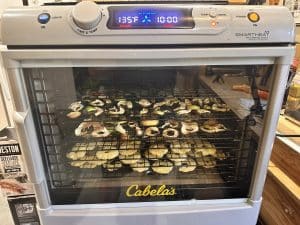
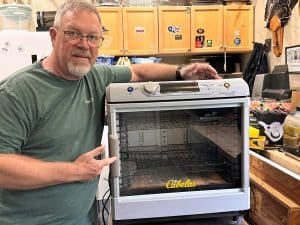
Hunters who process large quantities of wild game need capacity, and the Cabela’s 80-Litre Commercial-Grade Food Dehydrator is built for bigger jobs. Its 12 removable racks provide enough room for substantial batches of jerky, while the large cabinet also works well for fruit, vegetables, and other foods.
Field Note: We filled this unit to capacity. A full load took longer to dry, but it worked as expected. Finished products came out well, and the unit was easy to clean. My family said this one was staying in our lineup.
A 1,400-watt heater supplies the heat, while Cabela’s Penta 360-Degree Air Flo system uses five air tubes to move heated air throughout the cabinet. With a dehydrator this large, airflow is critical. You want food on every rack drying at a similar rate without continually moving trays around.
Smart Heat technology monitors incoming air and cabinet temperature and adjusts fan speed to maintain drying conditions. The four-color display shows both set and actual temperature and time, while a single control knob keeps adjustments straightforward. A preheat setting lets the cabinet reach operating temperature before you load food.
The 12 racks measure 18¾ by 15¾ inches. A removable rack frame and drain reservoir make cleanup easier, especially after drying marinated meat. Two interior lights with 24 high-intensity LEDs provide a clear view of what is happening inside.
Size is the trade-off for all that capacity. The unit measures 23¼ inches long, 20.12 inches wide, and 25 inches high and weighs 75 pounds. This dehydrator is better suited to a dedicated game-processing room, garage, or work area than one you’ll want to move in and out of a kitchen cupboard.
Pros
Cons
Best For: Hunters, anglers, gardeners, and families who routinely process large quantities of food and want to reduce the number of batches required.
This is the machine for the hunter who doesn’t want to spend days feeding small batches of jerky through a dehydrator. The combination of 12 large racks, 1,400 watts of power, and controlled airflow is well suited to processing significant quantities of venison, elk, moose, or waterfowl.
If you only make a few pounds of jerky each year, it is more machine than you need. If processing wild game is a regular part of your hunting season, the extra capacity can save considerable time.
Buying Verdict: A high-capacity choice for serious wild-game processors with space for a dedicated commercial-style dehydrator.
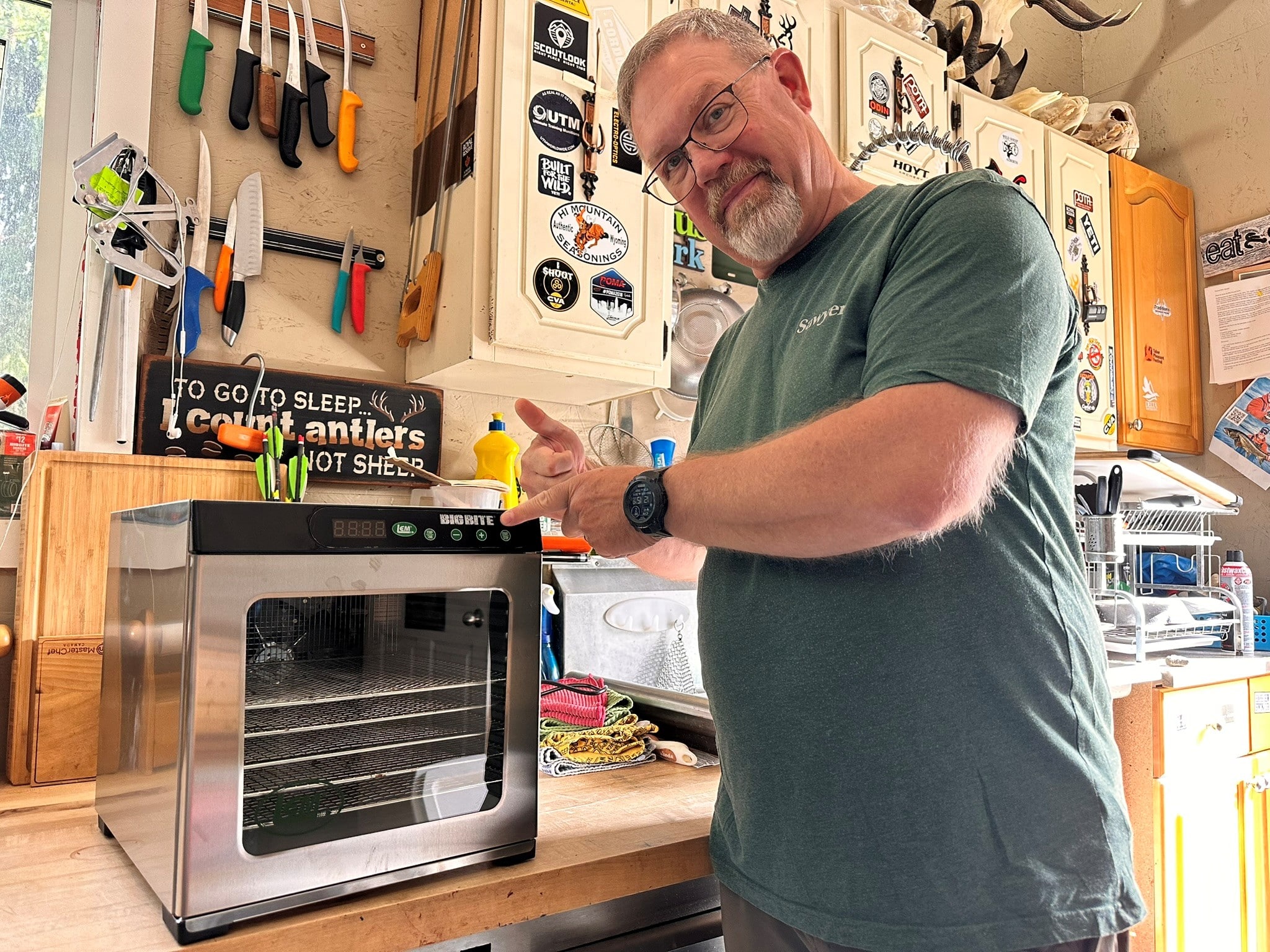
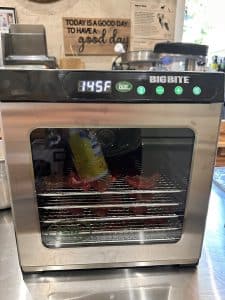
The LEM BigBite 10-Tray Dehydrator provides a useful middle ground between compact home dehydrators and much larger commercial-style machines. Its 10 stainless steel trays provide 10 square feet of drying area, giving hunters plenty of room for venison, elk, moose, or other wild-game jerky without requiring an oversized cabinet.
Field Note: BigBite was my family’s favorite of the lineup. It worked well, was easy to maintain, and looked good enough to leave out between batches.
An 800-watt heating element works with a rear-mounted fan to move heated air horizontally across the trays. That airflow design helps food dry consistently from rack to rack and reduces the need to rotate trays constantly.
Temperature is adjustable from 95°F to 176°F in two-degree increments, giving the BigBite one of the broader temperature ranges in this group. A digital timer operates from 30 minutes to 24 hours. The glass door lets you monitor progress without opening the cabinet and releasing heat.
Each stainless steel tray measures approximately 12 by 12 inches. Despite offering 10 square feet of drying space, the machine measures 13.38 inches long, 15.98 inches wide, and 14 inches high and weighs 19.51 pounds.
Cleanup is straightforward. The stainless steel racks and drip pan are dishwasher-safe, while the cabinet can be wiped clean.
Pros
Cons
Best For: Hunters who make jerky regularly and want good capacity, stainless steel trays, and precise controls without moving into a large commercial dehydrator.
The BigBite hits a practical sweet spot for many hunters. Ten square feet of drying space is enough to process a useful amount of meat per batch, while stainless steel racks, horizontal airflow, and a temperature range reaching 176°F make it a versatile processing tool.
It is large enough to handle regular jerky making but still manageable enough to use and store in a home.
Buying Verdict: A strong mid-capacity option for hunters who make wild-game jerky regularly. If you are unsure what size dehydrator to purchase, this is a good place to start.
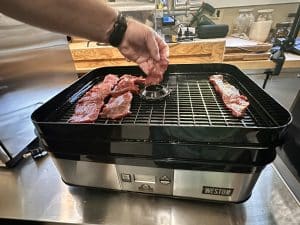
The Weston 6-Tray Digital Food Dehydrator Plus is a practical choice for hunters and gardeners who want useful capacity without dedicating a large part of the kitchen to a dehydrator. Six stackable trays provide 7.4 square feet of drying space, while an 800-watt heater gives it plenty of power for its size.
Field Note: This unit proved to be a workhorse with good capacity. Finished products came out as expected, and cleanup was a breeze.
Digital controls let you set temperatures from 100°F to 160°F. The timer can be programmed from one to 48 hours, and automatic shutoff stops the machine when the selected time has elapsed.
The Weston Plus also works well beyond hunting season. A solid tray is included for fruit leather, while a mesh screen handles herbs and other small foods. That makes the unit useful for garden produce, fruit, and everyday snacks.
The trays are dishwasher-safe, which simplifies cleanup. The dehydrator measures approximately 16.1 inches wide, 12.6 inches deep, and 13 inches high, giving it a relatively small footprint for 7.4 square feet of drying area.
Pros
Cons
Best For: Hunters, gardeners, and families who want one compact dehydrator for moderate batches of jerky, fruit, vegetables, and other dried foods.
The Weston Plus makes sense for hunters who make several batches of jerky each year but don’t need commercial capacity. The combination of 7.4 square feet of drying area, 800 watts of power, and a 48-hour timer provides plenty of versatility.
Capacity is the limiting factor. Anyone routinely processing large amounts of elk, moose, or several deer will appreciate moving to a larger cabinet-style machine.
Buying Verdict: A versatile home dehydrator for hunters who want enough capacity for regular jerky making without sacrificing too much kitchen or storage space.
Shop Weston 6-Tray Digital Plus
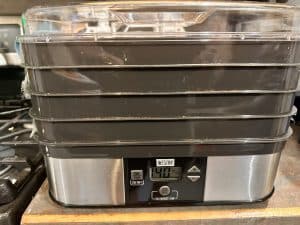
The Weston 6-Tray Digital Food Dehydrator keeps things simple for hunters and gardeners who don’t need a large processing machine. Six stackable trays provide up to five square feet of drying area, which is enough for smaller batches of wild-game jerky, fruit, vegetables, and herbs.
Field Note: We used this unit frequently because it was convenient for small batches of mushrooms, jerky, and fruit. The small footprint let it stay on the counter for weeks with regular use.
A 500-watt base-mounted heater and fan circulate air through the trays. The system is designed to provide consistent drying without routine tray rotation, although checking different trays remains worthwhile as a batch approaches completion.
Temperature can be adjusted from 100°F to 160°F. A digital timer operates from one to 48 hours and includes automatic shutoff. The clear, vented lid lets you check food without removing the cover and disrupting heat and airflow.
Six BPA-free trays form the main drying area. A mesh screen is included for herbs and small foods, along with a fruit-roll sheet. The trays and lid are dishwasher-safe, although Weston recommends avoiding heated drying and sanitize cycles. Hand-wash the mesh screen. Pros
Cons
Best For: Hunters and gardeners who want an uncomplicated dehydrator for occasional jerky, fruit, herbs, and other smaller drying jobs.
This Weston is a sensible starting point if you want to make jerky without investing in a larger machine. Five square feet of drying space will handle smaller batches, and the 48-hour timer and automatic shutoff add useful convenience.
The limitation is how much food you can process at once. After a successful elk or moose hunt, the smaller capacity could mean running numerous batches.
Buying Verdict: A practical entry-level dehydrator for hunters who make smaller amounts of jerky and prioritize compact size and simple operation.
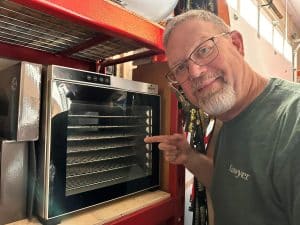
The MEAT! 6-Tray Dehydrator looks and feels more like dedicated meat-processing equipment than many compact home dehydrators. It combines a stainless steel cabinet with six chrome-plated racks and is clearly designed for jerky makers.
Air moves from back to front across the trays, helping food dry evenly without routinely rotating racks. That’s a worthwhile feature when several trays of venison, elk, or moose jerky are running at the same time.
The digital thermostat adjusts from 90°F to 167°F, providing a useful range for meat as well as fruit and vegetables. A clear window allows you to check progress without opening the cabinet and losing heat.
The dehydrator measures 17.75 inches long, 13.5 inches wide, and 12.25 inches high and weighs about 22 pounds. The cabinet-style design allows individual racks to be removed without dismantling a stack of trays.
Pros
Cons
Best For: Hunters who primarily want to make wild-game jerky and prefer the construction and accessibility of a cabinet-style dehydrator.
The MEAT! 6-Tray is designed around the type of work many hunters want a dehydrator to do. The stainless steel cabinet, accessible racks, back-to-front airflow, and 167°F maximum temperature make it well suited to regular jerky production.
Six trays are the main limitation. It has the construction of a serious meat-processing machine but not the capacity of larger 10- or 12-tray dehydrators.
Buying Verdict: A good choice for hunters who value cabinet construction, even airflow, and straightforward meat-processing capability more than maximum tray capacity.
The Cabela’s Deluxe 10-Tray Dehydrator provides plenty of drying area without the size and weight of a commercial machine. Its 10 trays offer 1,409 square inches—nearly 10 square feet—of space for jerky, fruit, vegetables, and other foods.
A rear-mounted 900-watt heater and 6½-inch fan move heated air horizontally across the trays. The design promotes consistent drying throughout the cabinet and eliminates the need for routine tray rotation.
Temperature is adjustable from 80°F to 160°F. A fold-down door with a magnetic closure and clear acrylic window allows you to monitor food without opening the cabinet and releasing heat.
The 10 drying trays are made from heavy-duty polypropylene. Both the trays and drip tray are removable, making cleanup easier after working with meat and sticky marinades.
The unit measures 20.5 inches long, 14.4 inches wide, and 16.2 inches high and weighs 20.9 pounds. It takes up more room than a six-tray model but remains considerably easier to move than a large commercial dehydrator.
Pros
Cons
Best For: Hunters who want close to 10 square feet of drying capacity without paying for or finding room for a full-size commercial machine.
Capacity is the big attraction here. Nearly 10 square feet of drying space combined with a 900-watt heater and horizontal airflow gives hunters room to process meaningful batches of wild-game jerky without repeatedly cycling small loads through the machine.
The design is relatively simple. You gain substantial drying area at a manageable size and weight, while giving up stainless steel racks and some electronic features available on other models.
Buying Verdict: A practical choice for hunters who put capacity and airflow ahead of electronic features and want larger batches without stepping up to a commercial-grade dehydrator.
Best Food Dehydrators: Full Reviews
Best Commercial-Grade Dehydrator
Cabela’s 80-Litre Commercial-Grade Food Dehydrator
Hunter-Focused Buying Verdict
Best Dehydrator for Venison
LEM BigBite 10-Tray Dehydrator
Hunter-Focused Buying Verdict
Best Home or Family Use
Weston 6-Tray Digital Food Dehydrator Plus
Hunter-Focused Buying Verdict
Best Entry-Level Dehydrator
Weston 6-Tray Digital Food Dehydrator

Hunter-Focused Buying Verdict
Best Value Dehydrator / Best Food Dehydrator for the price
MEAT! 6-Tray Dehydrator
Hunter-Focused Buying Verdict
Best Budget High-Capacity Dehydrator
Cabela’s Deluxe 10-Tray Dehydrator
Hunter-Focused Buying Verdict


The right dehydrator depends largely on what you intend to put through it and how much you normally process. Someone drying a few trays of apples or herbs has very different requirements from a hunter making 20 pounds of jerky after a successful season.
Understanding how the main components work makes choosing the right machine much easier.
Many smaller dehydrators use trays that stack vertically above the heater and fan. They are generally compact, relatively inexpensive, and adequate for smaller batches.
One disadvantage is access. Checking a lower tray may require removing several trays above it. Depending on the airflow design and how heavily the machine is loaded, you may also need to reposition trays during drying.
Cabinet-style dehydrators operate more like a small oven, with racks that slide independently into the housing. Many use a rear-mounted fan to move heated air horizontally across the food. This arrangement makes individual trays easier to access and can provide consistent drying across a large load.
For hunters regularly making jerky or gardeners preserving large quantities at harvest time, that convenience can matter.
The heating element provides the temperature required to remove moisture, but wattage alone doesn’t determine how well a dehydrator performs. Cabinet size, fan performance, thermostat accuracy, and airflow all influence the final result.
An adjustable thermostat provides much greater versatility. Meat, fruit, vegetables, mushrooms, and herbs don’t necessarily benefit from the same drying conditions.
For jerky, follow appropriate food-safety instructions for preparing and heating meat. Selecting a particular temperature on the dehydrator does not by itself establish that the meat has been safely heated.
The heater warms the air, but the fan moves that air across the food and carries moisture away. Poor circulation can create areas that dry quickly and others that remain moist.
Rear-mounted fans commonly move air horizontally across cabinet-style racks. Other dehydrators move air vertically through stacked trays. Either system can work, but the goal is consistent airflow reaching as much of the food surface as possible.
Good circulation becomes particularly noticeable with a full load. If every tray receives similar airflow, you spend less time moving racks around and are less likely to end up with over dried food beside pieces that still contain too much moisture.
Ventilation is easy to overlook, but removing moisture is the entire purpose of dehydration. As food warms, moisture moves into the surrounding air. That humid air needs somewhere to go. Properly designed intake and exhaust vents allow fresh air into the machine while moisture-laden air escapes.
Blocking vents or crowding a dehydrator can interfere with this process. Give the machine the clearance the manufacturer recommends, and avoid packing food so tightly that air cannot circulate around it.
Tray count can be misleading. Six large trays may provide more usable drying space than 10 small ones, so compare total drying area when possible.
A small machine may be fine for a couple of pounds of jerky, but processing large quantities of venison, elk, moose, or waterfowl can require batch after batch.
Gardeners face the same problem when tomatoes, berries, apples, or herbs become ready at once. More drying area lets you process food when it is ready instead of waiting for space in the dehydrator.
Stainless steel racks are durable, easy to scrub, and well suited to repeated meat processing. They are one of my preferences for a dehydrator that will see heavy use.
Plastic and polypropylene trays reduce weight and cost and can be adequate for home use. Check whether they are dishwasher-safe and follow the manufacturer’s cleaning instructions, particularly regarding high-temperature dishwasher cycles.
Whatever the material, trays should be sturdy enough to remain flat when fully loaded and easy enough to clean after sticky marinades or fruit.
A timer doesn’t improve airflow or make a heater more accurate, but it can make a dehydrator easier to use. Drying sessions can last many hours. A programmable timer and automatic shutoff allow the machine to stop without someone watching the clock.
I still check food for doneness rather than relying entirely on a timer. Meat thickness, moisture content, humidity, tray loading, and the food itself can all affect drying time.
A clear door or viewing window lets you monitor food without repeatedly opening the dehydrator and releasing heated air. Interior lighting makes that easier. Neither feature is essential, but both are useful when you’re learning a new machine or trying a different recipe.
If you’re making jerky, assume marinade will drip. Fruit can be equally messy once its natural sugars become concentrated.
A removable drip tray can save considerable cleanup. Removable racks and an interior without unnecessary seams and inaccessible corners are also worth looking for. If a dehydrator is difficult to clean, you will notice it every time you use it.
Fans run for hours, so noise deserves consideration. A louder dehydrator may not matter in a garage, basement, or dedicated processing room. Put the same machine on a kitchen counter for 12 hours and your opinion may change.
If the dehydrator will operate in your living space, fan noise should factor into your buying decision.
Large capacity comes with a price beyond the purchase cost: you need somewhere to put the machine. Measure your available space before buying. A large cabinet dehydrator can be excellent during hunting season but inconvenient if there is nowhere to store it afterward.
Weight matters as well. A 20-pound dehydrator is relatively easy to move. A commercial-style machine weighing 75 pounds will probably become a permanent fixture in your processing area.
Hunters and gardeners tend to use processing equipment hard and seasonally. A dehydrator may sit unused for months and then run frequently when meat or produce is available.
Look for sturdy trays, dependable controls, a solid door or lid, a fan designed for extended operation, and construction that can withstand repeated cleaning. Warranty coverage is also worth comparing, particularly on more expensive machines.
It’s easy to get caught up comparing wattage, digital displays, and the number of buttons on the control panel. I put airflow, temperature control, usable capacity, and ease of cleaning ahead of most extras.
For hunters, the machine needs enough room to make processing jerky efficient. For gardeners, it needs flexibility to handle everything from delicate herbs to fruit and vegetables when the harvest comes in.
A good dehydrator should make it easier to use more of what you harvest. Venison and goose can become jerky for the hunting pack. Berries and apples can be enjoyed months after they were picked. Mushrooms, herbs, and garden vegetables can be preserved instead of wasted.
Choose a machine that matches the amount of food you actually process, learn how its temperature and airflow systems work, and dehydration becomes another practical way to make the most of what you bring home from the field, forest, and garden.
Food Dehydrator Buyer’s Guide
Stacking Trays or Cabinet-Style Racks
Heater and Temperature Control
Fans and Airflow
Vents and Moisture Removal
Capacity and Drying Area
Tray Material
Timers and Automatic Shutoff
Viewing Windows and Interior Lights
Cleaning and Drip Management
Noise
Size, Weight, and Storage
Construction and Durability
What Matters Most?
Think about how much meat you normally process at one time. A smaller six-tray dehydrator can work well if you make a few batches of jerky each season. If deer, elk, moose, or waterfowl regularly end up in your freezer, the extra room provided by a 10- or 12-tray model can save considerable time. Serious home processors may find a larger commercial-style unit worth the extra cost and space.
For occasional use, six trays can be plenty. Hunters making larger batches will appreciate 10 or 12 trays because they can process more meat in a single load. Don’t judge capacity by tray count alone. Look at total drying area, as tray dimensions vary considerably between dehydrators.
Consider wattage along with the dehydrator’s size. A compact unit may operate on 500 watts, while larger home machines often run between 800 and 900 watts. Big commercial-style models can exceed 1,000 watts. More power isn’t necessarily better. What matters is having enough heat and airflow to maintain consistent drying throughout a full load.
Follow the manufacturer’s directions and appropriate food-safety recommendations for preparing, heating, and drying meat. Drying meat and safely heating it are different steps; a dehydrator’s temperature setting alone does not establish that the meat has reached a safe internal temperature.
I like horizontal airflow for jerky because heated air moves across the racks rather than working its way from the bottom of the dehydrator to the top. A good rear-mounted fan can provide consistent drying between trays and often reduces the need to move racks around. That becomes more important when the dehydrator is loaded to capacity.
That depends on the dehydrator. Many cabinet-style units with horizontal airflow are designed so trays don’t have to be rotated routinely. With some stackable or vertical-airflow models, moving trays during the drying cycle can help produce consistent results. Either way, check the food as it dries rather than relying only on a timer.
If you process a lot of wild game, I prefer stainless steel. The racks are durable, easy to clean, and well suited to repeated use with marinated meat. Good-quality plastic or polypropylene trays can still work well and usually keep the dehydrator’s price and weight down.
No, but a timer with automatic shutoff adds convenience during long drying sessions. A 24- or 48-hour timer also provides flexibility for different foods. You still need to check the batch and follow appropriate preparation and storage instructions.
A viewing window is more about convenience than performance. It lets you check progress without opening the dehydrator and releasing heat. I find it useful when experimenting with a new jerky recipe, different slice thickness, or a new dehydrator.
Jerky may be the obvious choice, but a dehydrator is much more versatile. Fruit, vegetables, mushrooms, and herbs can all be dried. Fruit leather and lightweight snacks are handy for the hunting pack, fishing boat, or camp.
Yes. Ground venison, elk, moose, and other wild game can be used for jerky and offer a way to use trim from processing. A jerky gun helps produce uniform strips. Follow appropriate meat-handling and heating instructions, particularly when working with ground meat.
Processing your own venison trim? Our guide to the best meat grinders compares options for preparing ground meat for jerky, burgers, and sausage.
Use the thickness specified in your tested recipe and keep slices uniform. If some strips are twice as thick as others, they won’t finish at the same time. Slightly freezing the meat before slicing firms it up and makes consistent cuts easier. A meat slicer is useful if you make jerky frequently.
Drying time changes with meat thickness, marinade, temperature, airflow, humidity, and how much food is packed into the dehydrator. Use your recipe and manufacturer’s recommended time as a starting point, then check the meat as it nears completion.
Start with usable capacity. After that, look closely at airflow, temperature range, and ease of cleaning. Individually removable racks, a drip tray, digital controls, and automatic shutoff are worthwhile features. I would rather have good airflow and enough drying space than a long list of electronic extras.
If you regularly make substantial batches of jerky, extra drying space can save time. A small dehydrator can handle the work in several loads, but loading and unloading each batch adds effort. If you only make a couple of pounds each year, there is little reason to dedicate the money and storage space to a commercial-size machine.
Follow the storage instructions associated with your preparation method and recipe. Let jerky cool before packaging, and do not assume homemade jerky is indefinitely shelf-stable. Storage life depends on preparation, drying, packaging, and temperature; refrigeration or freezing may be appropriate.
For packaging your harvest, explore our guide to the best vacuum sealers. Vacuum packaging does not replace proper preparation, refrigeration, or freezing when required.
The best dehydrator matches how much game you actually process. A six-tray model can be ideal for occasional batches. A 10- or 12-tray machine makes more sense for a family that goes through plenty of jerky. For large processing jobs, a commercial-style dehydrator’s capacity and construction may justify the extra investment.
Final Buying Advice: Buy enough capacity that making jerky doesn’t become a series of small batches, but don’t pay for a huge machine that will spend most of the year taking up space.
Frequently Asked Questions
What size dehydrator does a hunter need?
How many trays are enough for making jerky?
How much power does a dehydrator need?
What temperature should I use for wild-game jerky?
Is a rear-mounted fan better for jerky?
Do I need to rotate the trays?
Are stainless steel trays worth it?
Do I need a digital timer?
Is a viewing window important?
What else can hunters make in a dehydrator?
Can ground wild game be made into jerky?
How thick should meat be sliced for jerky?
How long does wild-game jerky take to dry?
What should a hunter look for when buying a dehydrator?
Is it worth buying a larger dehydrator?
How should homemade jerky be stored?
What is the best dehydrator for a hunter?