




A power station solves that problem quietly. There is no fuel to spill, no exhaust to manage and no generator droning beside the wall tent. The catch is that these units vary widely. A compact battery can be perfect for an overnight hunt but nearly useless for a four-day deer camp running a refrigerator. A larger station can power almost anything in camp, but carrying 35 pounds from the truck every time you move locations gets old quickly.
We compared five current power stations with hunting-camp use in mind. The goal was not to crown the unit with the largest number on its spec sheet. We looked for the models that make the most sense in specific situations: group deer camps, mobile truck camps, cabins, media-heavy hunts and short solo trips.
How authentic is this comparison?
Our writers have experience using portable power in outdoor camps and off-grid setups, but we did not conduct a controlled side-by-side discharge test on all five units. The recommendations combine that practical experience with verified specifications, a consistent runtime model, current warranty information, and recurring owner feedback. Any runtime figure labeled “modeled” is an estimate—not a laboratory measurement.
Our Top Picks
Portable Power Station Comparison
The table below highlights the specifications that matter most at camp. Capacity determines how long a station can run equipment, while AC output determines what it can run in the first place.
On a phone or narrow screen, swipe the table left to see every specification.
| Power Station | Our Rating | Capacity | AC Output | Weight | Max Solar |
|---|---|---|---|---|---|
| EcoFlow DELTA 3 Plus | Best Overall | 1,024Wh | 1,800W | 27.6 lb | 1,000W |
| Jackery Explorer 1000 v2 | Lightweight Full-Size | 1,070Wh | 1,500W | 23.8 lb | 400W |
| BLUETTI AC180 | Best Value | 1,152Wh | 1,800W | 35.3 lb | 500W |
| DJI Power 1000 | Best High-Draw | 1,024Wh | 2,200W | 28.7 lb | Accessory dependent |
| EcoFlow RIVER 3 Plus | Best Compact | 286Wh | 600W | 10.4 lb | 220W |
How We Evaluated These Power Stations
Portable power stations are usually marketed for emergency backup, RV travel or home offices. Those use cases overlap with hunting camps, but they are not identical. We emphasized the factors that affect a hunter after the station leaves the garage.
Camp Utility
Could it realistically run refrigeration, heated gear, optics chargers and several small electronics without constant cord swapping?
Capacity & Output
We separated stored energy from inverter output so a large wattage claim did not automatically outrank useful runtime.
Portability
Weight matters even at a truck camp. We considered how often a hunter would reasonably move each unit.
Charging & Longevity
Solar input, wall-charge speed, LiFePO4 chemistry, cycle life, warranty and cold-weather limits all influenced the picks.
We estimated approximately 85% usable energy when powering AC equipment. Actual results can be higher or lower depending on inverter efficiency, ambient temperature, battery age, the connected appliance and whether the load cycles on and off.
EcoFlow DELTA 3 Plus
The most complete 1kWh camp package in this group. It has enough output for real appliances, enough outlets for a group and enough solar input to make off-grid recharging more than a token feature.
The EcoFlow DELTA 3 Plus is our best overall pick because it gets the important tradeoffs right. A 1,024Wh battery is large enough to support a weekend hunting camp, but the 27.6-pound unit is still manageable for one person to move between a pickup and a shelter.
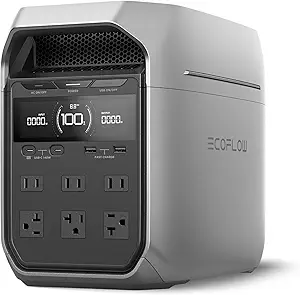

The 1,800W inverter covers the equipment most hunters realistically bring: a 12-volt refrigerator, coffee maker, battery chargers, laptops, camera gear and many small cooking appliances. Six AC outlets also make a bigger difference than they appear to on paper. At a group camp, chargers multiply quickly, and not having to unplug one hunter’s thermal-optic battery to charge another person’s phone is a practical advantage.
Why It Won
The DELTA 3 Plus does not lead every individual category. The Jackery is lighter, the BLUETTI stores more energy and the DJI delivers more continuous AC output. The EcoFlow wins by having the fewest meaningful weak spots.
Its two 140W USB-C ports are useful for modern laptops, cameras and large power banks. Charging those devices directly through USB-C avoids tying up an AC outlet and can reduce conversion losses. The 1,000W combined solar-input ceiling is also substantially higher than the Jackery and BLUETTI limits. A hunter does not need 1,000 watts of panels for a normal weekend, but the extra headroom matters at a semipermanent camp where solar is expected to replace meaningful daily use.
The station is expandable, backed by a five-year warranty and rated for 4,000 cycles to at least 80% capacity. Those details matter because a good power station should serve more than one season.
Best for
Two- to four-person truck camps, weekend deer camps, portable refrigeration, heated gear, camera equipment and hunters who want to add substantial solar charging later.
Reasons to Buy
- Excellent balance of capacity, output and weight
- Six AC outlets work well for group camps
- Two high-output 140W USB-C ports
- Up to 1,000W of solar input
- Fast wall charging and expandable capacity
- Five-year warranty and long-life LiFePO4 battery
Reasons to Avoid
- Usually costs more than value-focused 1kWh competitors
- Still too heavy for a true backcountry pack-in
- A 1,000W solar array is expensive and bulky
- The complete station should remain protected from rain and snow
The Tradeoff
The DELTA 3 Plus is easy to recommend, but it is not a lightweight station. Once you add solar panels, cables and an expansion battery, the system stops being particularly compact. Buy it for a capable base camp—not because the word “portable” suggests you will want to carry it far from the truck.
Jackery Explorer 1000 v2
The one to buy when a full-size battery is necessary but moving a 30- to 35-pound box around camp is not appealing.
The Jackery Explorer 1000 v2 proves that a few pounds matter. Its 23.8-pound weight is not backpack-light, but it is noticeably easier to move than the BLUETTI AC180 and lighter than the other full-size units in this comparison.
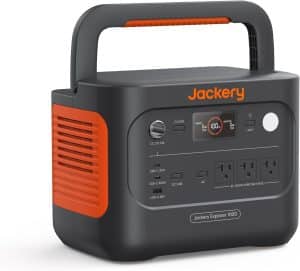

That matters for hunters who bounce between a pickup, blind, cabin, boat or ice shelter. Carrying a power station is rarely the only trip from the vehicle; it is usually competing with a cooler, gun case, pack and sleeping gear. The Jackery reduces that burden without dropping into compact-station capacity.
Why It Stands Out
Jackery preserved a 1,070Wh battery while keeping the unit under 24 pounds. Its 1,500W inverter is lower than the EcoFlow, BLUETTI and DJI outputs, but it remains sufficient for most normal camp loads. Refrigerators, lights, laptops, CPAP machines, battery chargers and many coffee makers fall within its range.
The port layout is straightforward: three AC outlets, two USB-C ports, one USB-A port and a regulated 12V automotive outlet. The 100W USB-C connection is useful, although the second USB-C port is limited to 30W.
The 400W solar-input limit is the clearest compromise. It is enough for a realistic portable panel setup, but hunters expecting solar to refill the battery quickly during short winter days will have more flexibility with the DELTA 3 Plus.
Best for
Mobile truck camps, hunters who move between several shelters, older users who want a lighter lift and anyone who wants approximately 1kWh without crossing the 25-pound mark.
Reasons to Buy
- Lightest full-size station in this comparison
- Slightly more listed capacity than most 1,024Wh competitors
- 1,500W output covers most normal camp equipment
- 100W USB-C charging
- Simple controls and LiFePO4 battery chemistry
- Up to five years of coverage when registered
Reasons to Avoid
- Only three AC outlets
- Lower output than the EcoFlow, BLUETTI and DJI
- Solar input is limited to 400W
- Second USB-C port is limited to 30W
- Cycle rating is measured to 70% remaining capacity
The Tradeoff
The Jackery makes the most sense when weight is more important than maximum output or solar speed. Hunters who expect to run several high-draw appliances at once should choose another model. Hunters who primarily need refrigeration, charging and lighting may appreciate the easier carry every time camp moves.
BLUETTI AC180
More stored energy than the other full-size picks and strong output for the money, provided you are willing to carry the heaviest box in the group.
The BLUETTI AC180 is our value winner because it pairs a 1,152Wh battery with a 1,800W inverter. That is approximately 12.5% more listed capacity than a 1,024Wh station, and the AC180 is often priced aggressively against other models in the same general class.
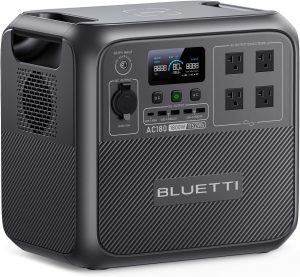

Using our 85% planning assumption, the AC180 has roughly 979Wh of modeled usable AC energy. That does not guarantee a specific refrigerator runtime, but it gives the BLUETTI more reserve for a multiday camp than the smaller batteries in this comparison.
Why It Earned the Value Award
The AC180 has the basic ingredients of a strong hunting-camp station: a large battery, a pure sine wave inverter, four AC outlets, a 12V connection, USB charging and a wireless charging pad. Its 500W solar limit is not class-leading, but it is enough for a substantial portable array.
BLUETTI’s Power Lifting mode is designed for certain resistive loads. It should not be confused with a true 2,700W continuous inverter, and it is not appropriate for every appliance. The feature can still provide extra flexibility with compatible simple heating equipment or appliances, but buyers should follow the manufacturer’s restrictions.
The 35.3-pound weight is the reason the AC180 does not rank higher overall. “Portable” becomes relative at that point. It is easy enough to move from a tailgate into a cabin, but few hunters will want to carry it back and forth several times a day.
Best for
Hunting cabins, wall tents close to a vehicle, refrigerator-heavy camps and buyers who prioritize battery capacity per dollar over easy portability.
Reasons to Buy
- Highest listed battery capacity in the comparison
- Strong capacity-to-price value
- 1,800W continuous output
- Four AC outlets and wireless charging
- 500W solar input
- Five-year warranty and long-life LiFePO4 chemistry
Reasons to Avoid
- Heaviest station in the guide
- Less convenient when camp moves frequently
- Only one 100W USB-C port
- Power Lifting mode is not true 2,700W continuous output
- Must be protected from precipitation
The Tradeoff
The BLUETTI is a value because it gives you more battery, not because it is the easiest unit to live with. For a cabin or camp that stays put, the weight is mostly irrelevant. For a mobile camp, the Jackery’s lower weight may be worth giving up some capacity.
DJI Power 1000
The strongest inverter in this comparison. It is particularly attractive for photographers and DJI users, but high output can empty a 1,024Wh battery quickly.
The DJI Power 1000 stands apart with a 2,200W continuous AC output and a 4,400W peak rating. That does not make its battery larger than the EcoFlow’s battery; it means the DJI can support equipment that demands more power at one time.
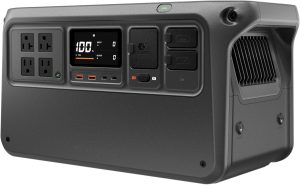

That distinction matters. A high-output inverter can start and run larger coffee makers, cooking appliances, freezers and some tools. It does not make those appliances efficient. A 1,500W device can still drain a roughly 1kWh station in well under an hour once conversion losses are considered.
Why It Stands Out
The DJI is the best fit for a camp that mixes normal charging with occasional high-draw equipment. Its two 140W USB-C ports can charge demanding laptops, large battery packs and camera equipment without AC adapters. DJI-specific SDC and SDC Lite accessories can also make it more efficient for users who already rely on compatible drones.
The limitation is outlet count. The station has only two AC outlets, which feels mismatched with a 2,200W inverter. A quality power strip can solve the number-of-plugs problem, but the combined load must remain within the station’s rating.
Hunters who do not own DJI equipment can still benefit from the high inverter output and USB-C ports. They simply receive less value from the proprietary charging ecosystem.
Best for
Outdoor photographers, videographers, DJI drone users, cabin owners and camps that occasionally need to operate higher-wattage appliances or tools.
Reasons to Buy
- Highest continuous output in this comparison
- Strong 4,400W peak rating
- Two 140W USB-C ports
- Useful DJI drone-charging options
- Manageable weight for its output
- Clean controls and quiet operation
Reasons to Avoid
- Only two AC outlets
- Solar setups may require additional DJI accessories
- Proprietary connections have less value to non-DJI users
- High-draw appliances can empty the battery rapidly
- Less straightforward expansion than some competitors
The Tradeoff
The Power 1000 gives you more inverter than battery. That is ideal when the challenge is starting or operating a demanding device. It is less impressive when the priority is the longest possible runtime. Hunters should buy it because they need the 2,200W output or DJI integration—not simply because the number is larger.
EcoFlow RIVER 3 Plus
A much better answer for charging electronics than for running camp appliances. Its 10.4-pound weight makes it the only station here that feels genuinely easy to carry.
Not every hunter needs a 1,000Wh battery. A solo hunter on an overnight trip may only need to recharge a phone, satellite messenger, GPS, headlamp, heated-gear batteries and a camera. Carrying a 30-pound station for that job is unnecessary.
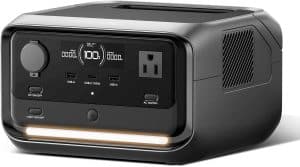

The EcoFlow RIVER 3 Plus weighs 10.4 pounds and provides a 286Wh battery with a 600W inverter. Using our planning assumption, it offers approximately 243Wh of modeled usable AC energy. Direct USB charging can stretch that energy further by avoiding the AC inverter for compatible devices.
Why It Stands Out
The RIVER 3 Plus is compact enough to move between a truck and a blind without turning the carry into a project. It has three AC outlets, a 100W USB-C port, fast wall charging and up to 220W of solar input. Compatible expansion batteries can increase total capacity to 858Wh, although adding one naturally reduces the compact advantage.
The limitation is straightforward: 286Wh is not multiday refrigerator capacity. A high-draw appliance can use the entire battery quickly, and the 600W continuous output excludes many coffee makers and cooking devices.
That does not make the RIVER inadequate. It makes it specialized. It is the best pick here for small electronics and short trips because it does not force a hunter to pay for or carry energy that will never be used.
Best for
Solo overnight hunts, day trips, ice shelters, blinds, phones, GPS units, headlamps, radios, cameras and hunters who value easy portability over appliance runtime.
Reasons to Buy
- Only 10.4 pounds
- Easy to carry and store in small shelters
- Three AC outlets and a 100W USB-C port
- Fast wall charging and 220W solar input
- Expandable capacity
- Quiet, long-life LiFePO4 design
Reasons to Avoid
- Far less capacity than the full-size stations
- Not intended for multiday refrigerator use
- 600W output limits appliance selection
- High-draw equipment depletes it quickly
- Expansion batteries add cost and bulk
The Tradeoff
The RIVER 3 Plus is easy to overbuy around. Hunters often assume the larger unit is automatically better, but unused battery capacity is just extra weight. Choose the RIVER when your list consists primarily of electronics. Choose a 1kWh station when refrigeration or AC appliances are part of camp.
Portable Power Station Buyer’s Guide
The best power station is not necessarily the most powerful one. Start by listing the equipment you plan to operate, how many hours each device will run and whether you will have access to a vehicle, wall outlet or solar panel during the trip.
How Much Battery Capacity Do You Need?
Battery capacity is measured in watt-hours. In theory, a 1,000Wh battery can supply 100 watts for 10 hours. Real runtime is lower because power is lost through the inverter, wiring and battery-management system.
Use this only as a planning estimate. Cycling loads, temperature and inverter efficiency change actual runtime.
For example, a 1,024Wh station operating a constant 50W load produces a modeled estimate of about 17.4 hours. A refrigerator does not normally draw its rated power continuously, so the manufacturer’s watt-hours-per-day figure is more useful than maximum wattage when estimating refrigeration.
Under 300Wh
Phones, headlamps, cameras, GPS units and short solo trips.
500–800Wh
One- or two-night trips with moderate electronics and occasional small AC use.
About 1,000Wh
The best general-purpose range for a weekend hunting camp.
2,000Wh+
Extended camps, multiple users, larger refrigeration loads and frequent appliance use.
Capacity and Output Are Different
Capacity tells you how long the station can supply energy. Output tells you whether it can operate a device at all. A 1,000Wh station with a 600W inverter cannot run a 1,200W coffee maker, even though the battery stores enough total energy to operate it briefly.
Check continuous output, surge output, appliance startup requirements and the combined draw of everything connected at the same time.
Choose LiFePO4 Battery Chemistry
All five selections use lithium iron phosphate batteries, usually abbreviated LiFePO4 or LFP. This chemistry generally offers substantially more charge cycles than older battery designs, making it a sensible choice for equipment expected to serve for many hunting seasons.
Compare the entire cycle-life claim. Some manufacturers measure the stated cycle count until the battery retains 70% of its original capacity, while others use 80%.
Weight Matters More Than the Word “Portable”
A 35-pound station is portable in the sense that it has handles. It is not something most hunters will want to carry far. Units above approximately 20 pounds make the most sense in truck-accessible camps, cabins, boats, ATVs and other situations where the final carry is short.
Match the Solar Panel to the Input Limit
A large panel cannot force more energy into a station than the charge controller accepts. Solar production is also affected by clouds, panel angle, temperature, partial shade and short late-season days. Treat advertised panel wattage as a best-case rating rather than guaranteed field production.
Plan for Cold Weather
Many power stations can discharge below freezing but should not be charged when the battery cells are below 32°F unless the unit includes a suitable heating system. During cold-weather hunts, store the station in an insulated shelter, keep it off frozen ground and let a cold-soaked battery warm before charging.
- Do not place the unit directly beside a heater.
- Keep ventilation openings clear.
- Protect it from condensation.
- Follow the manufacturer’s charging-temperature limits.
Do Not Buy One Primarily for Electric Heat
A typical portable space heater draws around 1,500W. Under our planning model, a 1,024Wh station would run that continuous load for only about 35 minutes. An electric blanket or heated sleeping pad uses far less energy and is generally a more practical battery-powered comfort option.
Count the Ports You Actually Use
USB-C can charge modern laptops, cameras and large power banks directly, leaving AC outlets open for appliances. Useful camp connections include high-output USB-C, USB-A, a regulated 12V automotive outlet, multiple AC outlets, wireless charging and any brand-specific connection your cameras or drones require.
Protect the Station From Weather
A power station should not be treated like a waterproof cooler. Even when a battery pack carries an ingress-protection rating, the display, outlets, charge ports and ventilation system still require protection from rain, snow and standing water.
Best Power Station by Hunting-Camp Scenario
The best station changes with the way you hunt. These are the models we would choose for six common camp setups.
EcoFlow DELTA 3 Plus
The most versatile combination of outlets, capacity, output and solar potential for several hunters.
EcoFlow RIVER 3 Plus
Enough energy for electronics without carrying a full-size battery that the trip does not require.
Jackery Explorer 1000 v2
Full-size capacity at 23.8 pounds makes repeated moves less of a chore.
BLUETTI AC180
More than 1,100Wh of capacity and 1,800W output where the extra weight matters less.
DJI Power 1000
High inverter output, dual 140W USB-C ports and DJI-specific charging options.
EcoFlow DELTA 3 Plus
A strong 12V and AC platform with enough capacity for weekend use and substantial solar recovery.
Frequently Asked Questions
What size portable power station is best for a hunting camp?
A station around 1,000Wh is the best general-purpose size for most weekend hunting camps. Hunters charging only small electronics may be satisfied with 250Wh to 500Wh, while extended camps with refrigeration and several users may require 2,000Wh or expandable capacity.
Can a portable power station run a hunting-camp refrigerator?
Most 1,000Wh stations can operate an efficient 12V portable refrigerator. Runtime depends on the refrigerator’s energy use, insulation, temperature setting and ambient conditions. Use the refrigerator manufacturer’s watt-hours-per-day figure when available.
Can a portable power station run a coffee maker?
Many coffee makers draw approximately 800W to 1,500W. The full-size stations in this guide can operate many models as long as the coffee maker’s demand remains below the unit’s continuous output. The high draw is usually brief, but it still consumes meaningful battery capacity.
Can a portable power station run a space heater?
Some full-size stations can technically run a small space heater, but runtime will be short. Propane heaters approved for the intended environment or properly installed wood stoves are generally more practical for camp heating. Always follow ventilation and carbon-monoxide safety requirements with combustion equipment.
Are portable power stations safe to use inside a tent?
Battery power stations do not produce exhaust like gas generators, but they still need ventilation and protection from moisture and direct heat. Never cover the ventilation openings. Gas generators must never be operated inside a tent, vehicle or enclosed shelter.
Can a solar panel recharge a station during hunting season?
Yes, but late-fall and winter conditions may provide fewer effective charging hours. Panel angle, clouds, shade and temperature all reduce output. The panel must also remain within the station’s voltage, amperage and wattage limits.
Final Verdict
The EcoFlow DELTA 3 Plus is the best portable power station for most hunting camps. It has the right mix of useful battery capacity, strong inverter output, six AC outlets, high-output USB-C connections and serious solar-charging potential without becoming the heaviest unit in the group.
The Jackery Explorer 1000 v2 is the better choice when weight drives the decision. The BLUETTI AC180 offers the most listed capacity and strong value for a stationary camp. The DJI Power 1000 is the most capable high-draw option, especially for camera and drone users. The EcoFlow RIVER 3 Plus is the practical compact choice for short trips and electronics.
Before buying, make a realistic list of the devices that will be in camp. Add their daily energy use, identify the highest-wattage appliance and leave a safety margin. Buying enough power is important. Carrying and paying for twice as much battery as the hunt requires is not.
Editorial note: Manufacturer specifications and warranty terms can change. Confirm current output limits, operating-temperature ranges, included cables and warranty requirements before purchasing. Modeled runtime examples are planning estimates and are not substitutes for measured testing with your exact equipment.