





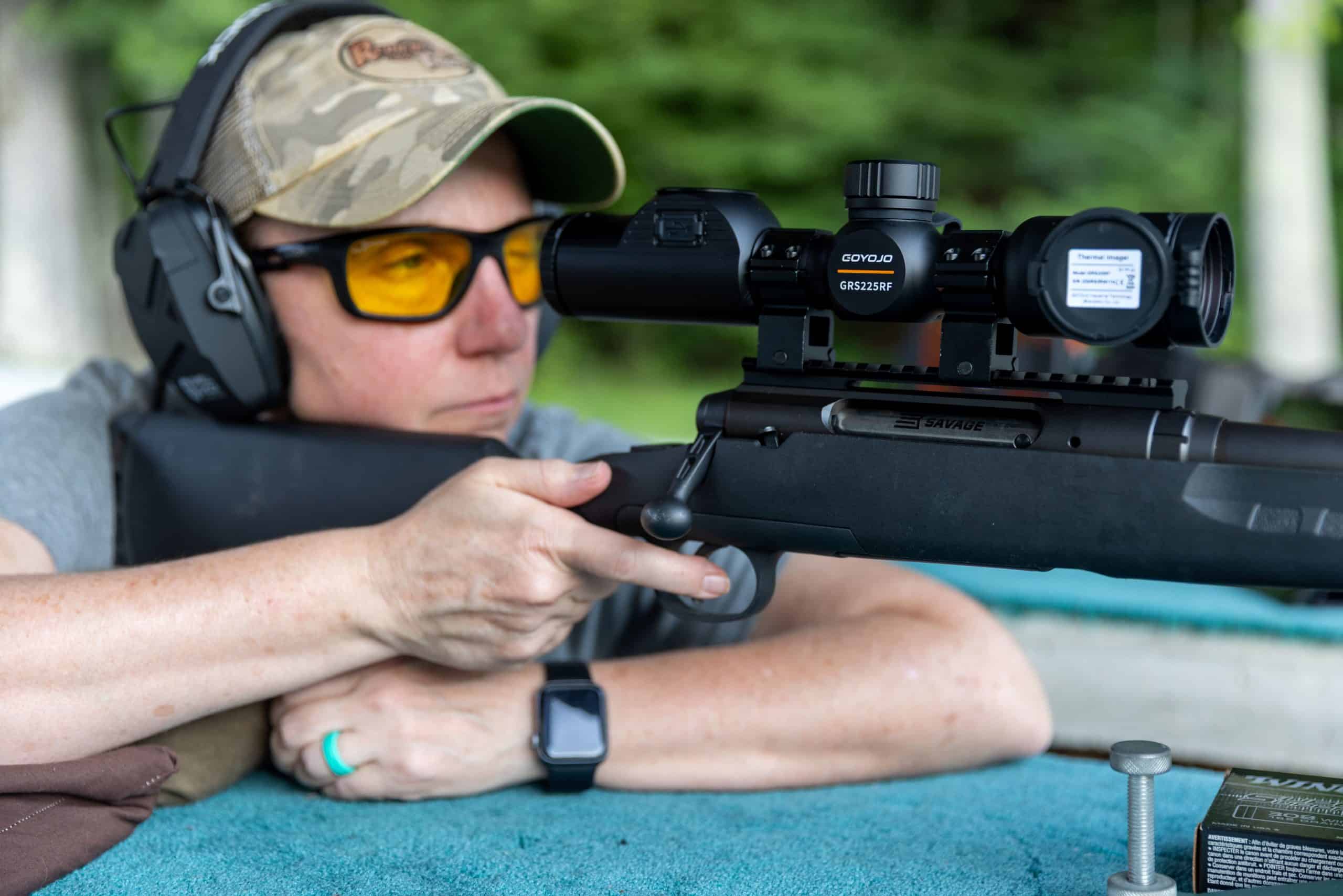
The GOYOJO GRS225RF delivers an unusually deep feature set for a budget thermal scope. Its integrated laser rangefinder, ballistic calculator, recoil-activated recording and app connectivity are genuine strengths. The tradeoff is its 256×192 sensor: we found it most dependable for target identification and shooting inside roughly 100 to 150 yards.
Just a few short years ago, thermal optics were a luxury reserved for hunters willing to spend several thousand dollars. That is changing. As thermal technology improves, manufacturers can offer lower-cost optics that are more than adequate for many hunters, including the GOYOJO GRS225RF.
Choosing a thermal scope still requires some honest questions. What will you hunt? How large are the fields or properties you cover? Do you need to identify animals several hundred yards away, or are most shots inside 100 yards? Features such as a laser rangefinder, ballistic calculator and onboard recording also affect both price and usefulness.
Thermal scopes now range from a little over $700 to more than $7,000. You cannot expect entry-level pricing to deliver the same long-range image clarity as a premium 640-resolution optic, but a lower-cost scope can still be a strong fit when its capabilities match the way you hunt.
We tested the GRS225RF to evaluate image clarity at several distances, target-identification confidence, menu operation, one-shot zero, laser ranging, and real-world usability at the range. The goal was simple: determine where this scope performs well and where hunters should consider stepping up to a higher-resolution model.
By the end of this review, you should have a clear idea whether the GRS225RF is the right cost-effective thermal scope for your hunting conditions or whether its resolution will be too limiting.


GOYOJO GRS225RF Review Snapshot
Coyotes, hogs and other legal nighttime game inside 100–150 yards
Integrated LRF and ballistic calculator at a budget-oriented price
The 256×192 sensor limits confident long-range identification
Prices and promotions can change. Confirm current pricing before publishing.
The short buying decision
Buy it when your hunting is primarily in small food plots, compact fields or blocks of timber and most shots will be inside 100 yards. Consider a higher-resolution thermal when you regularly need to identify animals beyond 150 yards.
How We Tested the GRS225RF
We evaluated the scope around the questions that matter most to hunters rather than relying only on the manufacturer’s specifications.
Thermal Image Quality: What the Numbers Mean
The GRS225RF pairs a 256×192 thermal sensor with a listed NETD of <35 mK. Those specifications tell different parts of the image-quality story.
NETD: <35 mK
NETD measures how small a temperature difference the sensor can detect. Lower is better. A reading under 40 mK is generally a positive specification for distinguishing subtle heat differences, especially in difficult weather or warm conditions.
Resolution: 256×192
Resolution controls the amount of image detail available. The GRS225RF can detect distant heat signatures, but the lower pixel count becomes the limiting factor when you need to positively identify an animal at longer distances.
Detection is not identification
Detection: You can see that a heat source exists.
Recognition: You can tell that the heat source is an animal.
Identification: You can confidently determine what animal it is before taking a shot.
GOYOJO lists a 1,300-meter detection range, but that does not mean a hunter can identify and ethically shoot an animal at that distance. In our testing, identification confidence—not raw detection—was the practical limit.
Key Features and Benefits
The reason the GRS225RF is compelling is not premium image resolution. It is the amount of useful technology built into a comparatively affordable scope.
Imaging and display

Ranging, aiming and zeroing
An integrated 905nm laser rangefinder measures distances out to a listed 1,000 meters, while the ballistic calculator can move the aiming point based on the selected rifle-and-ammunition profile. That combination is uncommon at this end of the thermal market.
The GRS225RF allows up to five custom shooter profiles. Each can store ballistic information, reticle preference and color selection, making it easier to move the optic between ammunition setups or shooters without rebuilding every setting.
Ten reticle options in four colors provide plenty of customization. Picture-in-picture mode adds a magnified aiming window while preserving a wider view of the scene, and the PIP magnification can be adjusted independently.
One-shot zero was one of the easiest features to use. After firing, the shooter freezes the image and moves the reticle to the impact point. A more precise thermal target—such as a small square of HVAC aluminum tape—would make the process even easier than the larger hand warmer we used.

Controls and ergonomics
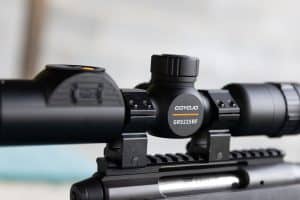
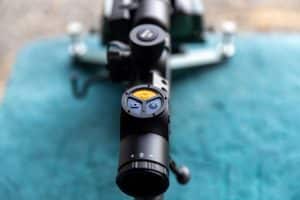
The menu was intuitive, and the silicone buttons were easy to locate without looking. The top dial controls menu navigation and zoom, reducing the amount of button hunting required in the dark.

Recording, storage and app connectivity
The scope records video and still images, which is valuable for more than sharing a hunt. Reviewing footage can help determine whether a shot connected and inform the decision about when to begin tracking.
Recoil Activated Video can automatically capture footage when the optic detects recoil, including several seconds before the shot. That helps preserve the moment even when the shooter forgets to start recording.
The GRS225RF includes 32GB of onboard storage, so there is no microSD card to forget. Direct computer transfer was less convenient, particularly with a Mac, but the IR-Tracker V app provided a workable solution.
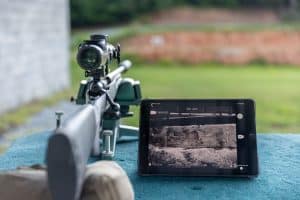
Through the scope’s Wi-Fi connection, the app mirrors the thermal display on a phone or tablet, provides menu control and allows photos or videos to be downloaded and shared. Viewing through a larger screen can also reduce eye fatigue during extended scanning.

Battery system
An internal rechargeable 18650 battery works with an external CR123 battery for a listed runtime of 7.9 hours. Wi-Fi and other power-intensive settings can shorten that figure, but the system should cover most nighttime hunting sessions. The internal battery recharges through USB-C.
Real-World Performance
The one-shot zero process was straightforward, the LRF returned expected distances on known targets and the controls were easy to operate from behind the rifle. We could not fully validate the ballistic correction because our available range distances were limited, so that feature should be treated as promising rather than fully verified in this test.
Practical identification distance
Strong confidence
We would feel comfortable identifying an animal and taking an appropriate shot.
Situational
Reasonable when there is enough time and movement information to make a confident identification.
Increasingly limited
Better suited for detection, scanning and ranging than positive identification and shooting.
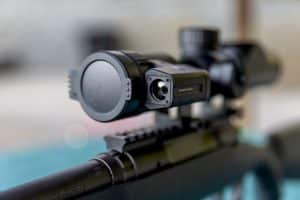
At 150 to 200 yards, digital zoom did not create additional detail. Instead, it enlarged the existing pixels and made the image look less defined. That makes this scope a better fit for small food plots, compact fields and wooded properties than for expansive western terrain or large agricultural fields.
Do not confuse the listed 1,300-meter detection range with a safe shooting range. Hunters must positively identify a legal target before firing, and our testing showed that identification quality declines well before the optic stops detecting heat.
GOYOJO GRS225RF Specifications
| Housing | Aluminum-magnesium alloy |
|---|---|
| Length × height | 11.75 in. without eyepiece × 2.75 in. at tallest point |
| Weight | Approximately 1 lb. 11 oz. with battery |
| Objective lens | 25mm |
| Eye relief | 65mm |
| Ring size | 30mm rings included |
| Field of view | 7.0° × 5.3° |
| Magnification | 3.5× optical; 1–8× digital zoom |
| Operating temperature | -22°F to 122°F |
| Waterproof rating | IP67 |
| Recoil rating | 800g / 0.4ms |
| Detection range | 1,300 meters, manufacturer listed |
| Laser rangefinder | 905nm infrared; listed to 1,000 meters |
| Operating time | 7.9 hours, manufacturer listed |
| Display resolution | 1440×1080 OLED |
| Sensor resolution | 256×192, 12μm sensor |
| Thermal sensitivity | NETD <35 mK |
GOYOJO GRS225RF Pros and Cons
What We Liked
- Strong feature value compared with many thermal scopes near its price
- Useful image quality for hunting inside approximately 100 yards
- Integrated laser rangefinder and ballistic calculator
- One-shot zero and intuitive menu operation
- Tactile controls that are easy to find in the dark
- Five shooter profiles and multiple reticle choices
- Recoil-activated video and 32GB internal storage
- App mirroring, remote control and file sharing
- Nearly eight hours of listed runtime and included 30mm rings
Reasons to Consider Another Scope
- 256×192 resolution is limiting for consistent identification beyond 150 yards
- Digital zoom becomes increasingly pixelated at longer distances
- The front lens cap was unusually difficult to open
- Direct file transfer did not work with our Mac setup
- Only a one-year warranty
- Confirm recoil compatibility with GOYOJO before using it on heavy-recoiling rifles or slug guns
Who Should Buy the GOYOJO GRS225RF?
The GRS225RF makes the most sense for hunters who want to enter the thermal market without giving up useful modern features. It is especially appealing for coyote or hog hunting in smaller fields, food plots and wooded terrain where shots are normally inside 100 yards and rarely exceed 150.
The integrated LRF, ballistic calculator, recording system and app connectivity give it capabilities that are often absent from entry-level optics. Those features can make a meaningful difference during a nighttime hunt.
Who should skip it?
Hunters who routinely scan large agricultural fields or need to identify targets several hundred yards away should move to a higher-resolution sensor. The GRS225RF may still detect heat at long range, but detection alone is not enough when a safe shot depends on positive identification.
Hunters interested in GOYOJO optics may also want to check the GOYOJO GRL335 Review.
Final Verdict
A feature-rich budget thermal for close- to moderate-range hunting
For legal nighttime hunting inside roughly 100 to 150 yards, the GOYOJO GRS225RF offers solid target identification, easy controls and an impressive list of integrated tools. Its lower-resolution sensor is the compromise, but hunters whose terrain and shot distances match its strengths may find it delivers considerable value.