



Dove hunting has a way of humbling even the best wingshooters. One minute you’re watching birds pour into a cut field, the next you’re missing shots that should have been easy. The birds are fast, the angles change constantly, and rarely do two shots look the same. That’s exactly why dove hunting is so addictive, and this is why your choke choice matters far more than most hunters want to admit.
Every season I hear the same thing in dove fields across the country: “I was right on him.” Maybe so, but being on the bird doesn’t mean much if your pattern doesn’t match the distance, angle, and speed of the shot. Dove hunting is a game of pattern density and timing, and the choke tube sitting in your barrel plays a massive role in how those pellets perform once they leave the muzzle.

Over the years, I’ve hunted doves from freshly cut wheat fields to sunflower edges and river-bottom roosts. I’ve shot them low, high, crossing, quartering, and straight overhead. Through all of that, one thing has remained constant: the right choke makes average shots lethal and tough shots possible. But, before diving into specific choke reviews, it’s important to understand how choke types work, why they matter for dove hunting specifically, and how to choose the right one for your shotgun and ammunition.
Best Overall: Muller DUV Choke 🛒
Best for Accuracy: Carlson’s White Wing Dove Choke 🛒
Most Durable: Jebs High Voltage 🛒
Best at Long Range: Kicks High Flyer Choke Tube 🛒
Best Budget: TruGlo Dove Choke 🛒
Best Overall Dove Hunting Choke: Muller DUV Choke 🛒
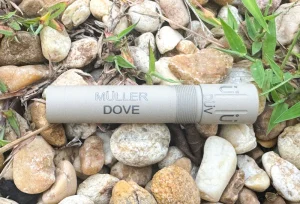
Muller chokes have developed a strong following among hunters who value precision engineering and repeatable results. These chokes are built with extremely tight tolerances and are designed to produce uniform, predictable patterns across a range of loads.
In the field, Muller dove chokes excel when shots stretch toward the outer edge of typical dove distances. During pattern testing, both the Modified and Improved Modified constrictions consistently delivered dense, even patterns at 30 to 40 yards. Edge density was particularly impressive, which is critical for clipping fast-moving wings on crossing shots.
What sets Muller apart is predictability. When paired with the right ammunition, the patterns stay remarkably consistent from shot to shot. That confidence matters when birds are skirting the edge of your range, and you need to know exactly where your pellets are going.
Muller chokes are best suited for hunters who take the time to pattern their guns and want maximum performance at mid to long ranges. They’re especially effective during mid- to late-season hunts when doves have seen pressure and refuse to fly low.
Best Dove Hunting Choke for Accuracy: Carlson’s White Wing Dove Choke 🛒
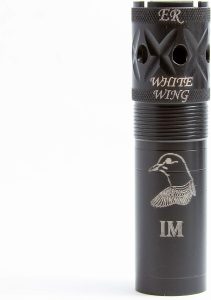
Few choke tubes have earned the reputation that Carlson’s White Wing Dove choke has. Designed specifically for dove and pigeon hunting, this tube has become a staple in dove fields across the country.
In real-world hunting conditions, the White Wing choke delivers an excellent balance of pattern density and forgiveness. The Improved Modified version consistently holds patterns together out to 35 yards and beyond, while still remaining usable on closer shots. That versatility is what makes it so popular.
Pattern testing with common dove loads showed strong mid-pattern density with no major voids, even when switching between shot sizes. On high-flying birds late in the morning, the White Wing IM produced clean kills that lesser chokes struggled to match. For hunters who want a dedicated dove choke that performs across a wide range of conditions, Carlson’s White Wing remains one of the safest bets on the market.
Most Durable Dove Hunting Choke: Jebs High Voltage 🛒
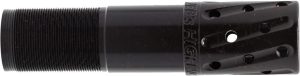
Jebs chokes often fly under the radar, but they’ve earned a reputation for durability and dependable field performance. These chokes aren’t flashy, but they do exactly what a dove hunter needs them to do.
In close- to mid-range situations, Jebs Modified and Improved Cylinder chokes produced forgiving patterns that made fast shots more manageable. While they may not deliver the extreme long-range density of some premium tubes, they shine in the distances where most dove shots actually occur.
One of the biggest advantages of Jebs chokes is their adaptability. They tend to pattern well with a wide variety of ammunition, making them a solid option for hunters who switch loads or hunt multiple locations throughout the season. For dove hunters who value reliability and simplicity, Jebs chokes are a strong, no-nonsense choice.
Best Dove Choke at Long Range: Kicks High Flyer Choke Tube 🛒
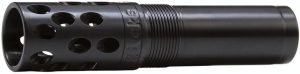
The Kicks High Flyer choke tube is best known in waterfowl circles, but it has found a home among dove hunters who regularly face longer shots. Designed to maintain pattern density at extended distances, the High Flyer brings impressive reach when birds refuse to cooperate.
In pattern tests, the High Flyer produced tight, well-defined patterns at 35 to 40 yards. Edge density remained strong, making it effective on crossing birds that would otherwise slip through thinner patterns. This choke is particularly useful during late-season hunts when doves fly high and wide of heavily pressured fields.
While it may be too tight for early-season, close-range shooting, the Kicks High Flyer excels when distance becomes the deciding factor. Hunters who routinely face longer shots will appreciate what this choke brings to the table.
Best Budget Dove Choke: TruGlo Dove Choke 🛒
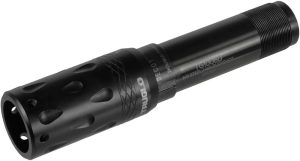
TruGlo’s dove choke is designed with accessibility and performance in mind. It’s a straightforward tube that focuses on delivering reliable patterns without the premium price tag of some high-end options.
In the field, TruGlo dove chokes performed best at close to mid-range distances. Pattern density was consistent at 20 to 30 yards, making them a good choice for early-season hunts or fields where birds tend to stay lower.
While they may not offer the extended reach of some specialty chokes, TruGlo dove chokes provide solid performance for hunters who want a dependable option without overthinking their setup.
Understanding Choke Types and What They Do
A shotgun choke controls how tightly or loosely your shot pattern spreads after leaving the barrel. That spread determines how many pellets reach the bird at a given distance. In dove hunting, where birds are small and fast, pattern efficiency matters more than raw range.
Skeet chokes are the most open option and produce very wide patterns. They’re best suited for extremely close shots, typically inside 20 to 25 yards. Early season hunts where birds fly low and fast over feeding areas are where skeet chokes shine. The downside is that patterns fall apart quickly beyond that distance, making longer shots unreliable and almost impossible.
Improved Cylinder chokes add just enough constriction to extend effective range without sacrificing forgiveness. IC chokes are deadly from roughly 10 to 30 yards and are one of the most versatile options for dove hunters who encounter a mix of close and moderate-distance shots.
Modified and Light Modified chokes are often considered the sweet spot for dove hunting. They offer a balanced pattern that holds together well from 20 to 35 yards, which is where the majority of dove shots occur. These chokes give you enough density to cleanly kill birds without being so tight that you miss close opportunities.
Improved Modified chokes tighten things up even more and are best reserved for pressured birds or late-season hunts where doves tend to fly higher and stay out of range. When properly matched with ammunition, an IM choke can deliver lethal patterns beyond 35 yards.
Full and Extra-Full chokes are rarely ideal for dove hunting. While they can reach impressive distances, their patterns are often too tight for fast-moving birds, especially at closer ranges. For most dove hunters, these chokes create more problems than solutions.
Why Choke Choice Matters for Dove Hunting
Dove hunting is unique because it demands versatility. Unlike turkeys or even waterfowl, dove shots can change dramatically from one minute to the next. Birds may come in low and tight at first light, then shift higher as pressure builds. Wind, terrain, and feeding patterns all influence how doves move through a field.
A choke that’s too open may leave you with beautiful swings and no birds to show for it once shots stretch past 30 yards. A choke that’s too tight can turn close-range opportunities into frustrating misses. The goal is to find a choke that produces consistent, forgiving patterns across the distances you’re most likely to encounter.
What many hunters overlook is that choke performance isn’t universal. Two shotguns with the same choke can pattern completely differently depending on barrel length, bore dimensions, and ammunition. That’s why selecting a choke based solely on manufacturer charts or internet advice often leads to disappointment.
The best dove hunters understand that choke selection is about pattern efficiency, not just constriction numbers stamped on the tube. On the same tolkien, duck choke hunter understand that the best duck choke is essential.
How to Choose the Best Choke and Match It to Your Ammunition
Choosing the right choke starts with knowing your typical shot distances. If most of your shots are inside 25 yards, an open choke like skeet or IC makes sense. If your birds routinely pass at 30 to 35 yards, a modified or light-modified option is usually the better choice. Late-season hunts with pressured birds often call for an improved modified choke.
Matching your choke to your ammunition is just as important. Different shot materials behave differently in flight. Lead patterns denser than steel typically go through the same choke, while steel often requires a slightly more open constriction to achieve similar pattern density. Bismuth and other non-toxic alternatives can vary widely depending on pellet hardness and size.
Pattern testing is the only way to know what truly works. Set up a 30-inch circle at 25, 30, and 35 yards. Shoot multiple rounds with the same choke and ammunition combination. Count pellet hits and look for even distribution without large gaps. The choke that delivers the most consistent patterns at your typical hunting distances is the one you should hunt with, regardless of brand name or marketing claims.
Final Thoughts on Dove Hunting Choke Tubes
Dove hunting rewards preparation. The right choke, properly matched to your shotgun and ammunition, can dramatically improve your success in the field. There is no single choke that works perfectly for every situation, but understanding how choke types function and how they pattern in your gun will put you ahead of most hunters before the season even opens.
Whether you prefer the precision of Muller, the proven versatility of Carlson’s White Wing, the rugged reliability of Jebs, the long-range performance of Kicks High Flyer, or the practicality of TruGlo, the key is pattern testing and confidence in your setup.
When the birds start cutting the sky and the shots come fast, you don’t want to be guessing. With the right choke in your barrel, you can focus on the bird, trust your swing, and let the pattern do the rest. Before you know it you will have a plate full of dove poppers on the grill just waiting to be devoured.
Per our affiliate disclosure, we may earn revenue from the products available on this page. To learn more about how we test gear, click here.