It’s incredible how perspective changes with experience. As a service rifle shooter, I regularly fire at 200 yards, 300 yards, and 600 yards with an AR-15. I’ve shot at these distances so many times that I always chuckle at the reactions I get when I explain my primary competitive discipline. “600 yards?! You shoot at 600 yards?!” “Yes,” I reply, smiling, and continue on to explain that when I started competing, I, as well as those for generations before me, only used iron sights. Long Range Shooting has come a long way!
What is Long Range Shooting?
Everyone has a target or distance that is hard for them to wrap their heads around or a stretch goal one may never have an opportunity to achieve. Many years ago, I realized that what is “long range” to one person, isn’t to someone else. I’ve always considered long range 1,000 yards, as that is the distance NRA and CMP Long Range matches are held at. But what is long range for a 308 is not the same as long range for a 22 LR. The calibers have their limits, and the definition evolves. The same applies to the skill of a shooter. Assuming a capable rifle and ammunition combination, hitting a 3” target at 200 yards requires more skill than hitting a 12” plate at 400 yards.
For me, that stretch goal distance has been a mile – the entry into Extreme Long Range Shooting (ELR Shooting). This isn’t a distance you just walk out to your local range and shoot. Very few ranges reach one mile, and it isn’t a feat easily accomplished without the right equipment and knowledge.

Mentorship in Long Range Shooting
I am a strong believer in mentorship, particularly when it comes to the outdoors. This year, I shot at a mile for the first time under the guidance of my friend Kevin Reese, an accomplished outdoor writer and Media Relations Manager for Sellmark Corporation. As a member of the Professional Outdoor Media Association (POMA), I was invited to visit Sellmark Ranch in Teague, Texas, and explore all it had to offer.
This 6,800-acre working ranch is a family-friendly outdoorsmen’s paradise centered around education and conservation. Several fellow POMA members and I stayed in the main lodge, which felt like a luxury retreat. Taxidermy adorned the fireplace, stretching to high ceilings. Spacious rooms and bathrooms gave everyone privacy while the open kitchen quickly became the center of activity. Outside there was a fire pit as well as a crystal-clear pool and hot tub – a welcome amenity after a cold, night-time thermal hog hunt.

Visitors to Sellmark Ranch have several options for accommodations and experiences, all with the opportunity for expert guidance. Hunters can pursue whitetail deer, ducks, and hogs or go shooting, fishing, or hiking. The property itself has an incredibly rich history, with an old moonshiner’s cabin still standing after two Prohibition-Era shootouts.
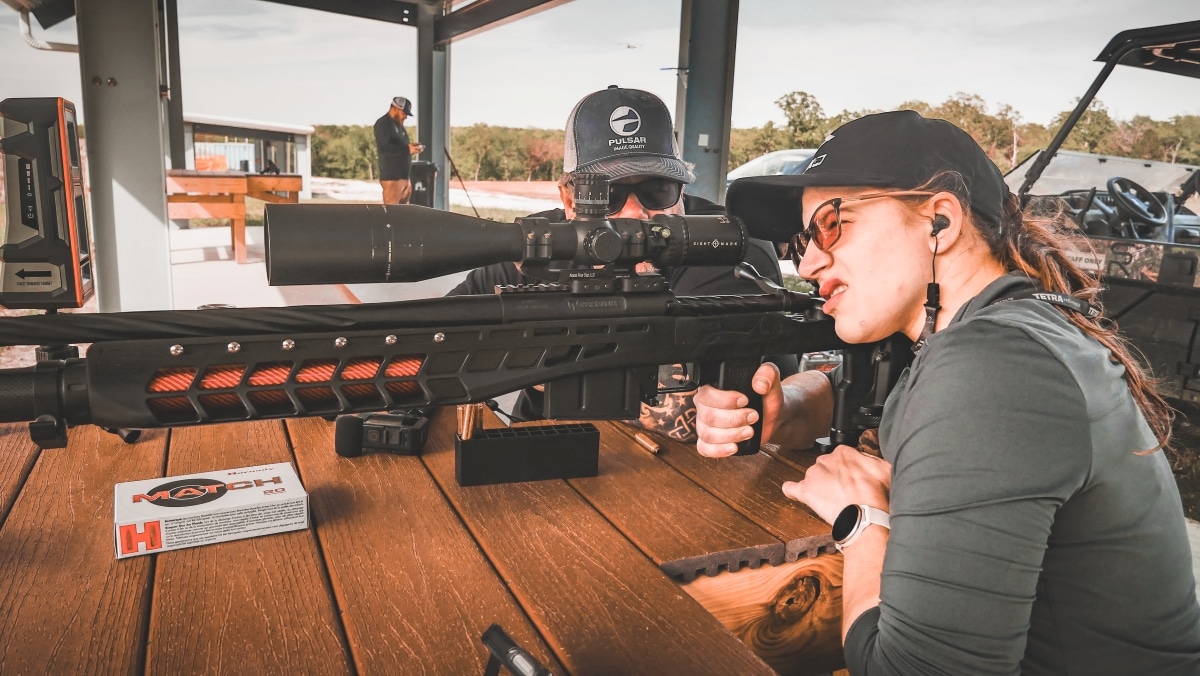
Of everything Sellmark Ranch has to offer, I was most excited to potentially join the One-Mile Club. Kevin, an avid long-range shooting pro, brought his personal rifle built by Alamo Precision Rifles. This 7mm PRC was equipped with a Sightmark Latitude 6.5-25×56 FFP scope and set in an Accuracy Solutions MAKO chassis. I had heard a lot about the chassis system, so I was eager to test it out. The rifle had a spiral-fluted barrel topped with an FPM Gunworks Nyati suppressor and torqued onto a Terminus Kratos action. The MAKO chassis is specially designed to accommodate a bipodeXt bipod extender. This tool pushed out the mounting location of the Accu-Tac bipod, further stabilizing the rifle and reticle. I learned this is a must-have in ELR shooting.
Calculating Holdovers
Kevin did all of the hard work, calculating the appropriate holdovers and come-ups. As I settled behind the rifle, he told me where to aim at the big white square steel target 1,760 yards in the distance. New to this rifle and having never fired a 7mm PRC, I took several dry-fires, getting used to the feel of the TriggerTech Diamond trigger. When I was ready, Kevin watched while my spotter, Tiff Thompson, got behind the new Sightmark Solitude HD 15-45×65 Compact Spotting Scope to monitor wind conditions and watch for trace. I confirmed my natural point of aim on the bench and took a few deep breaths as I looked through the scope. At a natural pause in my breathing, I pulled the trigger straight to the rear, then followed the reticle back to the target.

An impact at one mile isn’t immediate. It takes the bullet between 2.5 and 3.5 seconds to travel there – a period of time that feels like an hour when you are waiting. “Impact!” yelled Tiff. I was in shock. I had a first-round impact at a mile with factory ammunition. I loaded another round of Hornady 7mm PRC 180-Grain ELD-M Match and waited for Kevin’s direction.
Learning How to Shoot One Mile
Confirming long-range shooting impacts at a mile isn’t possible without a good spotter and/or some modern technology. Kevin had set up a Longshot LR-3 target camera system, providing us a live feed of the target to see our hits and misses. The LR-3 has changed the game for ELR shooters, eliminating the need to drive back and forth to the target between shots. Seeing your shots immediately also allows for quick follow-up shots before environmental factors change. The steel square was also equipped with flashing red Hornady HIT Target Impact Indicators, which provided a rewarding visual through the scope.
The LR-3 revealed that the first shot was on the left edge of the target. Maintaining the same sight picture, I fired a second shot. We had no feedback, so I proceeded to fire a third. This solid impact sent the HIT indicators flashing. I was pleasantly surprised by the mild recoil of the suppressed 7mm PRC as well as the performance of the factory ammunition. Kevin said he had observed 8.0 fps standard deviations with the Hornady Match ammunition we were using.

By the end of the day, our entire group had long-range shooting impacts at one mile, four of us for the very first time. The route to the target took us across terrain destroyed by wild hogs, a problem we would tend to that night, and past the remnants of sharecropper housing. It would take a good Thermal Scope for this task.
I greatly enjoyed my time at Sellmark Ranch and learned so much about a very different style of shooting. While I am by no means an ELR expert, I have a much better idea of how much math goes into a mile shot and that landing hits at distance is truly a team effort. “Long-range shooting, extreme long-range shooting – it’s a team sport,” Kevin told me. The shooter and spotter need to work together to land hits, and clear communication is vital to success. If you are interested in furthering your range, I encourage you to consider visiting Sellmark Ranch and letting their team help you join the Mile Club!
Per our affiliate disclosure, we may earn revenue from the products available on this page. To learn more about how we test gear, click here.