




INTRO/METHOD
I love to rifle hunt – deer, elk, hogs, you name it. But even more than that, I love to shoot rifles. Over the past few years, I have been fortunate to test a wide variety of guns from manufacturers such as Bergara, CVA, Mossberg, Sako, Tikka, and Ruger.
Through all this testing, we’ve learned that while some of the more expensive rifles do tend to outperform budget-friendly options, that isn’t always the case. Although having higher-end components may make the rifle feel better in your hands, it may not be the most accurate one out there.
That’s why the Ruger American Gen 1 Predator impressed us so much. It was one of the most affordable rifles we’d ever purchased, yet that .308 turned out to be surprisingly accurate compared to others in its class. So when Ruger released the new Ruger American Gen 2 Predator, we couldn’t wait to get our hands on it and see whether these upgrades would help it outperform its younger sibling.
PRODUCT DESCRIPTION
When Ruger sent the Gen 2 Predator our way, we decided to try it in 7mm-08 this time. Most of the key features and specs are consistent across calibers, but you will see differences in magazine capacity, weight, and twist rate. In the SPECS section, I’ll focus specifically on the 7mm-08, but if you’re interested in another caliber, you can easily compare them on Ruger’s website.
Ruger has built a strong reputation for producing lightweight, affordable, and surprisingly accurate rifles, so we were excited to put this one through its paces. But before we get to the range results, here are the standout features you need to know about the Ruger American Gen 2 Predator.

KEY FEATURES AND BENEFITS
- Threaded and Fluted barrel with Included Radial Muzzle Brake
A threaded barrel is a feature that quickly became a must-have on any rifle I buy – or even agree to shoot. After firing my first rifle with a muzzle brake, I never looked back. I can handle recoil, but I’m definitely not a fan of it, and a good brake does an incredible job of reducing felt recoil.
It goes back to that junior-high science lesson: for every action, there’s an equal and opposite reaction. When a rifle fires, the expanding gases push the bullet forward while simultaneously driving the gun backward into your shoulder (and sometimes up into your cheek). A muzzle brake reduces that rearward energy by redirecting gases outward instead of straight ahead, which means there’s far less force for you to absorb.
Most brakes claim a 30–40% recoil reduction – or even more – making larger calibers dramatically more comfortable and much more fun to shoot. With the lighter-recoiling 7mm-08, the difference may not be quite as dramatic, but with the brake in place, there is very little to notable recoil. And the fact that the Ruger American Gen 2 Predator comes with a radial brake already installed is an even bigger win.
Another major advantage of a threaded barrel is the ability to quickly and easily attach a suppressor. Now that I’ve hunted with a suppressor, I won’t go back – so a threaded barrel is mandatory on any rifle I plan to take into the field. We haven’t tested this out yet, but we will very soon.
- Fluted Barrel

The barrel isn’t just threaded – it’s fluted, too. The 5‑groove spiral fluting trims weight from the medium‑contour barrel, particularly near the tapered muzzle, while still maintaining stiffness for consistent accuracy. It also increases surface area, helping dissipate heat faster during repeated shots. Plus, let’s be real…it just looks cool.
- Cerakote Coating
Now that we’ve covered the barrel’s functionality, we need to discuss how to ensure it lasts. Ruger added a burnt bronze Cerakote finish to the alloy‑steel barrels on the Gen 2 Predator models. Cerakote is a thin polymer‑ceramic composite coating that’s highly abrasion‑ and corrosion‑resistant, giving the barrel extra durability and longevity by protecting it from the elements. And let’s be honest…it just looks cool. (Have I already said that?)
- Patented Power Bedding
Ruger uses its Patented Power Bedding integral bedding block system. This design ensures the receiver is positioned exactly where Ruger intends – and stays there – so you get consistent repeatability and reliability. As with most features like this, the ultimate goal is accuracy. Thanks to the Power Bedding system, the barrel is fully free‑floating, meaning it shouldn’t contact the stock in ways that could introduce inconsistencies.

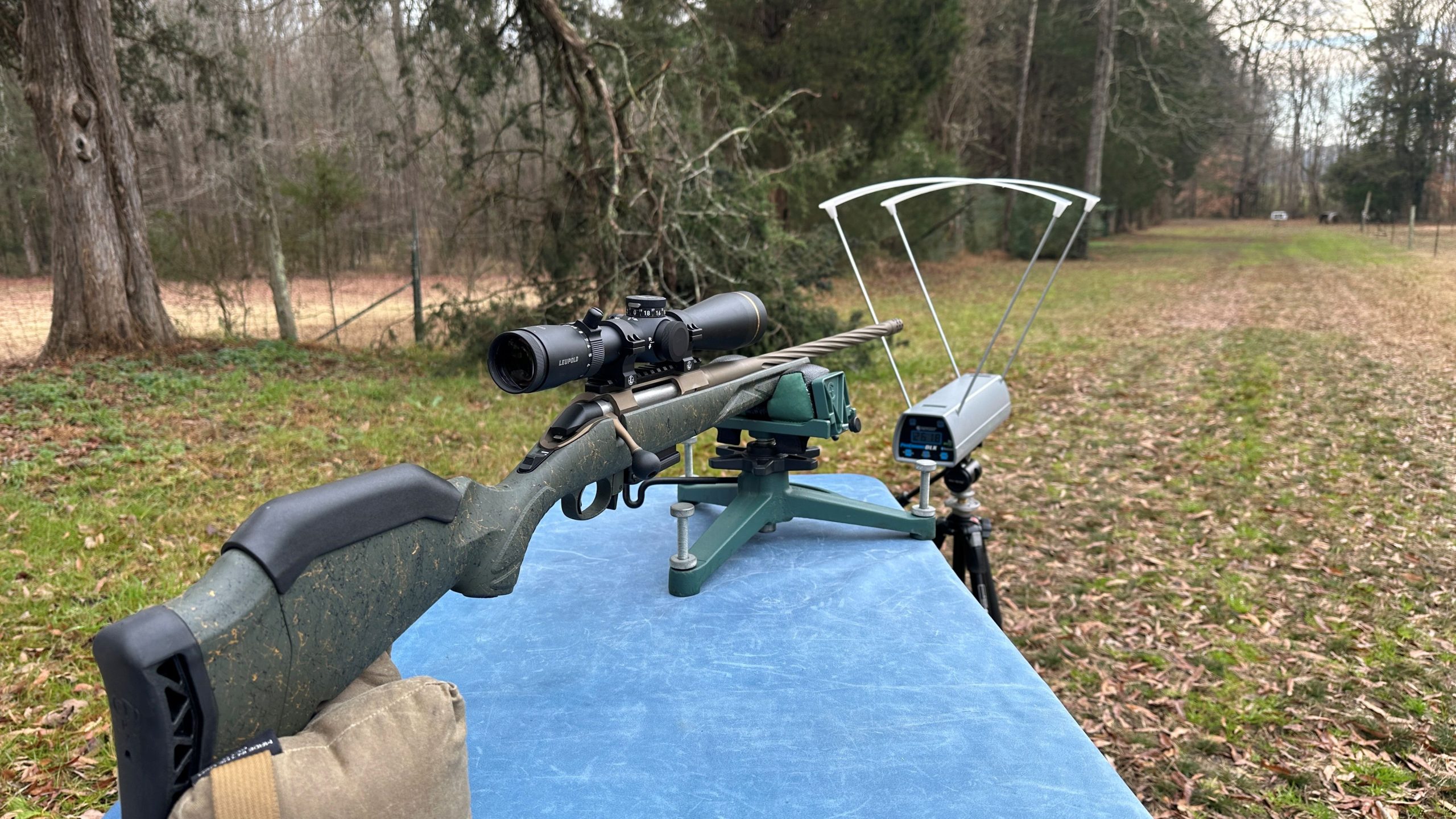
We used the Competition Electronics ProChrono DLX chronograph, which showed an average velocity of 2597fps, which only puts us about 150fps below the advertised speed – not bad for a 20” barrel! I’m not sure what factors most into the speed and accuracy, but I’d say Ruger figured something out.

We also had a radar chronograph running for comparison, and the ProChrono numbers were basically identical, with a price tag that’s about $230 lower!
- Stock Upgrades
One of the more frequent comments about the Gen 1 Ruger Americans was that the stock felt like it was made from cheap plastic. The Gen 2 stocks are still made of a plastic/polymer material, but they feel heavier-duty this time around.
The Predator model is green with a black-and-bronze splatter that adds texture to the stock, making it easier to grip in various conditions. The grip and forend also feature cutouts, swells, and texturized areas strategically placed to make the rifle easier and more comfortable to hold.
Plus, the thick, 1.5” viscoelastic recoil pad further reduces felt recoil. Again, with the lower-recoil caliber and the muzzle brake, there wasn’t much felt-recoil anyway, but I’m sure the pad helped.
- Adjustable FIT
One of my favorite upgrades Ruger made to the Gen 2 line is the added adjustability for improved fit.
First, the length of pull (LOP) is now adjustable. It comes standard with a 13.75″ LOP using the widest spacer (1¾”) installed. Removing that spacer brings the LOP down to 12″, which works well for youth, ladies, shorter shooters, or anyone hunting in frigid weather with bulky layers. If neither of those measurements fits you, Ruger offers additional spacers in 12.75″ or 13.25″ lengths. Unfortunately, they do cost extra – having those included would’ve been a nice touch.

Another big upgrade, and one of my personal favorites, is the adjustable cheek comb. With most traditional hunter or sporter-style stocks, I rarely get a proper cheek weld—usually it’s more of a jaw weld, so adjustability here is crucial. The Gen 2 comes with a low riser installed, and you can remove it if you prefer the standard stock profile. For me, the low riser wasn’t quite high enough, so I bought the additional kit that includes medium and high risers. Since we mounted the scope with medium-height rings, the high riser turned out to be the perfect choice. Again, these pieces cost extra, so including them would add significant value.
If Ruger adds more adjustability in future generations, there’s one area I’d love to see improved: the grip. On both the Gen 1 and Gen 2 Americans, the grip sits a bit too far back for me. When I place my hand where the grip is designed to rest, I can’t comfortably reach the trigger, so I end up adjusting my hand in a way that isn’t ideal. A more vertical grip option or modular grip pieces that shorten the reach to the trigger would be a fantastic upgrade down the road.
- 3-Position Tang Safety
The Gen 2 also uses a three-position safety. In the first position, the bolt is locked so it can’t be moved. In the second position, the bolt can be cycled for loading or unloading, but the gun is still on safe and can’t be fired. And of course, the third position is fire mode.
Most of the rifles I’ve shot use a simple two-position thumb safety, so that’s what I’m most comfortable with. But honestly, the tang safety on the Ruger is in such a convenient spot and is so easy to use that it didn’t take long to get used to it.
- 70-Degree Bolt Throw

Speaking of the bolt, one thing I really like about this rifle is the 70° bolt throw. A lot of rifles use a 90° throw, but that lower angle on the Ruger helps ensure the bolt won’t bump into your scope. It also gives you more room when you’re shooting in cold weather while wearing thick gloves, so you’re not fighting for clearance.
The bolt itself is CNC-machined from stainless steel, so it’s a solid, one-piece design with fewer moving parts and fewer wear points. The oversized bolt handle is also a nice touch, making the bolt easy to run. It’s not as smooth as some of the more expensive rifles out there, but it’s definitely smooth enough that it doesn’t slow you down or get in your way.
- Ruger Marksman Adjustable Trigger
Ruger didn’t update the trigger on this new model; it still uses the Ruger Marksman Adjustable Trigger. Unfortunately, the trigger is one of my least-favorite parts of this rifle. It’s advertised as being adjustable from 3 to 5 pounds, but the lowest we could get it was about 3.2 pounds. A lot of the rifles we’ve tested lately can be adjusted down to around 2 pounds, and I’ve really gotten used to that lighter pull. So this one just feels a bit heavier than I’d prefer.

Another downside is that you have to remove the trigger from the rifle to adjust it. An externally adjustable trigger would be a really nice upgrade on the next generation.
And finally – and this is just personal preference – I’m not a fan of the trigger safety. I much prefer a flat trigger with very minimal creep.
- AI-Style Magazine
I am a fan of the drop magazine. The AI-style magazine makes loading and unloading easier, removing the need to fight with the scope rail when top-loading. It would be nice if the magazine were more flush with the stock, but it doesn’t stick out so far that it has been a problem to carry.
- Included rail
I’m always a fan of features that reduce my need to spend more money, and the included and attached rail does just that. The full-length rail improved stability, which should lead to greater accuracy and consistency when shooting.
- Weight kit available
If you plan to hunt with a suppressor or just want to make the gun heavier for further reduced recoil, Ruger has a weight kit for the butt of the stock that can be purchased at an extra cost. So far, I don’t think we will need that, but it’s an option if you do.
Ruger American Gen 2 Predator – SPECS
| Total Length | 43.25 inches |
| Weight | 6.6 pounds |
| Barrel Length | 22 inches |
| Barrel | Medium Contour Cold-Hammer Forged Spiral Fluted |
| Barrel Material | Burnt Bronze Cerakoted Alloy Steel Barrel |
| Barrel Thread | 5/8″-24 |
| Length of Pull | Adjustable: 12”-13.75” |
| Trigger | 3-5 pound Ruger Marksman Adjustable Trigger |
| Bolt | 1-piece CNC machined with 70-degree bolt throw |
| Stock | Green Splatter Gen 2 American Stock |
| Magazine | 3-capacity AI Style |
| Caliber | 7mm-08 with 1:8.5” Right Hand Twist |
Why Would You Buy a Ruger American Gen 2 Predator?
The Ruger American Gen 2 Predator offers many features that make it an appealing hunting rifle. One of the primary benefits is that it is one of the most economical hunting rifles on the market, while still being extremely accurate.
But it also has its drawbacks.
PROS
- The adjustable length of pull is excellent to fit shooters and hunters of varying sizes.
- The adjustable cheek comb is also a very nice touch, allowing precise eye-scope alignment with a good, repeatable cheek weld.
- The stock feels sturdier than its predecessor.
- I do prefer the drop mag over a hinged floor plate for easier loading and unloading.
- The fluted barrel is aesthetically pleasing and reduces weight while improving heat dissipation without sacrificing stiffness.
- It is threaded 5/8-24 for easy use of a muzzle brake or a suppressor.
- A radial muzzle brake is included for reduced recoil.
- The large recoil pad also helps reduce felt recoil.
- A single-piece rail is included, so you don’t have to buy an aftermarket one.
- The 3-position tang safety is easy to reach and operate.
- The oversized bolt handle makes working the bolt easy.
- The 70-degree bolt throw makes working the bolt quicker and helps ensure you have plenty of room between the bolt, your hand, and your optic.
- Excellent accuracy.
CONS
- I prefer a more vertical grip or one with less distance to reach the trigger – maybe Ruger could make adjustable grip options like the cheek comb.
- Only the widest length-of-pull spacer is included with the Ruger American Predator Gen 2. You must purchase the others at an extra cost.
- Similarly, only the lowest cheek comb riser is included; others are an additional expense.
- The AI-style magazine is difficult to insert and keep in place without opening the bolt.
- I am not a fan of the trigger safety standard on Rugers.
- The trigger pull weight is only adjustable down to 3 pounds. I prefer a lighter trigger pull.
- While the bolt is relatively smooth, it is not as smooth as some more expensive rifles we have tested.
- Working the bolt is more difficult after a shot for a potential follow-up round.
Where to Purchase
The most amount of options and best pricing has been found at Sportsmen’s Warehouse, whether in location or online.
Shop The Sportsmen’s Warehouse Lineup
FINAL THOUGHTS on Ruger American Gen 2 Predator

There are a lot of things to like about the Ruger American Gen 2 Predator. The stock feels much sturdier than the previous version, and the adjustable LOP and cheek comb really set it apart from other non-adjustable rifles. The drop mag, fluted barrel, and included brake also bump it up a level. And getting it sighted in was almost effortless. We were out of the box, “hunting ready” after only eight shots!
This rifle doesn’t check off all of my perfect boxes, but at one of the lower price points on the market, the Ruger American Gen 2 Predator is definitely worth a look.
Per our affiliate disclosure, we may earn revenue from the products available on this page. To learn more about how we test gear, click here.


