




You’ve spent weeks scouting the perfect spot, hiked in before dawn, and finally settled into position as the woods come alive around you. Then it happens — a twig snaps under your shifting weight, your chair wobbles on the uneven ground, and the buck you’ve been waiting for lifts his head, locks eyes on your silhouette, and disappears into the tree line. Hunt over. The frustration is real, and for many hunters, it’s a recurring story.
The challenge isn’t just patience or skill — it’s the gear. A hunting chair that stands out against natural surroundings or shifts unpredictably on rough terrain can sabotage even the most carefully planned outing. Camouflage and stability aren’t optional extras; they’re fundamental requirements for any serious hunter. This article breaks down exactly why camouflage chairs give you the visual edge in the field, how all-terrain stability keeps you safe and steady during long waits, and why lightweight hunting gear matters for mobile hunters covering difficult ground. Whether you’re hunting dense forest, open marshland, or rocky hillsides, understanding these core features will help you choose a chair that works as hard as you do.
The Critical Role of Camouflage in Hunting Success
Deer, elk, and waterfowl have evolved over thousands of years to detect predators, and their visual systems are finely tuned to pick up shapes and movements that don’t belong in their environment. A bright or mismatched chair sitting in the middle of natural cover is essentially a warning sign. Camouflage chairs work by visually fragmenting your presence — breaking up the solid, recognizable shape of a person sitting in place — so that you become part of the landscape rather than an intrusion into it. The science behind this is straightforward: animals respond to contrast, outline, and motion. When your gear matches the surrounding colors and textures, all three threats diminish significantly.
How Camouflage Enhances Stealth and Avoids Spooking Game
The human silhouette is one of the most recognizable shapes in the wild, and any gear that reinforces that outline works against you. A well-camouflaged chair helps dissolve the hard edges of your seated form, making it far harder for game to isolate you as a threat. Beyond the static visual benefit, camouflage also reduces the perceived intensity of small movements — the subtle shift of weight or the slow turn of your head becomes far less alarming when your entire setup blends into the background. Experienced hunters who’ve switched from standard chairs to camo-patterned models consistently report longer undisturbed observation windows before game detects their presence.
Choosing the Right Camouflage Pattern for Your Environment
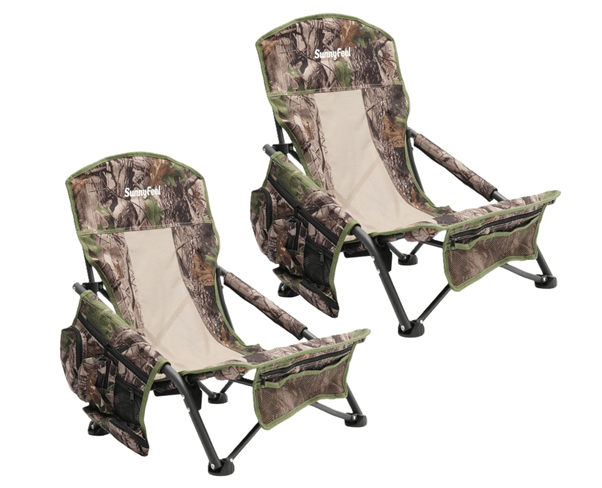
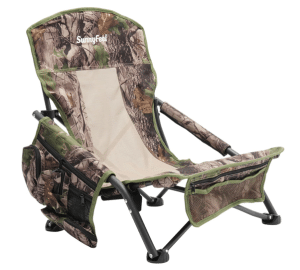
Not all camouflage patterns are created equal, and using the wrong one can be nearly as conspicuous as wearing no camouflage at all. Woodland patterns featuring dense, irregular arrangements of dark greens and browns work well in forested settings with heavy canopy, while open marsh or prairie environments call for lighter, more muted palettes with horizontal elements that mimic tall grass and reeds. Digital patterns, which use pixelated micro-details, tend to perform well across a wider range of distances and terrain types, making them a versatile choice for hunters who move between environments. Brands like SunnyFeelOutdoor have leaned into this demand by offering chairs with terrain-specific pattern options, recognizing that a single generic design rarely serves hunters across varied seasonal and geographic conditions. Seasonal timing also matters — a deep summer green pattern becomes a liability once leaves drop in fall, so consider whether your chair’s pattern shifts appropriately with the season or whether you need a cover that adapts.
Ensuring All-Terrain Stability for Safe and Comfortable Hunts
An unstable chair doesn’t just cost you comfort — it costs you shots. When you’re perched on a hillside or tucked into a marshy bank, an unexpected shift in your seat can telegraph movement to game at the worst possible moment, or worse, send you tumbling on a steep slope with a loaded firearm in hand. All-terrain stability is about more than convenience; it’s a genuine safety requirement and a direct contributor to shot accuracy. Hunters who’ve dealt with wobbly, sinking, or tilting chairs know how quickly a compromised position ruins focus during those critical seconds when a target steps into range. Chairs engineered for uneven terrain address this through wider leg spans, adjustable foot mechanisms, and frames built to resist lateral flex — features that collectively keep your platform solid whether you’re on soft mud, loose gravel, or angled forest floor. The payoff extends beyond safety: a stable seat reduces physical fatigue during long waits because your core muscles aren’t constantly compensating for an unreliable base.
Design Features That Maximize Stability on Uneven Ground
The most effective stability features start at the ground contact points. Wide-stance leg designs distribute your weight across a broader footprint, dramatically reducing the tipping risk that narrow-legged chairs carry on uneven surfaces. Individual leg adjustment — where each leg can be independently extended or locked — is particularly valuable on slopes, letting you level the seat even when the ground beneath each leg sits at a different height. Anti-sink feet, typically wider rubber or spiked tips depending on terrain, prevent legs from driving into soft soil under load, which is a common failure point in muddy hunting environments. Frame rigidity matters too: look for cross-bracing or reinforced joint construction that resists the racking forces applied when you shift your weight during a slow pivot to track moving game. Seat sling tension also plays a role — a properly tensioned fabric seat keeps your center of gravity low and centered rather than allowing you to sink unevenly to one side.
Practical Testing: How to Assess Stability in Various Hunting Scenarios
Before you trust a chair in the field, put it through deliberate stress tests that mirror real hunting conditions. Start on a flat, hard surface and apply your full body weight, then shift laterally and forward to check for any flex or creep in the frame joints. Next, find a moderate slope — a hillside or even a staircase landing — and set the chair at an angle to simulate how it would sit on uneven ground. Adjust the legs if the design allows it and verify that the seat remains level without excessive effort. Test soft-ground performance by placing the chair on grass or loose soil and standing up and sitting down several times to see how much the feet sink and whether the stance widens or buckles. For wet-condition hunting, check whether rubber feet maintain grip on damp rock or wet wood surfaces. These tests take less than ten minutes but reveal far more about real-world performance than any product description will.
Lightweight Hunting Gear: Balancing Mobility with Durability
Every pound you carry into the field is a pound that slows you down, drains your energy, and narrows the ground you’re willing to cover. For mobile hunters who rely on reading fresh sign and repositioning quickly, a heavy chair is often the first piece of gear that gets left behind — which means hunting without a stable, concealed seat or pushing through fatigue to drag unnecessary weight across miles of rough terrain. Lightweight hunting gear solves this trade-off by giving you the comfort and functionality of a full-featured chair without the burden that undermines your mobility. The difference between a ten-pound chair and a three-pound chair might seem minor at home, but after a two-mile pre-dawn hike with a full pack, it’s the difference between arriving at your stand fresh and arriving winded. Modern lightweight chairs achieve their reduced mass through material engineering rather than structural compromise, meaning hunters no longer have to choose between a chair that travels well and one that actually performs under load.
Benefits of a Lightweight Design for Enhanced Mobility
The most immediate advantage of a lightweight chair is the freedom it gives you to move. When repositioning mid-day based on wind shifts or fresh tracks, a compact, light chair folds down and disappears into your pack in seconds rather than becoming an obstacle you debate leaving behind. Quick setup and breakdown matter just as much as carry weight — a chair that deploys in under a minute lets you capitalize on fast-moving opportunities without fumbling through a complicated assembly while game is nearby. For backcountry hunters covering serious elevation and distance, the cumulative effect of lighter gear across every item in the pack compounds significantly; shaving weight from your chair contributes directly to the reserve energy you’ll need for the pack-out.
Material Considerations: Ensuring Durability Without Adding Weight
Aluminum alloy frames represent the most common solution to the weight-versus-strength equation in hunting chairs. Aircraft-grade aluminum delivers a high strength-to-weight ratio that handles the dynamic loads of sitting, pivoting, and standing repeatedly without developing the joint fatigue that cheaper alloys exhibit over time. Carbon fiber goes further on weight reduction but comes at a higher cost, making it the preferred choice for ultralight backpack hunters where every ounce justifies the investment. On the fabric side, ripstop nylon and high-denier polyester blends resist tearing under load while remaining significantly lighter than canvas alternatives. Reinforced stitching at stress points — particularly where the seat attaches to the frame — determines long-term durability more than raw fabric weight does. When evaluating lightweight chairs, examine the joint construction closely: welded connections outperform riveted ones under repeated stress, and that quality difference rarely adds meaningful weight.
How to Select the Perfect Hunting Chair: A Step-by-Step Guide
Knowing what makes a hunting chair effective is only half the battle — applying that knowledge to an actual purchase decision requires a structured approach. With dozens of options on the market, each claiming superior concealment or unmatched durability, cutting through the noise means evaluating chairs against your specific hunting conditions rather than generic specifications. The following steps walk you through a practical selection process that accounts for camouflage requirements, terrain demands, and mobility needs simultaneously.
Step 1: Assess Your Hunting Environment for Camouflage Needs
Start by mapping out where you actually hunt across the season. If you’re primarily in dense hardwood forest during early fall, you need a chair with deep, irregular woodland patterns in dark greens and browns that match heavy foliage. If your season extends into late fall after leaf drop, that same pattern may stand out against bare gray branches and brown leaf litter — in which case a transitional pattern with muted tans and grays serves you better. For hunters who split time between forest and open marsh or prairie, a digital or micro-pattern camo tends to bridge environments more effectively than a single-terrain design. Write down your primary terrain, your secondary terrain, and the months you hunt each — that list should drive your pattern choice before any other feature enters the conversation.
Step 2: Evaluate Stability Features Based on Your Typical Terrain
Once camouflage is settled, focus on how the chair handles the ground you actually hunt. Flat-ground hunters have the widest range of options, but anyone hunting hillsides, creek bottoms, or soft marshland needs to specifically verify independent leg adjustment, anti-sink foot design, and frame rigidity. Check the manufacturer’s stated weight capacity and apply a practical buffer — if you hunt in heavy layered clothing with gear on your person, your sitting weight exceeds your body weight. Look for non-slip rubber feet for rocky or wet surfaces, or spiked tips if you primarily deal with soft soil. If possible, test the chair on a slope before your season opener rather than discovering its limits when game is in front of you.
Step 3: Consider Weight and Portability for Your Hunting Style
Your hunting style determines how aggressively you should prioritize weight reduction. If you access your stand by vehicle or ATV and walk less than a quarter mile to your position, a chair in the six-to-eight-pound range is entirely manageable. If you’re a mobile hunter covering two or more miles on foot — particularly in backcountry or mountainous terrain — every pound matters, and targeting chairs under four pounds becomes a practical necessity rather than a luxury preference. Beyond raw weight, evaluate packed dimensions: a chair that folds to a compact bundle straps to a pack cleanly, while an awkward folded shape creates snagging and balance problems on long hikes. Quick-release buckles and integrated carry straps are small features that make a meaningful difference when you’re moving fast in low light.
Step 4: Compare Top Models and Make an Informed Decision
With your environment profile, terrain requirements, and weight target defined, narrow your shortlist to chairs that meet all three criteria rather than excelling at one while failing another. Read verified field reviews specifically from hunters who hunt similar terrain — a five-star review from a flat-ground food-plot hunter tells you little about how the chair performs on a steep Pacific Northwest ridge. Outdoor furniture specialists like SunnyFeelOutdoor are worth including in that comparison process, particularly when looking for chairs that balance structural durability with field-ready portability. Pay particular attention to reviews that mention the chair after a full season of use, since joint fatigue, fabric wear, and foot degradation only reveal themselves over time. If you can handle the chair in person before buying, do it: sit in it, shift your weight side to side, and simulate a slow pivot. That thirty-second physical test will confirm or eliminate a candidate faster than any specification sheet.
Gear That Works as Hard as You Hunt
A hunting chair might seem like a minor detail compared to your firearm, optics, or scouting effort — but the wrong chair can unravel everything those investments are meant to achieve. Camouflage breaks up your silhouette and keeps you invisible in the environments where game has spent a lifetime learning to spot threats. All-terrain stability keeps you safe on unpredictable ground and ensures that when the moment arrives, your platform doesn’t betray you with an ill-timed shift or wobble. Lightweight construction means you’ll actually bring the chair with you instead of leaving it in the truck when the terrain gets demanding.
These three qualities don’t exist in isolation — they reinforce each other. A stable, lightweight chair you can carry anywhere gives your camouflage pattern the chance to actually work. A well-concealed chair you can trust on a steep slope keeps your focus where it belongs: on the game in front of you. Use the step-by-step selection guide to match each feature to your specific hunting conditions rather than settling for a generic option. Quality gear doesn’t guarantee success, but it removes the preventable failures that stand between you and a clean, well-earned harvest. Invest accordingly.
Per our affiliate disclosure, we may earn revenue from the products available on this page. To learn more about how we test gear, click here.