



If you’re like me, this time of year gets you more excited than any other. The holidays are over, and deer season has wrapped up, which can only mean one thing – turkey season is right around the corner.
So what does every good turkey hunter do while they wait for spring? They start figuring out the upgrades their setups need to improve the chances of a harvest this year. And one of the most impactful upgrades you can make is your shotgun’s red dot.
But what is the best red dot for turkey hunting?
The answer to that question can be both simple and complicated at the same time. The simple answer: as long as the optic is rated for shotguns, just about any of them will do. The first red dot I ever put on my Remington 870 pump-action 20-gauge was an AR-style optic I bought online for $19, and I killed at least one turkey with it.
The more complicated answer is that there are so many options these days, you can spend hours going down rabbit hole after rabbit hole trying to find the right one (trust me, I’ve done it). And if you search for the “best” red dot, you’ll get a lot of different answers.
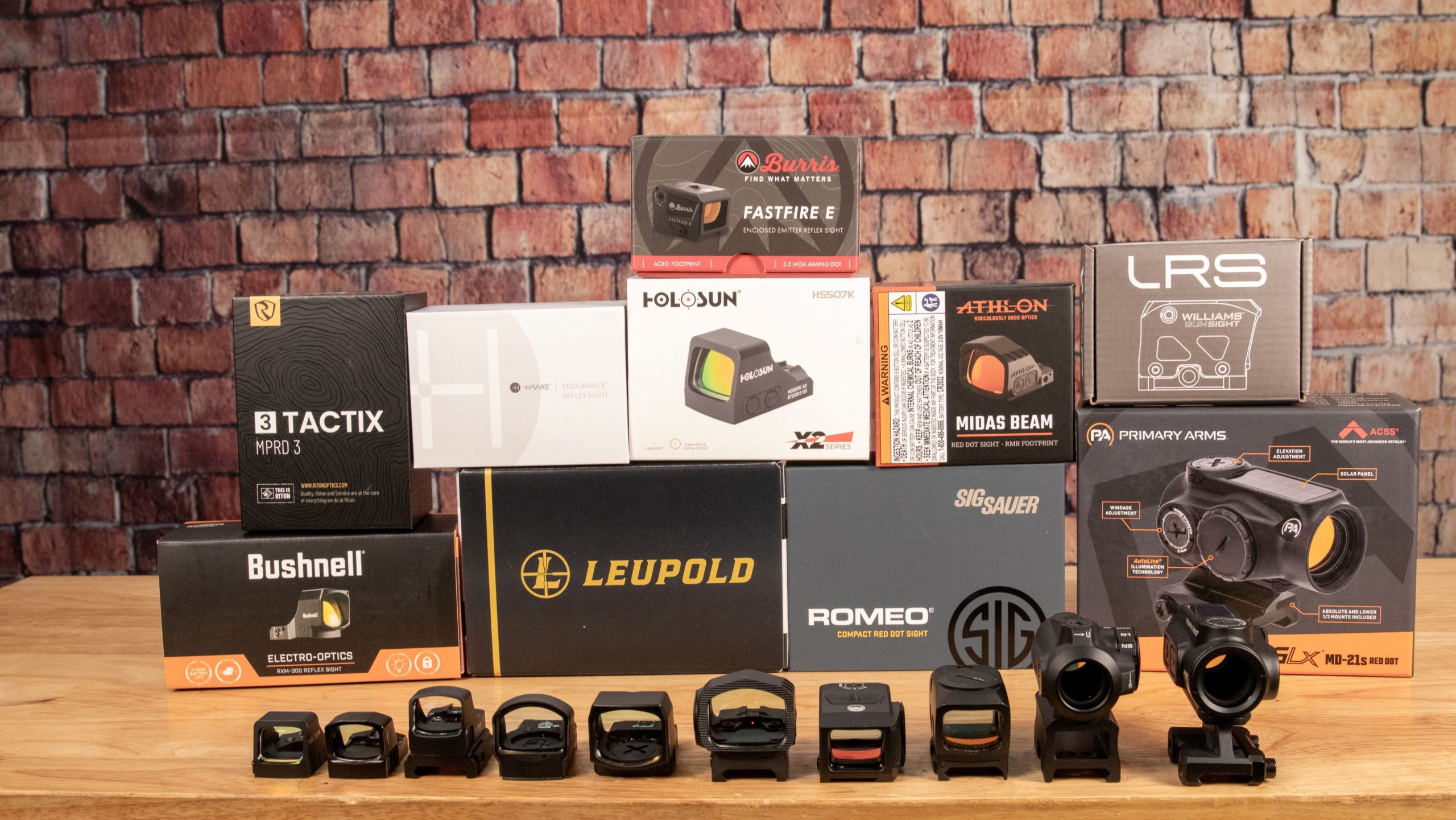
For the purposes of this article, we’re going to lump all optics that use an illuminated red dot reticle (and aren’t a true scope) into the “red dot” category to keep things simple. We’ll cover several key factors to consider when shopping for a new turkey shotgun optic. Then I’ll break down feature highlights, pros, and cons of 10 of the most popular red dots available.
Keep in mind that the red dot I like best may not be your favorite, since I may want different features than you do. But hopefully, I can save you from going down a few rabbit holes by the time we’re done.
For your convenience, the list is as follows, click green links to be taken to the section to read more, and orange to shop the item.
BEST LIGHTWEIGHT RED DOTS FOR RUN-AND-GUN 📖
BEST RED DOTS FOR WIDER FIELD OF VIEW📖
BEST RED DOT FOR LESS-THAN-IDEAL CONDITIONS📖
BEST RED DOT FOR HUNTING FROM BLINDS AND FIELD EDGES📖
BEST LIGHTWEIGHT RED DOTS FOR RUN-AND-GUN
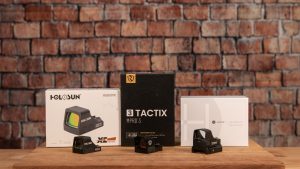
These optics fall into the Micro Reflex Red Dot category and are commonly seen on everyday-carry pistols because they’re extremely compact. The biggest advantage of micro reflex red dots is their small size, which reduces the risk of snagging on trees, grass, or brush while running and gunning through the woods or crawling in for a sneak attack. They’re also so lightweight that you’ll barely notice they’re there.
I’ve detailed the top three we tested in this category. I will say, for me, a similar optic with an auto-brightness feature would win out in this category over these, as none of them have that option.
Hawke Optics Endurance Reflex🛒
The major reason this red dot is in 3rd place here is that the battery is on the bottom, meaning you have to remove the optic to change the battery.
Features
- Reticle: Offers a 3 MOA red dot, a 32 MOA circle, or a circle-dot combination. To me, it is a pretty clear red dot, but I have astigmatism, so red dots are rarely crisp.
- Brightness Adjustments: 10 brightness levels, but no auto-brightness setting. Buttons are small but still pretty easy to work. I don’t like that they’re not on the same side.
- Shake Awake/Motion Sensing Technology: It features shake-awake technology that puts it to sleep after 5 minutes.
- Mounting Options: Shield RMSc platform, making it compatible with numerous mounting plates and firearms. Will direct-fit to the optics-ready Mossberg shotguns, so you will get a very low profile with this one.
Pros
- Shield RMSc fits on Mossberg’s optic-ready line, and there are a variety of aftermarket mounting options.
- Comes with multiple sets of screws for the perfect fit.
- 3 reticle options.
- Shake awake technology.
- Comes with a protective cover.
- Lifetime warranty.
Cons
- The battery is on the bottom – the sight must be removed to change it.
- Buttons are located on opposite sides.
- No auto-brightness capability.
Holosun HS507K🛒
I put the Holosun at the top of this list because I like the option to adjust the sleep time up to 1 hour or more, and because, in my opinion, it has the clearest/crispest reticle.
Features
- Reticle: Multiple reticle options, including a 2 MOA dot, a circle-only reticle, and a circle-dot combination. This reticle seems to be a bit sharper than the other two in this category.
- Brightness Adjustments: 10 brightness settings with no auto-brightness option. The buttons are small but large enough to be easy to find and work. They are on the same side, which I prefer.
- Power Off/Shake Awake: It features a shake awake feature and sleeps after 10 minutes by default. You can adjust the sleep time to 1 hour, 12 hours, or never.
- Mounting Options: Proprietary Holosun K platform, which is a modified RMSc. You will likely need an adapter plate, depending on your mounting choice.
Pros
- Mult-reticle option.
- May have the clearest reticle in this group.
- The smallest and lightest of our selection.
- Buttons are on the same side and easy to work.
- Shake awake.
- Sleep mode timing can be adjusted.
- Lifetime Warranty.
Cons
- It has the smallest sight picture.
- No auto-brightness setting.
- May need adapters for mounting the Holosun K platform.
Riton 3 Tactix MPRD3🛒
Features
- Reticle: Multi-reticle: 3 MOA dot, a 30 MOA circle, or both. The reticle looks slightly less clear on this one to me than the others in this category, but still good.
- Brightness Adjustments: 10 brightness settings with no auto-brightness option. The adjustment buttons are large, easy to find and use, and both are on the same side – all pluses.
- Power Off/Shake Awake: It features shake-awake technology. No advertised sleep time, but I tested it at 10 minutes.
- Mounting Options: RMSc platform, with a variety of mounting options, including a direct mount to Mossbergs. Plus, it comes with a Pic Rail adapter as well.
Pros
- Direct mount to Mossberg.
- Comes with a pic rail mount adapter.
- Buttons are easy to use and are on the same side.
- Shake awake technology.
- Multiple reticle options.
- Lifetime warranty.
Cons
- No paper user manual.
- No auto brightness setting.
BEST RED DOTS FOR WIDER FIELD OF VIEW
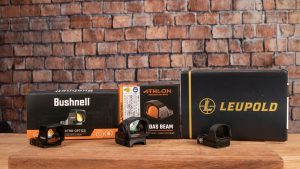
The biggest downside of the red dots in the previous category is their smaller sight window. The solution: a reflex red dot.
These larger optics increase the visible space around the reticle and your target. I tend to prefer these because they make it easier for me to keep both eyes open and stay aware of my surroundings.
Bushnell RXM-300🛒
The Bushnell is at the top of this category for one reason – it has an autobrightness setting. I would probably place it lower because of the button placement and quality if the others had autobrightness.
Features
- Reticle: 4 MOA red dot, which is a good size with the larger window. It’s as clear as the others.
- Brightness Adjustments: 12 settings, including an auto-brightness setting! But the buttons are small, challenging to work, and on opposite sides.
- Power Off/Shake Awake: Shake awake technology with sleep after 5 minutes. You can disable sleep mode on this one.
- Mounting Options: RMR platform. Comes with pic rail attachment.
Pros
- Auto-brightness setting!
- Large picture window.
- Comes with a cover.
- Comes with pic rail attachment.
- Lifetime warranty.
Cons
- No included manual.
- Buttons are small, hard to work, and on opposite sides.
Athlon Midas Beam🛒
Overall, this red dot is probably my favorite because of the size, sturdiness of the design, its very easy-to-use buttons, and the included pic rail attachment. For me, it just needs a smaller dot and autobrightness to be perfect.
Features
- Reticle: 6 MOA red dot. At this size, it will cover more of the turkey’s head or body, especially when the turkey is farther away. Overall, it’s pretty clear to me.
- Brightness Adjustments: 10 settings with no auto-brightness option. Buttons are large, easy to use, and on the same side.
- Power Off/Shake Awake: It features shake awake and will sleep after 5 minutes.
- Mounting Options: RMR platform, and it comes with a pic rail adapter.
Pros
- Largest sight picture of these 10.
- Shake Awake
- Comes with a protective cover.
- Comes with pic rail attachment.
- Lifetime Warranty.
Cons
- Red dot is larger than the others – could come into play if a turkey is at farther distances.
- The size is larger and bulkier than the others we’ve discussed so far.
- No auto-brightness.
Leupold Delta Point Pro🛒
The Leupold rounds out this category for me – primarily because of having only one button for brightness adjustment, and the fact that you can’t see the dot while making those adjustments. Plus, it does not come with a Pic Rail adapter.
Features
- Reticle: 5 MOA red dot that may be a little clearer than the other. 6 MOA is also available.
- Brightness Adjustments: 8 levels with no auto-brightness option. Only one button on top, and you can’t see the reticle while you adjust it.
- Power Off/Shake Awake: Sleeps after 5 minutes and turns back on with very slight movement.
- Mounting Options: Delta Point Pro platform. Must buy pic rail adapters separately.
Pros
- Shake awake.
- Comes with a cover.
- Lifetime warranty
Cons
- The top battery compartment is a little weird to open.
- Only one button – can’t see the dot as you adjust the brightness.
- Must buy pic rail adapters separately.
BEST RED DOT FOR LESS-THAN-IDEAL CONDITIONS
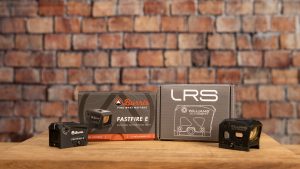
Both micro and standard reflex red dots share one important drawback: they use an open emitter. The emitter that projects the LED onto the lens is exposed, which means mud, dirt, or debris can block it – especially in crawling or wet conditions. If that happens, the reticle disappears, and the sight is essentially useless until it’s cleaned.
Burris FastFire E🛒
Of the two we have, the Burris FastFire E is the winner – primarily because it is actually fully enclosed. The downside to both of these is that they have no auto-sleep function, so you must remember to turn them off and back on when you need them.
Features
- Reticle: 5 MOA dot that’s pretty clear.
- Brightness Adjustments: 10 brightness levels with no auto-brightness setting. Buttons on top are big and easy to work.
- Power Off/Shake Awake: Burris uses “Always On” technology, so you have to remember to turn it off. When you turn it back on, it will be on brightness level 9.
- Mounting Options: ACRO P2 platform with no included pic rail adapter.
Pros
- Fully enclosed to protect the emitter
- Nice, big buttons on top
- It won’t turn off accidentally.
Cons
- No auto sleep mode
- No shake awake
- Turns back on at brightness level 9
- ACRO P2 mounting – does not come with pic rail adapter.
Williams GunSight LRS (Partially Enclosed)🛒

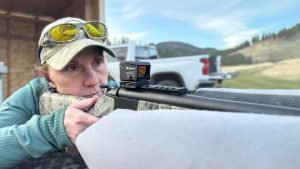
The WGS LRS is a unique optic in this survey because it’s basically upside down, so the window is lower to your gun, helping with cheek weld. Unfortunately, it comes in second in this category because the emitter isn’t fully protected, as there’s no glass on the rear. However, the casing provides greater protection than the open reflex red dots we’ve already discussed.
Features
- Reticle: Circle dot with 3 MOA red dot only – not multi-reticle. Fairly clear compared to others.
- Brightness Adjustments: 6 levels with no auto-brightness setting. The buttons on the side are easy to use.
- Power Off/Shake Awake: No auto-sleep with no shake-awake technology.
- Mounting Options: Comes with a pic rail, but must contact WGS for other mounting plates.
Pros
- Not fully enclosed, but extra protection
- Low profile is ideal for turkey hunting.
- Good buttons.
- Comes with pic rail adapter.
- Won’t accidentally turn off.
Cons
- No sleep mode or shake awake – must remember to turn off.
- Must contact WGS for other mounting plates.
- No listed warranty.
BEST RED DOT FOR HUNTING FROM BLINDS AND FIELD EDGES
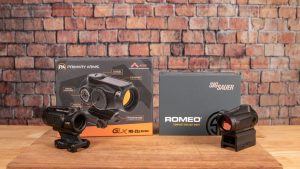
Tube-style red dots may offer brighter reticles, which can be helpful in very bright or open environments such as field edges. They can also be nice because many hunters are already used to using scopes, so it’s a natural fit.
Like enclosed red dots, the emitter is fully protected from the elements, making them very reliable in harsh conditions. The downside is obvious: they’re larger, bulkier, and heavier than the other options. If you do a lot of hiking – especially in hilly or mountainous terrain – this style may not be ideal.
Primary Arms GLX MD-21S🛒
The coolest thing about this red dot is that it has a solar failsafe, so you should never be left without a working reticle. It also comes with both high and low rail attachments.
Features
- Reticle: 2 MOA dot, chevron, chevron layers for aiming points, chevron with circle. Overall, lines are crisp, but hard for me to tell they’re chevrons and not dots.
- Brightness Adjustments: 12 levels with auto-brightness option. Great buttons on the side are very easy to use.
- Power Off/Shake Awake: Auto sleep after 2 min with shake-awake technology.
- Mounting Options: Includes low- and high-rise pic rail attachments.
Pros
- Solar power backup!
- Fully enclosed to protect the emitter.
- Shake awake.
- Multiple reticle options.
- Great buttons.
- Lifetime warranty.
Cons
- Larger and heavier.
- Small sight picture.
- Sits fairly high off your shotgun.
Sig Romeo MSR Gen 2🛒
Unfortunately, the Sig has a few drawbacks for me. I find the dial that adjusts brightness and power difficult to turn – especially in cold or wet conditions while wearing gloves. And it doesn’t come with a low mount.
Features
- Reticle: 2 MOA dot that is fairly clear.
- Brightness Adjustments: 12 levels, no auto-brightness option. Adjust levels with a dial that’s hard to turn.
- Power Off/Shake Awake: No auto off or shake awake – controlled with a dial.
- Mounting Options: Includes a high pic rail mount. Must buy a low mount separately.
Pros
- Fully enclosed protects the emitter.
- Clear red dot.
Cons
- Small sight window.
- Larger and heavier.
- High mount only – have to buy a low mount.
- No auto brightness option.
- Brightness dial is difficult to turn.
- Must remember to turn it on and off.
So which red dot is the best for turkey hunting? It all comes down to which features are most important to you and which red dot gives you the most of them. If none of these do it for you, you can head down the rabbit hole with me.
Red Dot Features – What to look for in a red dot.
There are several features to consider before deciding which red dot to buy. Some will be must-haves for you, while others may not impact your decision at all. Either way, here they are.
Size and Style
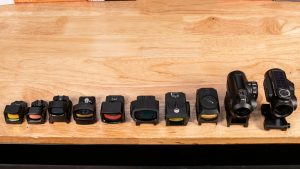
Like most optics, red dots come in a variety of sizes and styles. For this article, we’ve selected three different styles across four sizes to give you a wide range of options to consider.

Micro Reflex Red Dots
These are the red dots you commonly see on everyday-carry pistols because they’re extremely compact. The biggest advantage of a micro reflex red dot is its small size, which makes it less likely to snag on trees, grass, or brush while hiking through the woods – or while crawling in for a sneak attack. They’re also so lightweight that you’ll barely notice they’re there.
If compactness and minimal weight are your top priorities, a micro reflex red dot could be a great fit.
The downside is that the sight window is also very small. If you prefer a larger sight picture with more open space around your target, this size may feel limiting.
Reflex Red Dot
If you want a larger sight window, the next step up is a reflex red dot. These are often seen on larger handguns and other compact platforms. While still lightweight and relatively small, they offer a noticeably bigger sight picture.
The biggest benefit of this style is the increased visible space around the reticle and your target. I personally tend to prefer a larger optic because it makes it easier to keep both eyes open and stay aware of my surroundings.
Both micro and standard reflex red dots share one important drawback: they use an open emitter. The emitter that projects the LED onto the lens is exposed, which means mud, dirt, or debris can block it – especially in crawling or wet conditions. If that happens, the reticle disappears, and the sight is essentially useless until it’s cleaned.
Enclosed Red Dots
To eliminate the issues associated with open emitters, enclosed red dots fully protect the emitter with glass on both the front and rear of the optic. This design keeps debris out and ensures your reticle stays visible, even if you drag your shotgun through mud or brush. In most cases, all you’ll need to do is wipe off the glass.
The tradeoff is size and weight. Enclosed red dots are generally larger and heavier than open reflex sights. While you likely won’t notice a huge difference on your shotgun, they can be slightly more prone to getting hung up on brush or gear.
Tube Red Dots
The final style to consider is the tube-style red dot. These are most commonly found on rifles, especially AR-style platforms. Like enclosed red dots, the emitter is fully protected from the elements, making them very reliable in harsh conditions.
Tube-style red dots are also extremely rugged and may offer brighter reticles, which can be helpful in very bright or open environments.
The downside is obvious: they’re larger, bulkier, and heavier than the other options. If you do a lot of hiking – especially in hilly or mountainous terrain – this style may not be ideal. However, if you hunt from a blind overlooking a field, a tube-style red dot could be exactly what you need. Another consideration is the field of view, as tube-style optics often have a narrower sight window.
Reticle
Another factor to consider before you buy is the type and size of reticle you prefer.
Single Dot
The most common reticle option is a single red dot, which is simple and straightforward: you zero your optic so the center of your shotgun’s pattern hits where the dot is placed, and you’re ready to go.
This is the reticle style I use most often, and it’s usually my go-to. If you prefer a single dot, the next decision you’ll need to make is dot size. Dot size is measured in MOA (minute of angle), which means that at 100 yards, a 1 MOA dot covers roughly one inch.
Most red dots used for turkey hunting fall in the 2–4 MOA range. At 30 yards, that means the dot only covers about 0.6 to 1.2 inches, allowing you to clearly see a gobbler’s head while aiming. Some hunters, however, prefer a larger dot – up to 6 MOA – because it can appear clearer and easier to pick up, especially for shooters with astigmatism.
Multi-Reticle
Multi-reticle options have become much more popular in recent years. These optics typically allow you to choose between a single dot (often around 3 MOA), a larger open circle (commonly 32 MOA), or a combination of both.
The biggest advantage of a circle or circle-dot reticle is that the circle often correlates well with your shotgun’s pattern. At typical turkey-hunting distances of 30-40 yards, the circle gives you a visual reference for how much of the turkey’s head and neck are likely to be in the kill zone.
Circle reticles can also help with fast target acquisition. If a turkey pops up quickly, you simply get his head inside the circle rather than trying to place a small dot in a precise spot. And if he’s very close, you can use the circle almost like a dot by centering it on the base of the neck.
Brightness Adjustments
Throughout a day of turkey hunting, you can encounter a number of ambient light situations. Early in the morning, on rainy days, or in thick timber, you will need a dot that won’t be too bright and wash out your sight window. But in the middle of a sunny day over a field, that dot is going to have to be as bright as possible to see it.
Being able to adjust your brightness for different conditions is critical. Most red dots offer between 6-12 brightness settings that can be adjusted with push buttons. Some sights also offer an autobrightness setting, which I love. The optic detects the ambient light levels and adjusts accordingly. I like this option because first thing in the morning, I don’t have to remember to turn the brightness down. Or, if I get on a mid-morning gobbler that’s coming running, I don’t get stuck with a reticle that’s too dim and have to figure out how to change it without moving too much.
The flip side, though, is that I prefer to have both. I like sights that have an autobrightness setting but also let me manually adjust if needed. You never know when it may not have it just right.
Power Off/Shake Awake
It often feels like red-dot batteries last forever, with some manufacturers advertising over 50,000 hours of runtime – that’s nearly six years. Features like auto-off or sleep modes can extend battery life even further, making them a nice bonus.
If a red dot shuts off automatically, shake-awake or motion-sensing technology, as some call it, is a must. The last thing you want is to be sitting with your shotgun aimed at an approaching tom, only to realize your red dot has turned off. With shake-awake, a small amount of movement – even imperceptible to those eagle-eyed turkeys instantly reactivates the reticle.
You can also manually turn off most red dots, but that means you’ll need to remember to turn them back on when it counts.
Red dots without a sleep mode have their own advantage: you always know the optic is on. Just be sure to turn it off at the end of the hunt so you don’t drain the battery unnecessarily.
Mounting Options
The final factor to consider when shopping for a red dot is how you want to mount it on your shotgun.
Thanks to the growing popularity of turkey hunting with red dots, many newer shotgun models are now drilled and tapped, making it easy to add a rail. In those cases, you’ll need to make sure the optic you choose either comes with a Picatinny/Weaver mounting adapter or has one available as an add-on.
Mossberg also offers a line of “optic-ready” shotguns. These feature a cutout in the receiver that allows a red dot with a Shield RMSc footprint to be direct-mounted. The biggest advantage of this setup is that it keeps the optic low, helping maintain a solid cheek weld.
If you’re running an older shotgun without either of these options, you still have a couple of good choices. You can have the receiver drilled and tapped by a gunsmith, or you can use a rib-vent mount, such as those made by Meadow Creek Mounts, or Warne Mounts. These mounts are available in a wide range of footprints to fit nearly every red dot on the market. I’m a big fan of this method because it positions the optic farther forward, giving you a wider field of view.
So which red dot is the best for turkey hunting? It all comes down to which features are most important to you and which red dot gives you the most of them. If none of these do it for you, I guess you’ll be headed down the rabbit hole with me.
Per our affiliate disclosure, we may earn revenue from the products available on this page. To learn more about how we test gear, click here.