




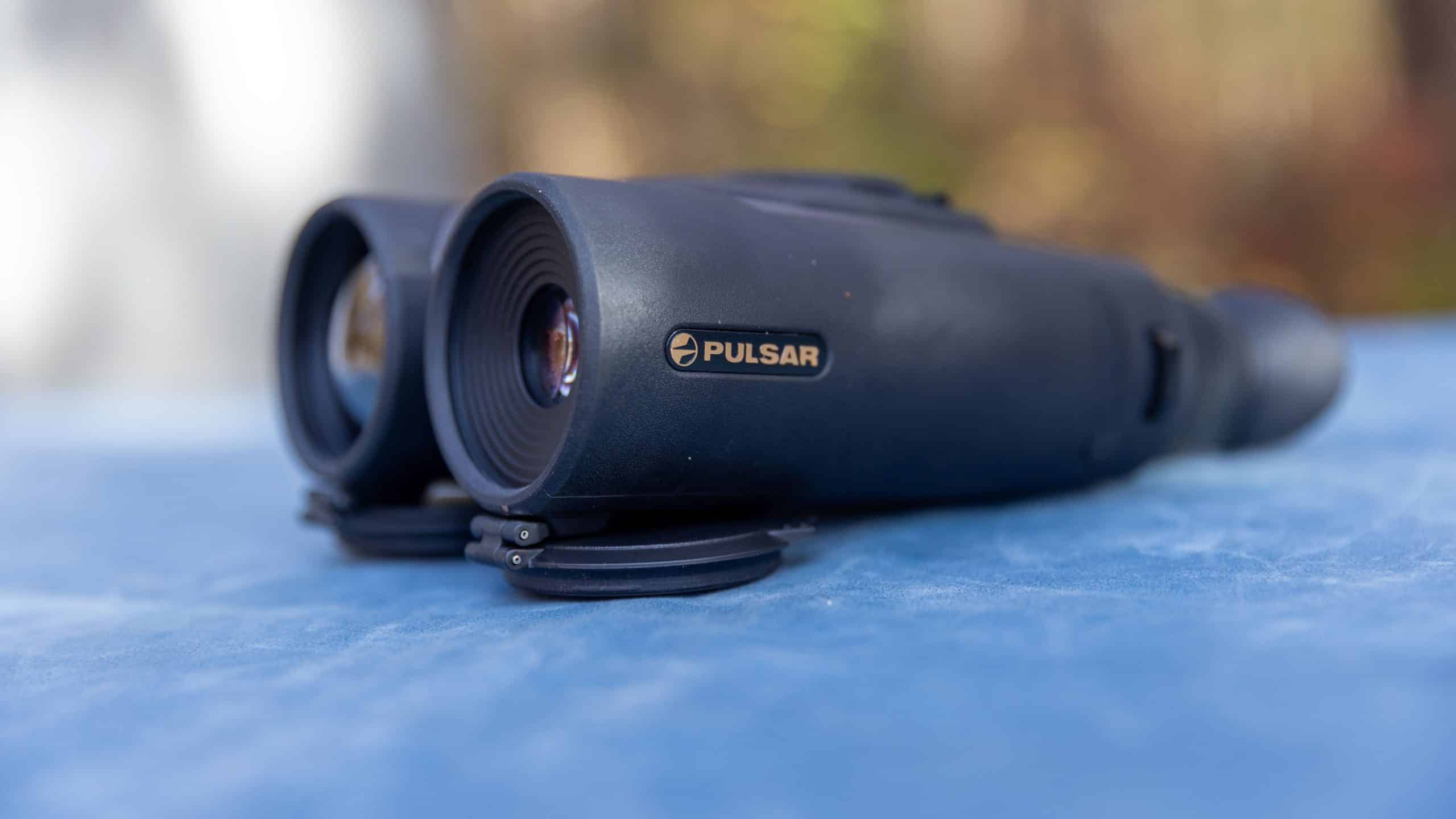
Disclosure: Pulsar loaned us the Symbion LRF DXT50 for independent field testing. This article contains affiliate links. We may earn a commission from qualifying purchases at no additional cost to you.
JUMP TO:
Quick Verdict |
Specifications |
Field Testing |
Image Quality |
Battery Life |
Pros & Cons |
Comparisons |
FAQ |
Final Verdict
Pulsar Symbion LRF DXT50: Quick Verdict
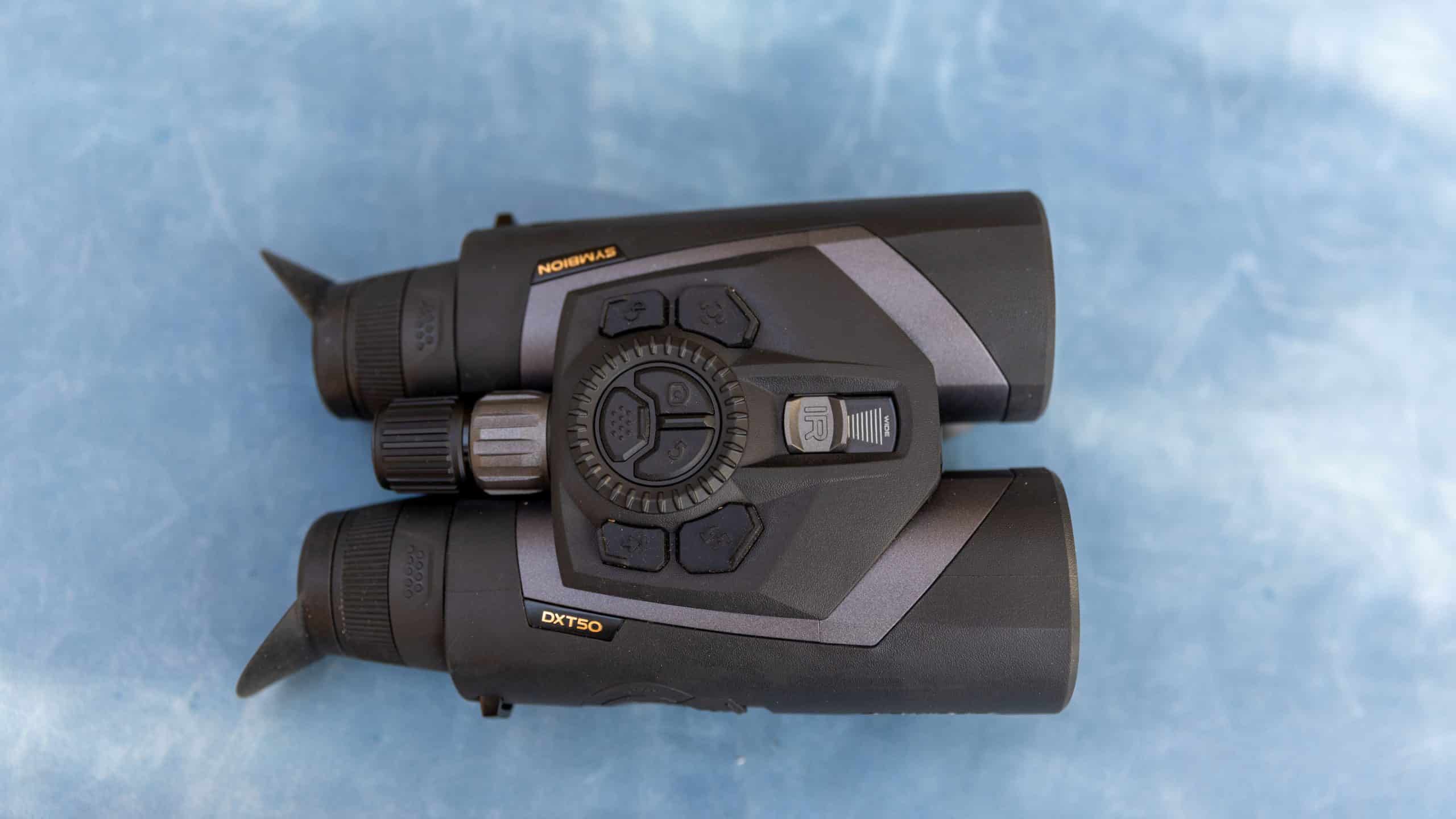
Exceptional Technology. Premium Price.
The Pulsar Symbion LRF DXT50 delivers impressive thermal image quality, an exceptionally wide field of view and the versatility of combining thermal imaging with 4K digital daytime and night vision in one device.
Our side-by-side testing revealed noticeably sharper thermal detail than the 640-resolution Pulsar Oryx LRF XG35. However, at approximately $8,000, the Symbion is difficult to justify for the average recreational hunter.
Best for: Serious thermal users, guides and extended observation in open country.
Biggest drawback: Premium price and additional weight.
Manufacturer price: $7,999
Anyone who’s spent hours sitting in the dark scanning a field with a thermal monocular knows about “thermal eye.” You hold the optic up to your dominant eye, scan for 20 minutes, and when you pull it down, that eye has temporarily lost much of its dark adaptation while your other eye is still adjusted to the night. It can take a while for your vision to balance back out, and by the end of a long night chasing hogs or coyotes, your face and eyes are worn out.
The other issue I run into with thermal optics is positive identification. Thermal sensors are excellent for finding heat signatures in pitch-black woods or across an open field. But once you see that white shape standing next to a brush pile at 200 yards, you sometimes want to see more detail. Is it a big boar with cutters, a sow with piglets hiding in the tall grass, or somebody’s stray calf that got through a fence?
In the past, answering that question often meant putting down the thermal and picking up a digital night vision optic or a pair of daytime binoculars if there was still enough light left.
That exact problem is why multispectral binoculars have started getting so much attention lately. Instead of forcing you to carry two optics around your neck, they pack both a high-end thermal sensor and a 4K digital day/night camera into one housing.
Pulsar loaned us the Symbion LRF DXT50, their flagship multispectral binoculars built around a 1280×1024 HD thermal sensor, a 4K digital channel and an integrated laser rangefinder. We wanted to see how they performed in the real world and whether a binocular setup like this makes sense for regular hunters.
Pulsar Symbion LRF DXT50 Specifications
| Specification | Symbion LRF DXT50 |
|---|---|
| Manufacturer Price | $7,999 |
| Thermal Sensor | 1280 x 1024, 12 µm |
| Sensor NETD | <35 mK |
| System NETD | <20 mK |
| Refresh Rate | 50 Hz |
| Digital Sensor | 4K CMOS, 3840 x 2160 |
| Thermal Objective | 50mm F/1.0 |
| Digital Objective | 50mm focal length |
| Thermal Magnification | 2x–24x |
| Digital Magnification | 6.5x–26x |
| Thermal Field of View | 17.5° / 92.1 ft. at 100 yards |
| Digital Field of View | 5.8° / 30.6 ft. at 100 yards |
| Displays | Dual 1920 x 1080 AMOLED |
| Minimum Focus Distance | 3.28 yards |
| Eye Relief | 13mm |
| Thermal Detection Range | Approximately 2,515 yards |
| Laser Rangefinder | Up to 1,640 yards |
| Infrared Illuminator | Focusable 850nm LED |
| Battery | Removable APS5, 4,900 mAh |
| Rated Battery Life | 8 hours across two batteries at 72°F |
| Internal Storage | 64GB |
| Recording Resolution | 1440 x 1080 with audio |
| Connectivity | Wi-Fi, Bluetooth, USB-C |
| Housing | Magnesium alloy |
| Dimensions | 8.2 x 5.2 x 2.9 inches |
| Weight | 35.3 oz. with battery |
| Operating Temperature | -13°F to 104°F |
| Weather Protection | IP67 |
Specifications are based on Pulsar’s current DXT50 operating manual. Maximum detection and operating ranges depend on environmental conditions. Retail pricing may vary.
How We Tested the Pulsar Symbion LRF DXT50
We tested the Symbion from stationary setups across three separate sessions: a very cold, slightly foggy morning deer hunt over an open field, a cold evening hunt in clear conditions, and a warmer evening side-by-side comparison against several other thermal optics.
During those sessions, we evaluated thermal image quality, digital daytime and night vision performance, image stabilization, controls and battery performance. We also observed wildlife and conducted distance tests to see how much detail the optic retained at different magnification levels.
Our Testing Conditions
- Three separate field-testing sessions.
- Cold, foggy and clear weather conditions.
- Open fields and woodland edges.
- Wildlife observation and controlled distance tests.
- Side-by-side comparison with other thermal optics, including the Pulsar Oryx LRF XG35.
What Are Multispectral Binoculars?
The Symbion LRF DXT50 is a multispectral binocular designed for daytime, twilight and nighttime use. Pulsar has made top-notch thermal and digital night vision gear for years, and with the Symbion, they’ve merged technology from both worlds into a classic binocular body.
With two separate imaging channels working side by side, you no longer have to choose between thermal detection and visual detail. On one side, you’ve got a 50mm thermal lens feeding a high-definition 1280×1024 sensor. On the other side, you have a 4K full-color digital camera paired with a focusable infrared illuminator for when the sun goes down.
You can run it purely in thermal mode, switch over to full-color daylight viewing, use digital night vision, or view both channels simultaneously with multispectral picture-in-picture.
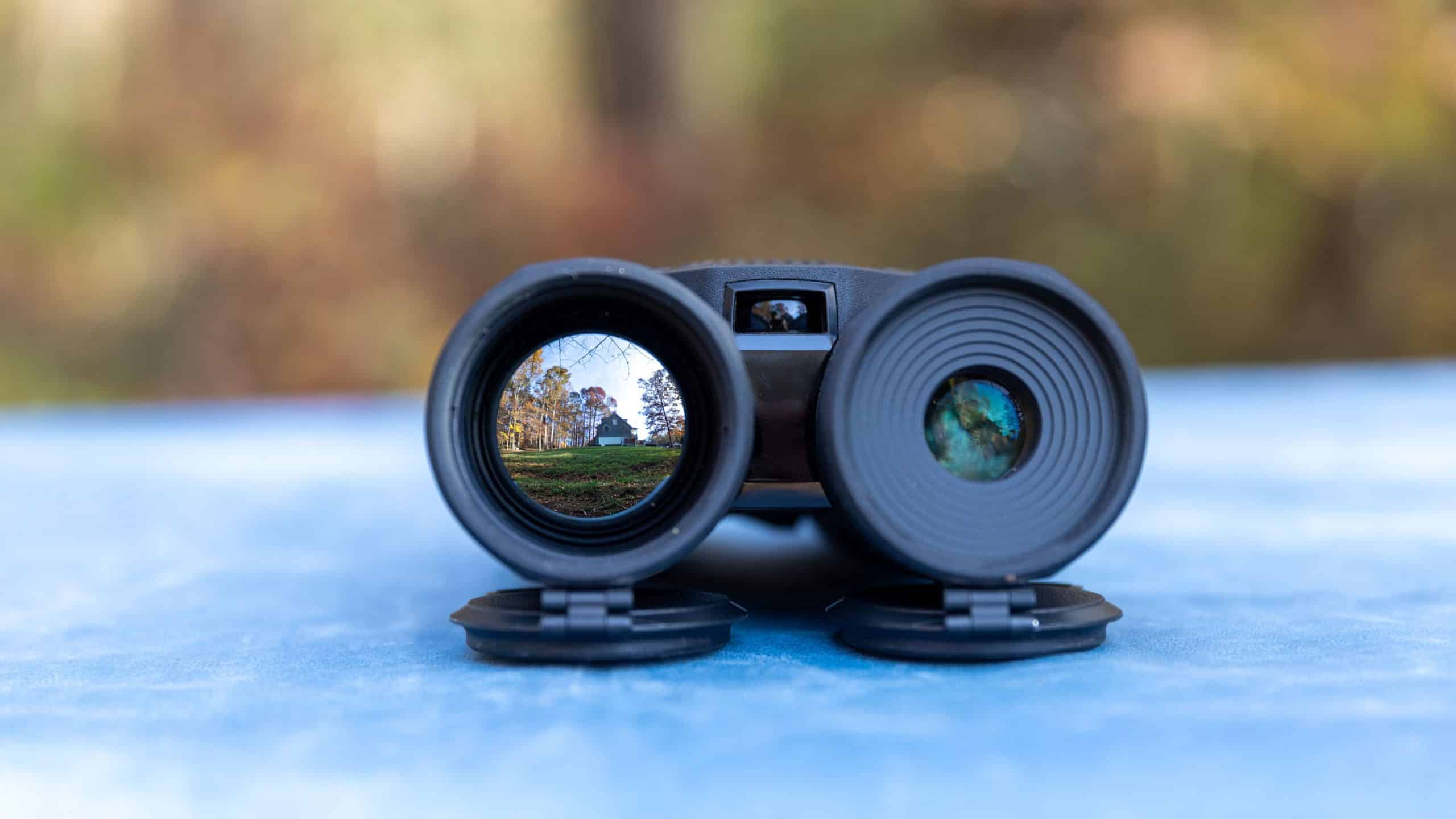
Even though we’ll primarily talk about these for hog and predator hunting, a setup like this has plenty of uses outside of that. During deer season, having an optic that lets you switch between digital viewing and thermal observation can be particularly helpful when searching for a downed animal, where permitted by local regulations.
Thermal imaging can reveal temperature differences between an exposed animal and its surroundings, although it cannot see through solid objects or dense vegetation.
Beyond hunting, multispectral optics also have applications in wildlife observation, search and rescue, property monitoring and nature conservation.
For more information on how technology is changing the way hunters locate downed game, read North American Deer Hunter’s article on modern deer recovery methods.
Thermal Image Quality: The 1280×1024 HD Sensor
Most high-end thermal optics run on a 640×480 sensor, which already gives you a very sharp picture. The Symbion LRF DXT50 steps up to a 1280×1024 microbolometer sensor with a 12-micron pixel pitch, and the difference when you look through the eyepieces is immediately obvious.
Compared side by side with the 640-resolution Pulsar Oryx LRF XG35, the Symbion delivered noticeably sharper detail, especially at longer distances.
Because so many more pixels are packed into the image, you don’t lose clarity nearly as fast when you start zooming in. During our hunts and distance tests, deer at 200 yards were unmistakably deer, a fox at 150 yards was easy to identify, and we could pick out individual human features at 100 yards, along with smaller subjects like squirrels and birds.
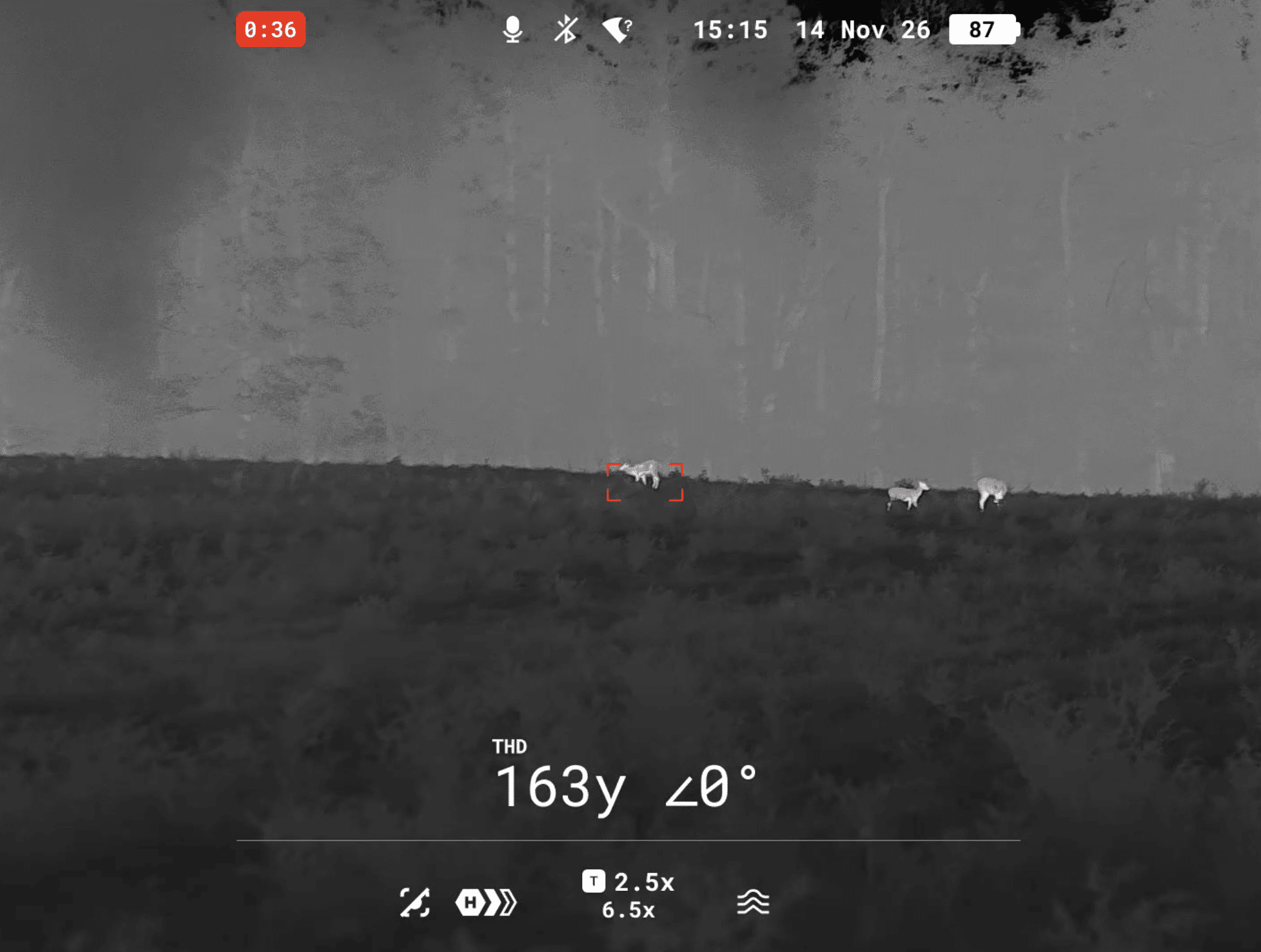
The current manufacturer specifications list a sensor NETD rating under 35 mK and a system NETD rating under 20 mK. NETD stands for Noise Equivalent Temperature Difference, which is a measure of thermal sensitivity. Generally speaking, a lower number indicates better sensitivity to subtle temperature differences.
The Symbion held onto good background contrast even during our foggy morning sit, when thermal images can start looking flat and washed out.
Thermal Magnification: 2x to 24x
The thermal channel starts at 2x base magnification and can be increased digitally to 24x. That gives you considerable flexibility, whether you’re scanning a large field or taking a closer look at something you’ve already spotted.
Like any digital imaging system, however, increasing magnification eventually comes at the expense of fine detail. Even with a 1280-resolution sensor, the picture becomes noticeably softer at maximum magnification.
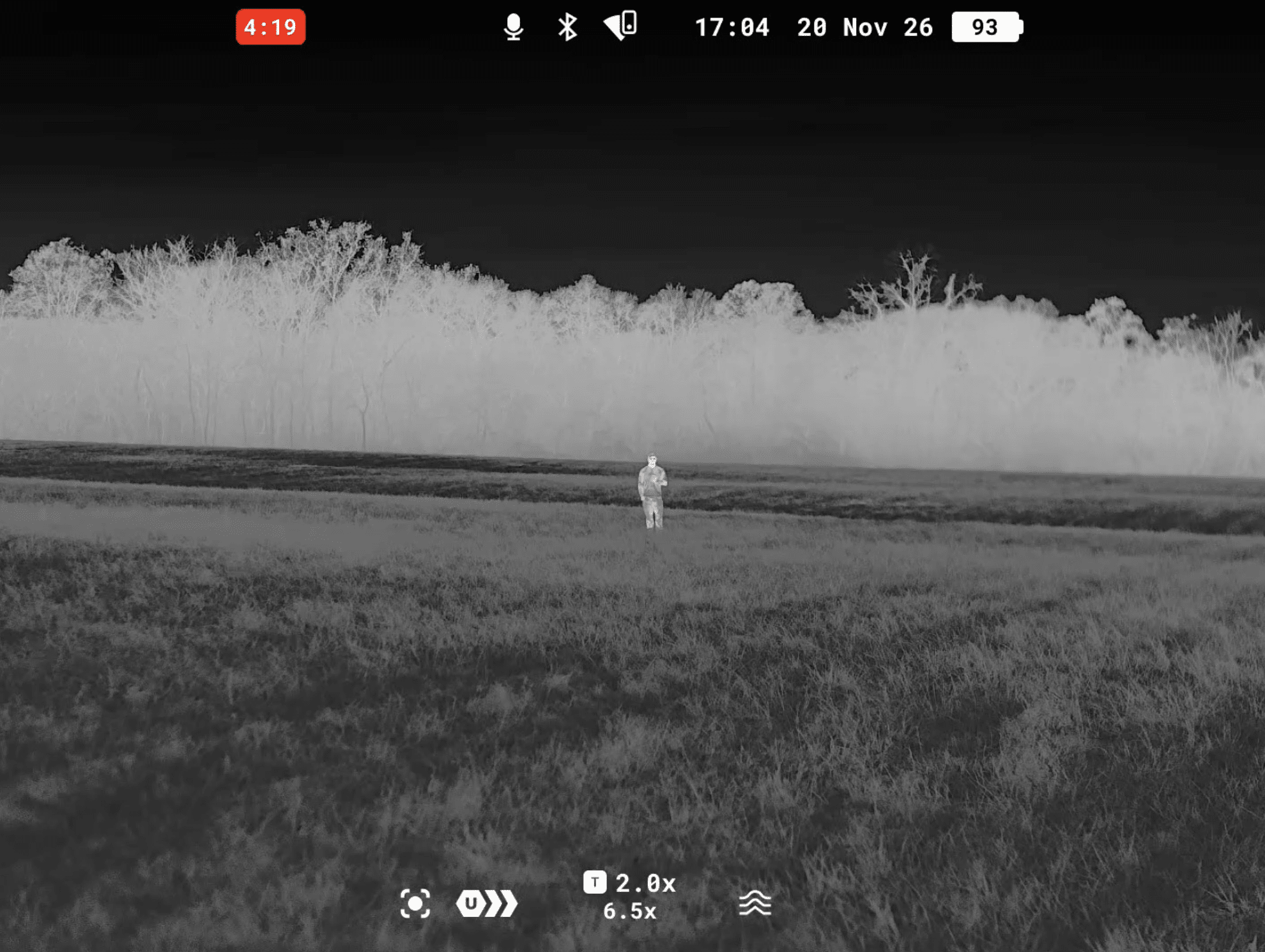
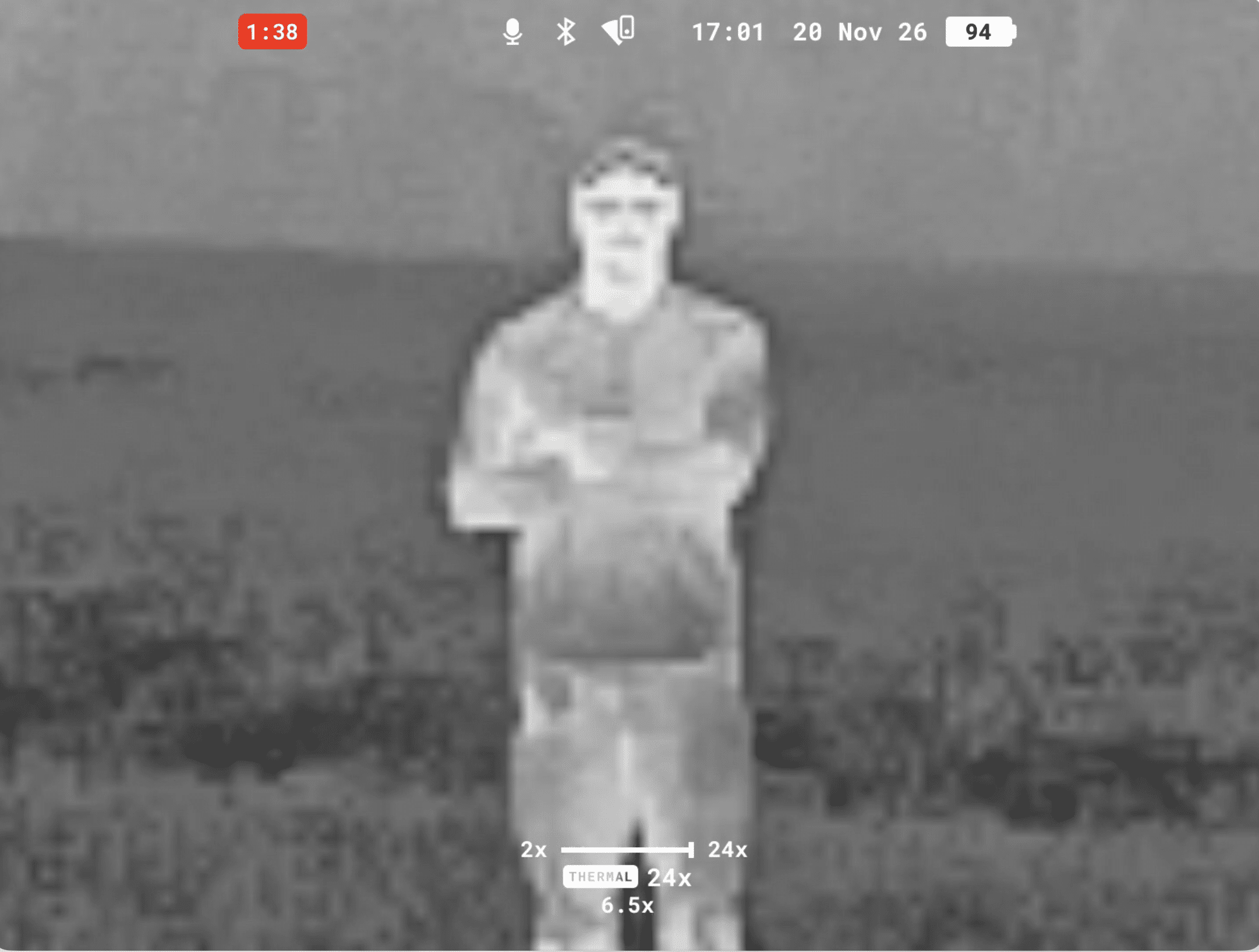
Original field-testing images illustrate the trade-off between a wide field of view and increased digital magnification.
4K Digital Daytime and Night Vision Performance
The second half of the multispectral equation is the 4K CMOS digital sensor, with a resolution of 3840×2160, paired with a 50mm focal-length lens. During the day and through twilight, this channel gives you a full-color image with magnification from 6.5x to 26x.
I do want to mention that daytime clarity with the digital lens isn’t comparable to a good pair of standard glass binoculars. The image is solid, especially inside 150 to 200 yards, though fine detail softens if you try pushing it out toward 500 yards.
Once it gets completely dark, you can switch the digital channel into night vision mode using the focusable 850nm infrared illuminator built right into the bridge.
With the IR light on, we were able to get useful black-and-white night vision images at distances of around 150 to 200 yards. That additional visual information is helpful when you want to distinguish details that may not be as apparent through a thermal image alone.
Keep in mind that digital night vision performance depends on available light, infrared illumination, weather and the characteristics of whatever you’re observing. The 4K sensor resolution also doesn’t mean the image displayed or recorded by the binoculars is necessarily 4K.
Multispectral Picture-in-Picture and Image Stabilization
Having two great cameras in one housing is nice, but how you view them is what makes the Symbion so useful. You don’t have to toggle back and forth between two completely separate screens. Pulsar gives you combined multispectral Picture-in-Picture (PiP) modes that let you view both channels at the same time.
For example, you can keep your main screen on the wide thermal view while a smaller box at the top displays a magnified digital view of the subject you’re observing.
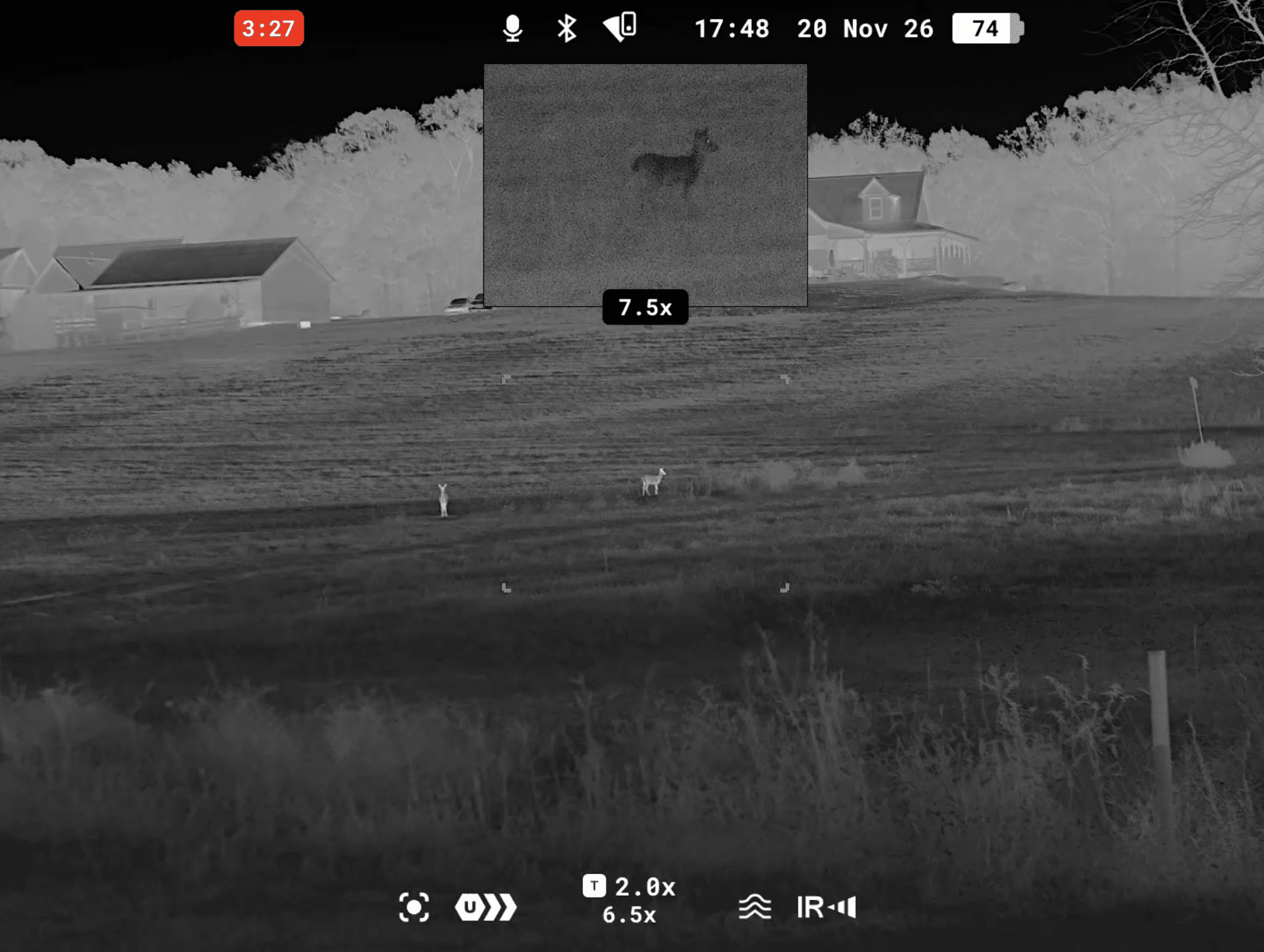
You can also turn on electronic image stabilization, which is especially useful when viewing at higher magnification. Even looking at an object 250 yards away at higher zoom levels, turning image stabilization on versus leaving it off made a huge, immediate difference in steadying the picture freehand.
That’s one feature I appreciated during our testing. The farther you increase magnification, the more noticeable those little movements in your hands become.
Two-Eye Comfort and Dual AMOLED Displays
If you’ve spent an entire night squinting through a single-eye monocular, switching to a binocular format feels like a huge relief. Looking through two 1920×1080 AMOLED displays with both eyes is a more natural viewing experience.
It can help reduce eye fatigue and the imbalance in dark adaptation that comes with viewing through a monocular, although both eyes are still exposed to illuminated displays.
Pulsar also built in a proximity sensor between the eyepieces. When the power-saving function is enabled, the displays can automatically switch off after you pull the binoculars away from your face for several seconds. Bringing the binoculars back up to your eyes wakes the displays again.
You can also adjust the interpupillary distance from 62.5mm to 74mm and adjust the diopter on each eyepiece to suit your vision.
Wide Field of View and Long Detection Range
Because the thermal channel uses a 50mm F/1.0 objective lens paired with that 1280 sensor, you get an impressive combination of magnification and field of view. It starts at a low 2x base magnification on the thermal side, which gives you a very wide 17.5-degree field of view.
At 100 yards, you’re looking at a slice of terrain over 90 feet wide.
Usually, when you get a wide field of view like that, there are trade-offs in long-distance observation. Pulsar rates the Symbion’s thermal detection range at approximately 2,515 yards for a deer-sized object.
Obviously, you aren’t judging trophy quality at nearly a mile and a half. Detection range means you may be able to distinguish a heat signature, not necessarily determine what it is.
Being able to cover a large cutover or agricultural field with fewer sweeps is one of the biggest advantages of the Symbion’s wide thermal field of view.
Integrated Laser Rangefinder
Estimating distances through a digital display can be difficult, particularly in darkness when familiar visual reference points are harder to distinguish.
The Symbion LRF DXT50 has an integrated laser rangefinder with a manufacturer-rated maximum measuring distance of approximately 1,640 yards, or 1,500 meters. It offers individual measurements as well as a continuous scanning mode.
During our comparison session, the rangefinder displayed a reading of 1,496 yards across an open field. That’s an impressive recorded distance for a handheld binocular, although we did not independently verify the accuracy of that particular measurement.

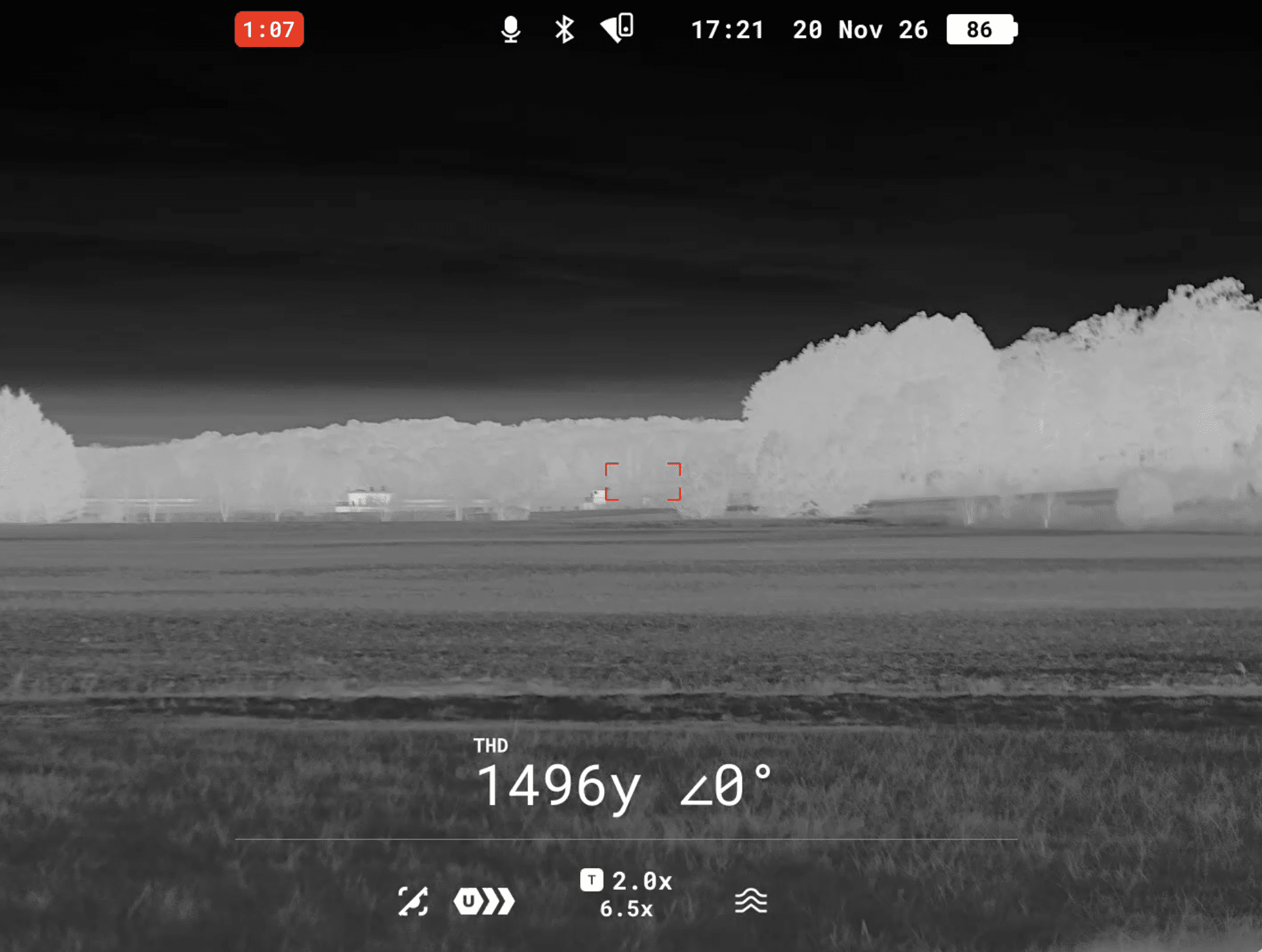
Actual maximum range depends on the size and reflectivity of the object being measured, along with atmospheric conditions.
Nine Thermal Color Palettes and Calibration Modes
Pulsar loaded the Symbion with nine thermal color palettes so you can set the screen up for your personal preferences and observation conditions.
White Hot, Black Hot and Red Hot are still my favorites when I’m sweeping a field just trying to spot movement. When I find something and want to see more contrast across the animal’s body, switching to Rainbow or Ultramarine makes the temperature differences pop.
If you’re doing long-term glassing in the dark, palettes like Red Monochrome, Sepia and Violet may be more comfortable on your eyes. Display brightness also makes a difference.
You get three sensitivity amplification levels, a smoothing filter and manual, semi-automatic or automatic calibration modes to help maintain image quality as outdoor temperatures change.
Ergonomics, Controls and Build Quality
Even though these are full-sized binoculars, Pulsar laid out the controls so you can reach the main buttons with one hand while holding the unit steady. The focus wheels and zoom controls are easy to find by feel in the dark, even in light hunting gloves.
Working the unit does take some practice, though, to learn and remember what all the buttons do. Once you have the hang of it, that one-handed control is straightforward.
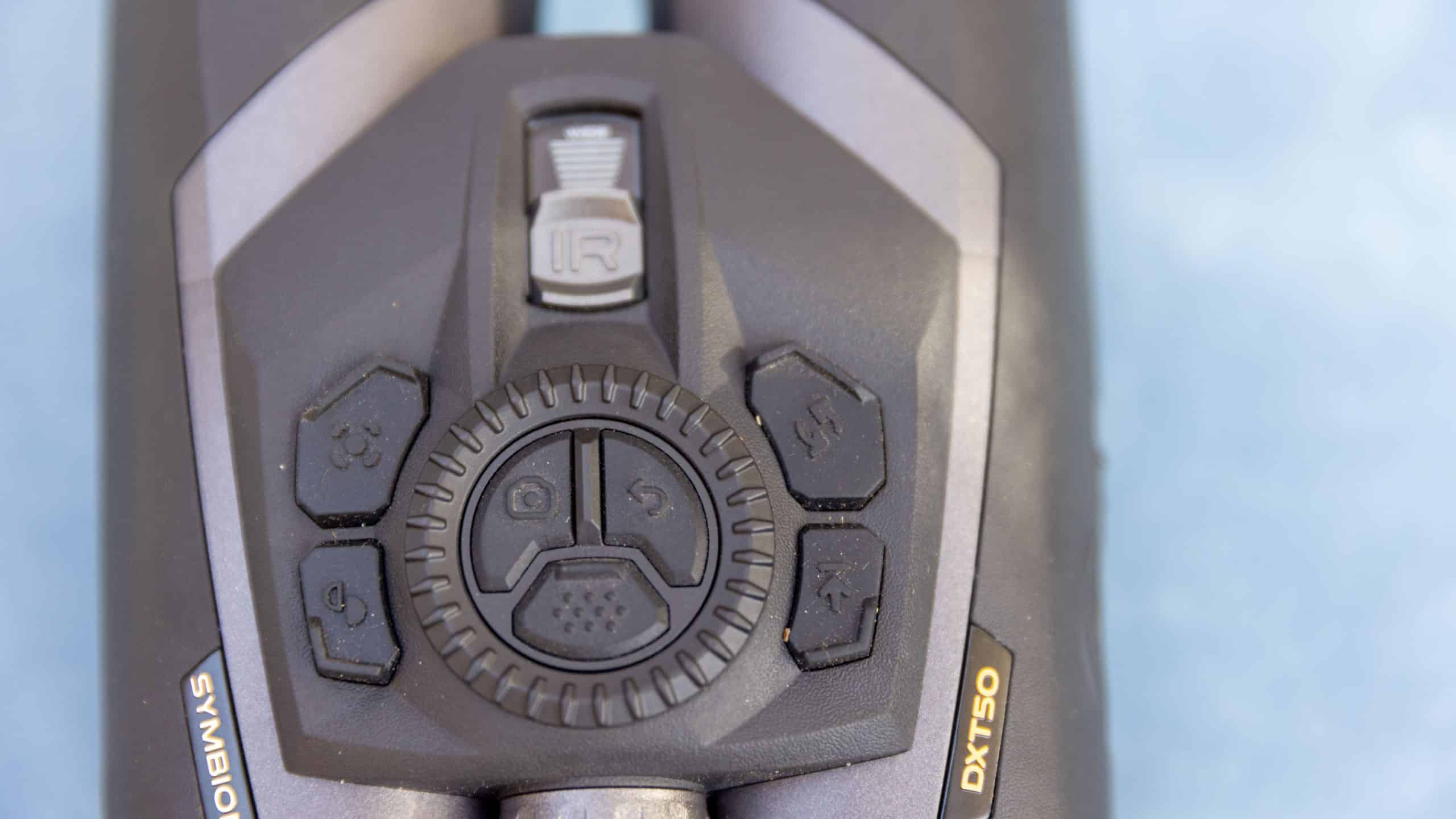
The housing is made from magnesium alloy and carries an IP67 rating for dust and water protection. That provides a reassuring level of environmental protection when using an expensive electronic optic outdoors.
It also has a standard quarter-inch tripod socket on the bottom, which is nice if you’re observing from a blind or stationary setup and want to mount it on a tripod for steady glassing.
At 35.3 ounces with the battery installed, these are considerably heavier than a compact thermal monocular. That’s something to consider if you spend a lot of time walking or already have other optics hanging around your neck.
Battery Life and Charging
The Symbion runs on Pulsar’s removable 4,900 mAh APS5 lithium-ion battery packs. Pulsar rates the DXT50 for eight hours of combined runtime using two batteries at approximately 72 degrees Fahrenheit.
Actual battery life depends on temperature and how much you use features like the rangefinder, Wi-Fi, video recording and infrared illuminator.
In our testing, we ran the unit for a couple of hours at a time during cold hunts and recorded continuously for at least 45 minutes during our comparison test, and we still had plenty of battery life left.
We did not run both batteries to depletion, so we can’t independently confirm the manufacturer’s full eight-hour runtime.
Since the batteries are external and quick-change, carrying a spare APS5 pack gives you the ability to replace a depleted battery in the field. You can also use USB-C to recharge the battery inside the unit or operate the binoculars with a compatible external power bank.
Video Recording and Stream Vision 2 Connectivity
For recording your hunts and wildlife observations, the Symbion has 64GB of built-in memory and records video and audio at 1440×1080 resolution.
You never have to worry about forgetting an SD card on your kitchen table before heading to the woods (not that I’ve ever done that).
You can pull your clips off with a USB-C cable plugged directly into your computer, and it works on a Mac, which I’ve learned isn’t the case for all thermals.
You can also connect over dual-band Wi-Fi to the Stream Vision 2 app to download videos to your phone, update firmware or stream your view live to a friend’s phone screen.
You can also use your phone as a handheld viewer in case you get tired of putting your eyes up to the binos.
What’s Included and Warranty Coverage
At this price point, it’s worth knowing what comes with the Symbion. Pulsar lists the following among the included accessories:
- Two rechargeable APS5 batteries.
- APS5 battery charger and power adapter.
- USB-C cable with USB-A adapter.
- Binocular carrying case.
- Binocular harness and neck strap.
- Lens cleaning cloth.
- Quick-start guide and warranty documentation.
Pulsar’s U.S. warranty policy provides a three-year limited warranty, with qualifying newer products eligible for an additional two years of coverage upon registration. Rechargeable battery packs and charging docks have separate one-year coverage.
For complete eligibility requirements, registration details and exclusions, see Pulsar’s official warranty policy.
Pulsar Symbion LRF DXT50: Pros and Cons
Reasons to Buy
- Exceptional 1280×1024 thermal sensor.
- Wide 92-foot thermal field of view at 100 yards.
- Thermal, digital daytime and night vision capabilities.
- Comfortable two-eye viewing format.
- Multispectral picture-in-picture.
- Effective electronic image stabilization in our testing.
- Integrated laser rangefinder.
- 64GB storage with audio and video recording.
- Rugged IP67-rated housing.
- Two batteries and carrying accessories included.
Reasons to Consider
- Approximately $8,000 purchase price.
- Heavier and bulkier than a thermal monocular.
- Learning curve with buttons and menus.
- Daytime clarity trails quality traditional binoculars.
- Rated eight-hour runtime requires two batteries.
- Noticeable loss of fine detail at maximum digital magnification.
- More technology than most occasional users need.
Pulsar Symbion DXT50 vs. DXR50
If you’re considering the flagship DXT50, it’s worth looking at the less expensive Symbion DXR50 before making a decision.
Both models combine thermal imaging with a 4K digital channel and integrated laser rangefinder. The biggest difference is the thermal sensor, with the DXT50 offering more than four times the total thermal sensor pixels of the DXR50.
| Feature | DXT50 | DXR50 |
|---|---|---|
| Price | $7,999 | $5,999 |
| Thermal Sensor | 1280 x 1024 | 640 x 480 |
| Base Thermal Magnification | 2x | 4x |
| Digital Sensor | 4K | 4K |
| Rated Detection Range | 2,515 yards | 2,515 yards |
| Laser Rangefinder | 1,640 yards | 1,640 yards |
| Rated Runtime (Two Batteries) | 8 hours | 10 hours |
This is a manufacturer-specification comparison. We did not conduct a direct field test of the DXR50 for this review. More thermal sensor pixels do not automatically translate into proportionally better perceived image quality.
The DXR50 offers a similar multispectral concept at a savings of approximately $2,000. For someone who wants both thermal and digital imaging but doesn’t necessarily need the flagship thermal sensor, it represents another option worth considering.
I’ve also spent time testing other premium Pulsar thermal optics, including the Telos LRF XP50. You can read my full Pulsar Telos LRF XP50 review on Crossbow Magazine for another perspective on Pulsar’s high-end thermal technology.
Pulsar Symbion vs. Pulsar Oryx: Is the Upgrade Worth It?
One of the most useful parts of our testing was being able to look through the Pulsar Symbion LRF DXT50 and Pulsar Oryx LRF XG35 side by side.
The difference in thermal detail was noticeable, particularly at longer distances. The Symbion’s larger thermal sensor, wider field of view and second imaging channel distinguish it from the more compact Oryx.
| Feature | Symbion DXT50 | Oryx XG35 |
|---|---|---|
| Approximate Price | $7,999 | $2,800 |
| Thermal Sensor | 1280 x 1024 | 640 x 480 |
| Thermal Objective | 50mm | 35mm |
| Thermal Field of View | 17.5° | 12.5° |
| Viewing Format | Binocular | Monocular |
| Weight | 2.2 lbs. | 1.1 lbs. |
| 4K Digital Channel | Yes | No |
| Integrated Rangefinder | Yes | Yes |
Approximate prices are provided for comparison and may vary by retailer.
While the Symbion is undoubtedly more versatile, the Oryx is considerably lighter, easier to carry and costs less than half as much. For my style of hunting, that’s a pretty significant difference.
Who Should Buy the Pulsar Symbion LRF DXT50?
The Symbion makes the most sense for someone who regularly spends extended periods observing wildlife, works across large areas of open country or has a genuine need for thermal and digital imaging in one device.
Best Use Cases
- Professional guides and frequent thermal users.
- Extended wildlife observation.
- Scanning large fields and open terrain.
- Users who prefer a two-eye viewing format.
- People who regularly need both thermal and digital imaging.
If you’re primarily looking for a compact thermal scanner or only use thermal optics a few times a year, a quality 384-resolution or 640-resolution monocular may be a more practical investment.
For those looking for a more affordable entry into thermal imaging, our field-tested Pulsar Axion XQ19 thermal monocular review explores a considerably smaller and more budget-friendly alternative.
A Note About Hunting Regulations
Regulations governing thermal and digital night vision optics vary by state, species, season and intended use. Some jurisdictions also restrict electronic optics for wildlife recovery or observation during hunting seasons. Always verify the applicable regulations with your state wildlife agency before using these devices.
Frequently Asked Questions
What is the difference between a thermal binocular and a multispectral binocular?
A standard thermal binocular displays temperature differences through thermal imaging. A multispectral binocular like the Symbion LRF DXT50 combines thermal imaging with a digital day/night channel and infrared illumination, allowing you to view additional visual information using the same device.
Can you use the Pulsar Symbion LRF DXT50 during the daytime?
Yes. Both the thermal and digital channels work during daylight. The digital channel provides a full-color image, while the thermal channel reveals temperature differences. However, daytime digital image clarity does not necessarily match that of premium traditional binoculars.
How long does the Pulsar Symbion battery last?
Pulsar rates the Symbion LRF DXT50 for a combined eight hours of operation using two APS5 batteries at approximately 72 degrees Fahrenheit. Actual runtime varies based on temperature, settings and feature usage.
Does the Symbion require proprietary batteries?
Yes. The Symbion uses Pulsar’s removable APS5 rechargeable lithium-ion battery pack. Two batteries are included, and the binoculars also support compatible external USB-C power supplies.
What is the difference between the Pulsar Symbion DXT50 and DXR50?
The DXT50 features a 1280×1024 thermal sensor, compared with the DXR50’s 640×480 thermal sensor. Both provide digital daytime and nighttime viewing and an integrated laser rangefinder. The DXT50 offers higher thermal resolution but costs approximately $2,000 more.
Is the Pulsar Symbion better than the Pulsar Oryx?
In our side-by-side testing, the Symbion produced noticeably sharper thermal detail. It also offers a wider field of view and an additional digital imaging channel. However, the Oryx is lighter, more compact and substantially less expensive. Which optic is better depends on your needs and budget.
Are thermal binoculars legal for hunting?
It depends on your state, the species involved, the season and the intended use. Always consult your state wildlife agency’s current regulations before using thermal or digital night vision equipment.
Is the Pulsar Symbion LRF DXT50 worth the money?
For frequent thermal users who need high-resolution thermal imaging, multispectral functionality and comfortable extended observation, the Symbion offers considerable capability. For occasional users, a quality thermal monocular may offer significantly better value.
Final Thoughts: Is the Pulsar Symbion Worth the Price?
The Pulsar Symbion LRF DXT50 is easily one of the most capable handheld optics I’ve ever looked through. Being able to sweep a huge field with a 1280 HD thermal sensor, locate a heat signature and instantly check it with a 4K digital camera without ever dropping the binoculars from your eyes is a game changer.
Add the comfort of using both eyes and the built-in laser rangefinder, and it’s hard to find anything missing from the feature list.
That said, if I were spending $8,000 of my own money, I wouldn’t buy these for my style of hunting.
For the terrain I hunt, I’d rather spend less than half that on a top-of-the-line thermal monocular like the Pulsar Oryx LRF XG35 and put the extra money toward other equipment that better suits my needs.
However, if you spend serious hours glassing big open country, guiding hunts or observing wildlife and want flagship 1280 thermal clarity paired with digital imaging in one rugged package, the Symbion LRF DXT50 is tough to beat.
Pulsar Symbion LRF DXT50
1280 HD thermal imaging, 4K digital observation and an integrated laser rangefinder in one premium multispectral binocular.
Per our affiliate disclosure, we may earn revenue from the products available on this page. To learn more about how we test gear, click here.