





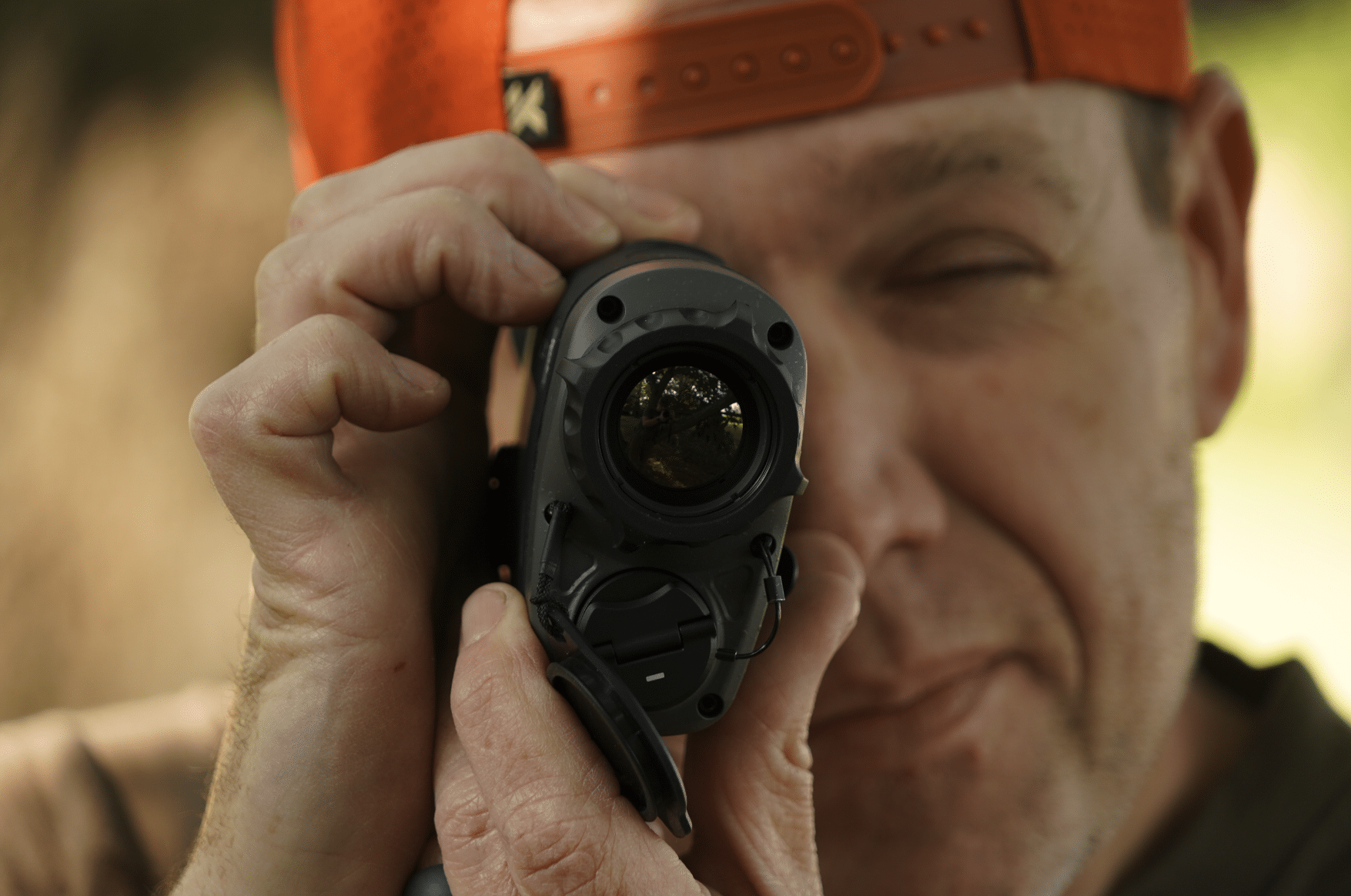
Thermal technology has completely changed the way predator hunters approach the night. Whether you’re targeting coyotes on a frozen January evening, calling hogs under a moonless sky, or simply trying to recover game after dark, thermal optics have become one of the most valuable tools a hunter can carry. The challenge for many hunters, however, has been finding a thermal unit that offers solid performance without the complexity and sky-high price tags often associated with premium thermal equipment. That’s where the Vortex Veil 400 Thermal Monocular enters the conversation.
I have had the opportunity to use many Vortex optics over the past 8 years, such as their rangefinders, binoculars, and rifle scopes. I can say with confidence that I am a fan of Vortex and their innovative optic designs for hunting. After reviewing the specifications and intended design of the Veil 400, it’s clear that Vortex built this thermal monocular specifically for hunters who want dependable thermal performance that works even in the middle of the night without needing a degree in electronics or expertise in thermal technology.
Disclaimer: Vortex is not an advertiser and does not pay for this article. We make our revenue by purchases from readers. If you find this objective article to be helpful – and plan to purchase one after reading the article, purchasing using this link helps us to create more content moving forward.
First Impressions of the Vortex Veil 400
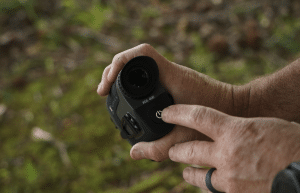
The first thing that stands out about the Veil 400 is its simplicity. Unlike some thermal units that feel more like operating a computer than a hunting tool, the Veil features a straightforward three-button design and a compact, rangefinder-style body that feels familiar in the hand.
Throughout the review process, I couldn’t help but think about how useful this unit would be during night predator hunts. If you’re not familiar with hunting coyotes or other predators such as bobcats, foxes, and wild hogs after dark, it may not be immediately obvious why a predator hunter would use a handheld thermal monocular. While thermal optics mounted on a rifle or scope are essential for making the shot, a handheld monocular serves a different purpose. It allows hunters to efficiently scan large areas, locate animals, and identify targets without constantly pointing a firearm in every direction. This makes a handheld thermal an invaluable tool for spotting game and maintaining situational awareness before ever looking through a scope.
When calling coyotes at night, the hunter typically wants to stay motionless to avoid being seen by approaching predators. If your thermal is attached to the firearm, that means you are swinging the bulky firearm back and forth to catch the body heat of a fast-approaching animal. Suppose you have a small handheld monocular unit such as the Veil 400. It would allow the area to be scanned until a predator is spotted, then transition to the firearm to make the shot. Many times when I hunt at night, I have a partner along who uses the monocular while I stay behind the gun and operate the remote for the electronic caller. One of my first impressions of this unit was its potential to help spot more coyotes without the need to carry bulky night-vision equipment or to create unnecessary movement that could alert approaching predators. At just 13.3 ounces, it won’t weigh down your predator hunting bag or become a burden during long nights of calling multiple stands. The compact size also makes it easy to carry in a jacket pocket, bino harness, or the side pouch of a hunting pack.
For predator hunters who spend hours scanning fields, CRP grass, cattle pastures, and timber edges, this kind of lightweight gear matters.
Vortex Veil 400 is designed for real-world predator hunting
One of the biggest strengths of the Veil 400 is its balance between magnification and field of view. With a 2.3x base magnification and an 11-degree field of view, hunters have enough magnification to clearly identify approaching coyotes while still retaining a wide enough viewing area to detect animals slipping in from the edges. This broader field of view is especially useful when a second coyote appears unexpectedly or when deer and other wildlife come in to investigate the call, allowing hunters to quickly identify non-target animals before making any decisions.
Many predator hunters know the frustration of losing a charging coyote because their thermal’s field of view was too narrow. The Veil 400 seems to strike a practical balance between scanning large areas and maintaining target identification. When using it, it doesn’t feel like any areas are restricted due to limited visibility.
The 400×300 thermal sensor combined with the 12-micron pixel pitch provides a noticeable step above many entry-level thermal units. While it won’t compete with ultra-premium 640-resolution systems costing several thousand dollars more, it offers plenty of image quality for most predator-hunting situations.
Vortex Veil 400 – Performance in the Field
The advertised 1,100-yard detection range gives hunters plenty of reach for spotting heat signatures across open fields and crop ground. When used during coyote calling, the unit allowed animals to be identified at greater distances and with less delay, giving hunters more time to adjust e-caller sounds or prepare on the rifle. This reduced the sense of urgency that comes from animals appearing too close before they can be clearly seen.
More importantly, the 50 Hz refresh rate helps create smooth image movement when panning or tracking animals. This becomes especially important when following a moving coyote or scanning large sections of terrain during a stand.
The Veil 400 offers four color palettes:
- White Hot
- Black Hot
- Red Hot
- Multicolor
Most experienced predator hunters will likely spend most of their time using white hot or black hot, but having options allows users to adapt to changing weather conditions and personal preferences.
The three viewing modes, balanced, contrast, and brush, also provide flexibility depending on the terrain. Brush mode could be particularly useful when hunting areas with thicker vegetation or tall grass, when separating animals from background clutter becomes more challenging.
A Battery System Hunters Will Appreciate
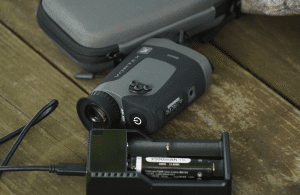
One feature that I think deserves attention is the use of rechargeable 18650 lithium batteries. There is nothing worse than spending too much time in between call stands due to charging or changing batteries on equipment.
Many thermal users and predator hunters have dealt with proprietary battery systems that are expensive or difficult to replace at night while still in the field. The Veil 400’s use of a common 18650 lithium battery means hunters can carry multiple spares without spending a fortune. The included hard protective case holds the extra battery in place while in a backpack or when thrown in the backseat of a truck.
The listed runtime of 4.5 hours per battery was pretty close to real use. When testing, I was hunting in mild spring-like temps, which is ideal for battery life. They lasted just past the 4.5-hour mark. I’m sure in extreme cold conditions, it may be slightly less. Its compact size lets it fit in a jacket pocket when not in use, which also extends battery life. The Veil 400’s battery life should comfortably cover most predator-hunting sessions, and swapping batteries is far easier than ending a hunt early due to a dead internal battery.

More Than Just a Predator Hunting Tool
While predator hunters will likely be the primary audience, the Veil 400 offers utility beyond calling coyotes. It can help locate wild hogs before a nighttime stalk. As a deer hunter, I have found myself in the situation of recovering downed game. This small unit would be a game-changer for finding a downed deer or other big-game animal (check state regulations before use). The Veil 400 could also be used by homeowners who want to monitor their property after dark or navigate unfamiliar terrain safely.
The thermal monocular can be used in many situations, and many hunters quickly discover that once thermal enters their gear lineup, they find reasons to use it year-round.
The Non-Feature That May Matter Most
Thermal optics are electronic devices, and electronics can fail. For many hunters, that reality has created hesitation about purchasing a thermal. The same goes for electronic callers; hunters don’t want equipment that is going to fail mid-hunt. There is nothing worse than reaching the prime hours of a night hunt, when conditions are at their best, only to have the experience disrupted by a unit that fails or performs inconsistently. This can force the hunt to end early or lead to missed opportunities, especially when a hungry coyote suddenly charges into the call. One of the most appealing aspects of the Veil 400 is that it’s backed by Vortex’s VIP warranty, which includes electronic components. That level of support and confidence is uncommon in the hunting thermal market and provides peace of mind for hunters making a significant investment.
How the Vortex Veil 400 Compares to Similar Thermal Monoculars
In the current thermal monocular market, the Vortex Veil 400 lands in a very competitive price range. It is not the cheapest handheld thermal on the market, and it is not trying to compete with high-end 640-resolution units that cost several thousand dollars more. Instead, it sits in the middle of the practical predator-hunting category, where hunters are looking for a useful scanning tool that provides good image quality, simple controls, and enough durability to trust in the field.
Two of the most obvious competitors in this range are the Pulsar Axion 2 XQ 35 Pro and the AGM Taipan V2 19-384. Both are strong options, each with features that will appeal to different types of hunters. The Pulsar Axion 2 XQ35 Pro offers a 384×288 thermal sensor, a 35mm objective lens, 2-8x magnification, Wi-Fi connectivity, photo and video recording, and an impressive listed battery life. For hunters who want a more feature-rich handheld thermal with app connectivity and longer runtime, the Pulsar is a serious contender.
The AGM Taipan V2 19-384 is another strong competitor because it delivers a 384×288, 12-micron sensor, 50 Hz refresh rate, removable 18650 batteries, onboard storage, Wi-Fi, and a very attractive price. It is a solid choice for hunters who want to get into a 384-class thermal monocular without overspending. On paper, the AGM offers a lot of value, especially for hunters who prioritize affordability and extra features.
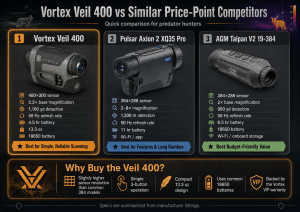
So why would someone choose the Vortex Veil 400 instead?
The biggest reason is confidence. Thermal optics are electronic hunting tools, and that matters. A rifle scope, binocular, or rangefinder can take years of abuse and still keep working, but thermal optics depend on sensors, processors, displays, batteries, and internal electronics. That makes warranty support a major part of the buying decision. The Veil 400 is backed by Vortex’s VIP warranty, including electronics, which immediately separates it from much of the thermal market. For a hunter spending this kind of money on a handheld scanner, that support is not a minor detail. It may be the most important feature that never shows up in the spec chart.
The Veil 400 also has an edge in simplicity. Some thermal units are packed with menus, apps, wireless features, and advanced settings that sound good until you are standing in the dark wearing gloves with coyotes responding to the call. The Veil 400 is built more like a hunting tool than a tech gadget. The three-button layout, rangefinder-style body, and simple operating system make it easier to pick up and use quickly. That matters for hunters who do not want to spend half the night adjusting settings or trying to remember which menu controls which function.
From an image-performance standpoint, the Veil 400’s 400×300 sensor gives it a slight resolution advantage over common 384×288 models. That difference is not massive, but it does provide a little more image information, and when paired with the 12-micron pixel pitch, 50 Hz refresh rate, and 1024×768 OLED display, the Veil produces the kind of smooth, usable image predator hunters need for scanning. It is not a premium 640 unit, but it is well matched to real-world coyote and hog hunting where the goal is to detect heat, track movement, and make decisions quickly.
Compared to the Pulsar Axion 2 XQ35 Pro, the Veil 400 gives up some battery life and wireless/app functionality. The Pulsar may be the better choice for someone who wants longer continuous runtime, smartphone integration, and a more advanced feature set. Compared to the AGM Taipan V2 19-384, the Veil 400 may cost a little more, depending on street pricing, and the AGM offers strong specs for the money. But the Vortex counters with a slightly higher resolution sensor, a very straightforward hunter-focused design, and warranty coverage that is hard to ignore.
For many predator hunters, that is the deciding factor. If you are buying a thermal monocular strictly by spec sheet, there are plenty of models worth comparing. But if you are buying one as a long-term hunting tool, the Veil 400 becomes more appealing. It is the kind of thermal a hunter can throw in a pack, use at stand after stand, hand to a hunting partner, and trust without overthinking it.
The best buyer for the Vortex Veil 400 is someone who wants dependable scanning performance without unnecessary complexity. It makes sense for the coyote hunter who wants to stop swinging a rifle-mounted thermal across an entire field. It makes sense for the hog hunter who needs to locate animals before beginning a stalk. It also makes sense for the hunter who has been hesitant to buy thermal because of concerns about electronics, service, and long-term reliability.
There are cheaper thermal monoculars. There are thermals with longer battery life. There are models with more tech features. But the Veil 400’s combination of image quality, easy operation, common 18650 batteries, compact size, and Vortex warranty support gives it a very clear reason to exist. It is not the flashiest thermal monocular in the category. It is the one that makes the most sense for hunters who want a simple, reliable tool that helps them see more, move less, and hunt more effectively after dark.
Final Thoughts on Vortex Veil 400
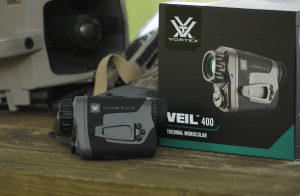
The Vortex Veil 400 Thermal Monocular fills an important niche in today’s thermal market. It isn’t trying to be the most advanced thermal available, nor is it trying to overwhelm hunters with endless features. Instead, it focuses on what most predator hunters actually need: good image quality, simple operation, lightweight design, practical magnification, and reliable battery power that will last an entire night of hunting.
For the coyote hunter looking to make the jump into thermals or the experienced night hunter wanting a dedicated scanning monocular, the Veil 400 appears to offer an excellent combination of performance, usability, and value.
In a world where thermal technology often feels complicated and expensive, the Veil 400 keeps things simple, and sometimes that’s exactly what a predator hunter needs when the eyes in the darkness finally appear.
Per our affiliate disclosure, we may earn revenue from the products available on this page. To learn more about how we test gear, click here.