



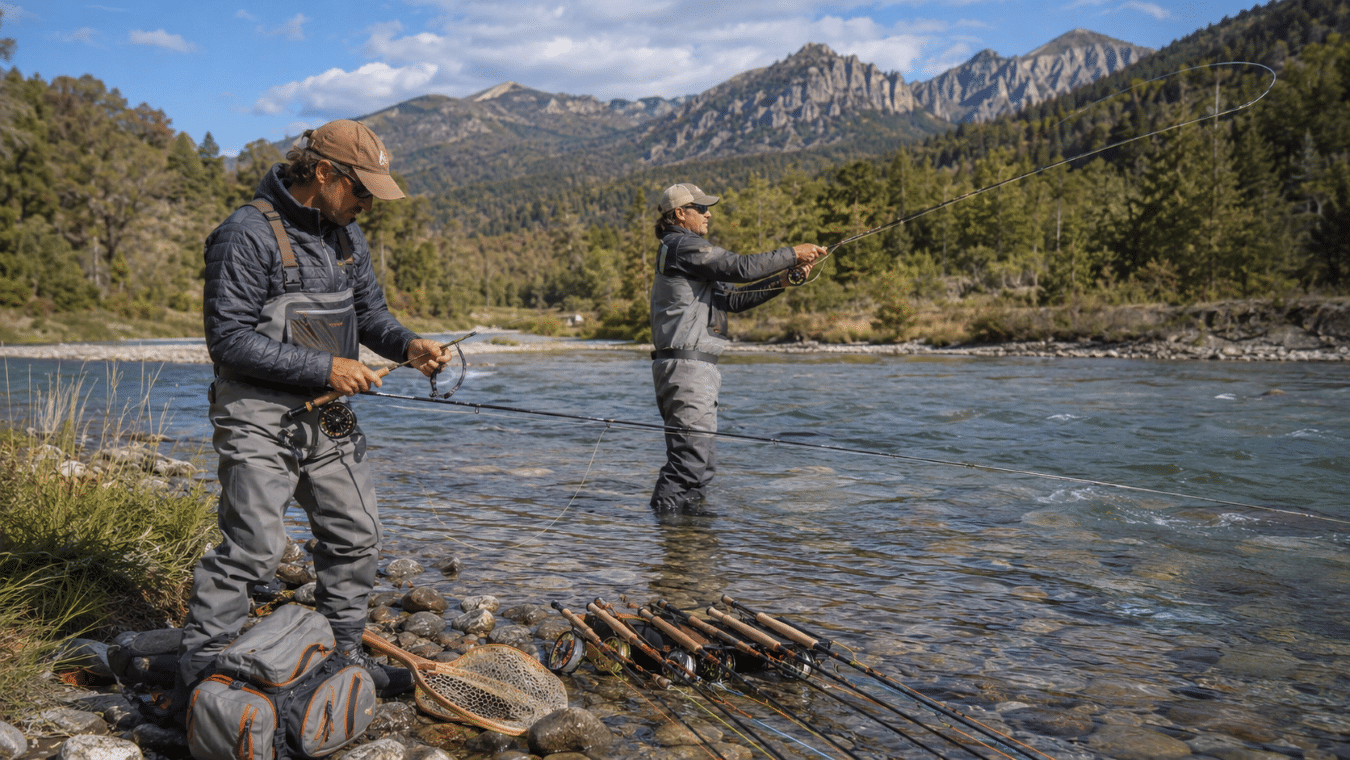
From a first 5-weight to premium trout rods, compact travel models, technical Euro-nymphing tools, and saltwater 8-weights, these nine picks cover the situations fly anglers encounter most often.
Choosing the best fly fishing rod is not the same as choosing the most expensive rod. A fast 9-foot 5-weight that feels ideal on a large western river may be frustrating beneath tight Appalachian cover. A soft fiberglass rod that makes brook trout exciting will struggle to drive a large streamer through coastal wind. The right rod depends on the fish, water, flies, casting distance, and the angler’s preferred stroke.
For most freshwater anglers, a 9-foot 5-weight remains the most versatile starting point. It provides enough delicacy for trout, enough strength for bass and moderate wind, and enough reach for mending and common nymphing techniques. The more specialized picks in this guide show when it makes sense to move shorter, longer, lighter, heavier, slower, or faster.
Our Picks at a Glance
Sage R8 Core 590-4
One premium trout rod that can handle dries, nymphs, and streamers
Orvis Helios D 9-Foot 5-Weight
Accurate casts, high line speed, wind, and longer presentations
ECHO Carbon XL 590-4
Affordable all-around freshwater performance
Orvis Clearwater 9-Foot 5-Weight
Learning to cast and building a first versatile trout setup
R.L. Winston AIR 2 9-Foot 4-Weight
Dry flies, light nymphs, long leaders, and technical trout
Redington Butter Stick v3 476-4
Creeks, close casts, dry flies, and maximum fish-fighting feel
ECHO TRIP 590-8
Air travel, backpacks, vehicles, and compact storage
Thomas & Thomas Contact III+ 1003
Euro nymphing, tight-line control, micro leaders, and strike detection
G. Loomis IMX-PRO V2S 890-4
Bonefish, redfish, striped bass, wind, and inshore saltwater
Fly Rod Comparison Table
Prices are approximate and were checked at the time this guide was prepared. Fly rods frequently vary by line weight and length, so confirm the exact model before ordering.
| Award | Fly Rod | Size Reviewed | Action | Pieces | Approx. Price | Best For |
|---|---|---|---|---|---|---|
| Best Overall | Sage R8 Core 590-4 | 9-foot, 5-weight | Fast | 4 | $1,100 | One premium trout rod that can handle dries, nymphs, and streamers |
| Best for Distance and Wind | Orvis Helios D 9-Foot 5-Weight | 9-foot, 5-weight | Fast / distance-focused | 4 | $1,098 | Accurate casts, high line speed, wind, and longer presentations |
| Best Value | ECHO Carbon XL 590-4 | 9-foot, 5-weight | Moderate | 4 | $289.99 | Affordable all-around freshwater performance |
| Best for Beginners | Orvis Clearwater 9-Foot 5-Weight | 9-foot, 5-weight | Medium-fast | 4 | $298 | Learning to cast and building a first versatile trout setup |
| Best Dry-Fly Rod | R.L. Winston AIR 2 9-Foot 4-Weight | 9-foot, 4-weight | Fast with presentation feel | 4 | $1,195 | Dry flies, light nymphs, long leaders, and technical trout |
| Best for Small Streams | Redington Butter Stick v3 476-4 | 7-foot 6-inch, 4-weight | Classic medium fiberglass | 4 | $329.99 | Creeks, close casts, dry flies, and maximum fish-fighting feel |
| Best Travel Rod | ECHO TRIP 590-8 | 9-foot, 5-weight | Versatile medium-fast blend | 8 | $399.99 | Air travel, backpacks, vehicles, and compact storage |
| Best Euro-Nymphing Rod | Thomas & Thomas Contact III+ 1003 | 10-foot, 3-weight | Technical nymphing | 4 | About $995 | Euro nymphing, tight-line control, micro leaders, and strike detection |
| Best Saltwater Rod | G. Loomis IMX-PRO V2S 890-4 | 9-foot, 8-weight | Fast saltwater | 4 | $595 | Bonefish, redfish, striped bass, wind, and inshore saltwater |
How We Chose the Best Fly Fishing Rods
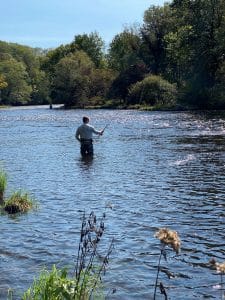
No single fly rod can honestly win every category. We compared current models according to the job each rod is designed to perform, then selected winners that solve meaningfully different angling problems. Manufacturer specifications, rod action, available lengths and weights, components, price, warranty support, packability, and intended fishing application were all considered in addition to hours on the water to confirm durability and performance.
Casting Character
How clearly the rod loads, how quickly it recovers, and whether its action suits the experience level and casting stroke of the intended angler.
Fishing Control
Accuracy, mending, line pickup, tippet protection, fly turnover, strike detection, and fish-fighting power matter more than maximum casting distance alone.
Purpose and Versatility
All-around rods were rewarded for range, while specialized rods were judged according to how effectively they solve one demanding technique or environment.
Value Over Time
Purchase price, materials, finish, warranty, replaceability, and whether the rod remains useful as the angler’s skill level changes were considered together.
How to Choose a Fly Fishing Rod
Start With Line Weight
Match Rod Length to the Water
A 9-foot rod is the all-around standard because it balances casting, reach, mending, and manageable swing weight. Short rods from roughly 7 to 8 feet are easier beneath trees and on tight creeks. Rods from 10 to 11 feet provide additional reach for Euro nymphing, indicator fishing, lake fishing, and long mends, but they can feel tip-heavy if paired with the wrong reel.
Understand Action
Fast action:
Flexes primarily toward the tip. It can generate high line speed and perform well in wind, but it often requires more precise timing.
Medium-fast action:
Balances feedback and power. This is a sensible action for general trout fishing and for anglers developing a consistent cast.
Moderate or slow action:
Flexes more deeply, protects light tippet, and loads well at short range. It is less efficient for hard wind and large flies.
Budget for the Complete System
A fly rod does not work alone. A properly matched reel, backing, fly line, leader, and tippet affect performance immediately. A high-quality line on a well-matched midpriced rod is usually a better fishing system than an expensive rod paired with bargain line. Our guide to fly-fishing backing, leaders, and tippets explains the connections from the reel to the fly.
Think Beyond the Rod
Anglers building a complete river setup should also consider the site’s guides to the best fly fishing vests, choosing fishing waders, and how to pick a fly box. Technique matters just as much as equipment, particularly when learning to identify productive lies in freestone streams.
Best Fly Fishing Rods by Species
The fish species matters, but it is only part of the decision. The size of the fish, current, wind, casting distance, cover, and the weight of the fly can all move an angler one or two line sizes in either direction. A 5-weight can handle most trout and smaller bass, while salmon, steelhead, large carp, pike, musky, and saltwater fish require more backbone.
| Species | Recommended Setup | Best Match in This Guide | Important Qualification |
|---|---|---|---|
| Rainbow and Brown Trout | 9-ft. 5-weight, medium-fast to fast | Sage R8 Core 590-4 | Move to a 6-weight for large streamers, heavy wind, or oversized western trout. |
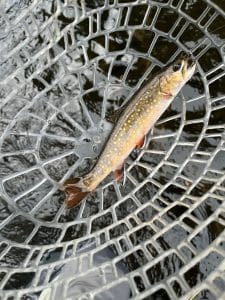
| Brook Trout and Small-Stream Trout | 7- to 8-ft. 3- or 4-weight, moderate | Redington Butter Stick v3 476-4 | Shorter rods are easier beneath trees but provide less reach for mending. |
| Cutthroat and Dry-Fly Trout | 8½- to 9-ft. 4-weight, medium-fast | R.L. Winston AIR 2 | A 5-weight is safer when nymph rigs or streamers are also part of the day. |
| Smallmouth and Largemouth Bass | 9-ft. 6- to 8-weight, fast | Orvis Helios D for smaller flies; G. Loomis IMX-PRO V2S for big bugs and cover | Fly size and cover usually matter more than the average size of the bass. |
| Bluegill, Crappie, and Other Panfish | 7½- to 9-ft. 3- to 5-weight | Redington Butter Stick v3 | A light rod makes small fish more enjoyable; use a 5-weight when bass may also strike. |
| Carp | 9-ft. 7- or 8-weight, fast | G. Loomis IMX-PRO V2S 890-4 | Smaller clear-water carp can be pursued with a 6-weight, but large fish and wind favor an 8-weight. |
| Steelhead | 9- to 10-ft. 7- or 8-weight; switch or Spey rods where appropriate | G. Loomis IMX-PRO V2S 890-4 for single-hand fishing | Large rivers and swung flies often favor a dedicated two-handed rod not represented in this roundup. |
| Salmon | 9- to 10-ft. 8- to 10-weight, fast | G. Loomis IMX-PRO V2S 890-4 for pink, coho, and smaller Atlantic salmon | Large Chinook and heavy current call for a true 9- or 10-weight rather than the exact 8-weight reviewed here. |
| Pike and Musky | 9-ft. 9- to 12-weight, fast | Use a dedicated heavy-predator rod | None of the exact rods reviewed is ideal for large musky flies; an 8-weight is only appropriate for smaller pike flies and fish. |
| Bonefish, Redfish, Snook, and Striped Bass | 9-ft. 8-weight, fast, saltwater-ready | G. Loomis IMX-PRO V2S 890-4 | Large tarpon, oversized permit, and heavy surf require a 9- to 12-weight. |
Best for Rainbow and Brown Trout
Sage R8 Core 590-4
Its 9-foot 5-weight configuration handles dry flies, indicator rigs, and moderate streamers, making it the most complete one-rod trout choice in the roundup.
Best for Brook Trout and Panfish
Redington Butter Stick v3 476-4
The short fiberglass 4-weight loads easily at close range, protects light tippet, and makes smaller fish feel lively without overpowering tight water.
Best for Bass and Carp
G. Loomis IMX-PRO V2S 890-4
The 8-weight has the power to turn over bulky bugs, fight fish around cover, and control hard-running carp, particularly when wind becomes part of the equation.
Best for Steelhead and Smaller Salmon
G. Loomis IMX-PRO V2S 890-4
This single-hand 8-weight provides useful lifting power for steelhead, pink salmon, coho, and smaller Atlantic salmon. Large Chinook require a heavier rod.
Best for Inshore Saltwater Species
G. Loomis IMX-PRO V2S 890-4
An 8-weight is the standard first choice for bonefish, redfish, snook, sea trout, and many striped-bass situations because it balances line speed and fish-fighting authority.
Heavy-Species Warning
Do Not Undersize the Rod
Large Chinook, musky, giant pike, tarpon, and heavy bluewater fish need a dedicated 9- to 12-weight. None of the exact rods in this roundup should be presented as a universal answer for those fisheries.
The Best Fly Fishing Rods of 2026
Each winner below addresses a different type of angler or water. Use the category, line weight, action, and tradeoffs to choose the rod that best matches the fishing you actually do.
Best Overall
Sage R8 Core 590-4
The Sage R8 Core 590-4 earns our best-overall position because it solves the problem most trout anglers actually have: choosing one rod that can cover a full day of changing techniques. A hatch may call for long leaders and dry flies in the morning, an indicator rig may become necessary by midday, and streamers may be the best option when light fades. The R8 Core is designed to move among those jobs without feeling like a compromise rod.
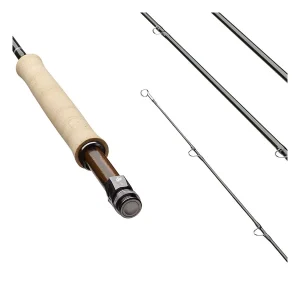
Its fast action produces line speed and tight loops, but the rod is not built only for parking-lot distance. Sage combines a powerful lower section with a more sensitive tip, giving the 9-foot 5-weight enough touch for light tippets and enough authority for mending, line pickup, and heavier flies. That blend is what separates a useful fast-action rod from one that simply feels stiff.
The R8 Core is especially appealing to experienced anglers who already understand their casting stroke and want a rod that responds immediately. It can carry line accurately, recover quickly, and maintain control when wind, current, or fly size begins working against the angler. It is also made in the United States and finished with premium guides, cork, reel-seat hardware, and an aluminum tube.
The price is the obvious obstacle. A newer angler can catch just as many fish with a good rod costing a fraction as much. For an angler who fishes frequently, appreciates refined feedback, and wants one high-end 5-weight to cover most trout water, however, the R8 Core is the benchmark in this group.
5-weight
9 ft.
Fast
4
All-around trout
$1,100
R8 composite technology
Made in USA
Reasons to Buy
- Excellent balance of power and feel
- Handles multiple trout techniques
- Fast recovery and precise line control
- Premium components and finish
- Made in the United States
Reasons to Consider
- Premium price
- Fast action rewards sound casting mechanics
- More rod than an occasional angler needs
Best for Distance and Wind
Orvis Helios D 9-Foot 5-Weight
The Orvis Helios D is the rod we would choose when conditions make an ordinary trout rod work harder. The D series is tuned for line speed, lifting power, and controlled distance, making it especially effective on large western rivers, windy lakes, drift boats, and any fishery where quick shots or long mends are common.
Many powerful rods cast well at distance but become vague when only a short section of line is outside the guides. The Helios D is designed to remain accurate up close while still providing the reserve power needed to drive a loop through wind. That matters because most anglers do not fish at one fixed range. A rod may need to place a dry fly 25 feet away on one cast and reach a seam across the river on the next.
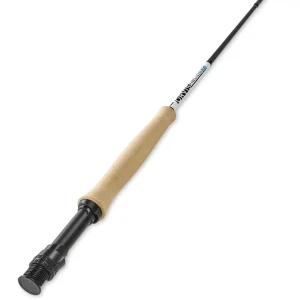
The 9-foot 5-weight is the most broadly useful freshwater configuration in the series. It can fish dry flies, nymph rigs, and light streamers, but anglers with an aggressive casting stroke will appreciate it most. Orvis backs the rod with a 25-year guarantee and builds the Helios in the United States.
Anglers whose fishing centers on small spring creeks, soft presentations, and extremely light tippets may prefer a more presentation-oriented rod. For larger water and inconsistent weather, the Helios D offers one of the most capable combinations of speed, accuracy, and fish-fighting power available.
5-weight
9 ft.
Fast / powerful
4
Wind and distance
$1,098
Modified full wells
25-year guarantee
Reasons to Buy
- Excellent line speed
- Accurate at varied distances
- Strong lifting and fish-fighting power
- Made in the United States
- 25-year Orvis guarantee
Reasons to Consider
- Expensive
- More powerful than necessary on tiny water
- Presentation-focused anglers may prefer a softer rod
Best Value
ECHO Carbon XL 590-4
The ECHO Carbon XL is our value pick because it offers a broad sweet spot, manageable swing weight, and a price that leaves room in the budget for a better reel and fly line. The 9-foot 5-weight weighs approximately 3.5 ounces and is intended to cover dry flies, nymphs, small streamers, rivers, and lakes.

Its moderate action is an advantage for a wide range of anglers. Newer casters can feel the rod load more clearly, while experienced anglers with smoother strokes can use that deeper flex to produce controlled loops and gentle presentations. The Carbon XL does not demand perfect timing, which makes it comfortable during long days and useful when sharing a rod with a less experienced fishing partner.
This is also an honest all-around design. It is not pretending to be a specialized long-distance cannon or competition nymphing rod. Instead, it handles the everyday work of trout and warmwater fly fishing at normal ranges. For many anglers, that is exactly what a primary 5-weight should do.
The tradeoff is that a moderate rod will not generate the same effortless line speed as the fastest premium designs when throwing bulky flies or casting into a hard wind. Its components and finish are practical rather than luxurious. Those limitations are reasonable at this price, and they do not prevent the Carbon XL from being one of the smartest buys in the category.
5-weight
9 ft.
Moderate
4
3.5 oz.
$289.99
Freshwater all-around
ECHO lifetime warranty
Reasons to Buy
- Excellent performance for the price
- Forgiving moderate action
- Useful for multiple techniques
- Light 3.5-ounce listed weight
- Suitable for beginners and experienced anglers
Reasons to Consider
- Less line speed in strong wind
- Not designed for large streamers or heavy rigs
- Components are functional rather than premium
Best for Beginners
Orvis Clearwater 9-Foot 5-Weight
A beginner rod should help an angler develop repeatable timing instead of disguising mistakes with excessive stiffness. The Orvis Clearwater 9-foot 5-weight provides enough feedback to feel the cast develop while retaining the power needed for practical trout fishing, moderate wind, and common dry-dropper or indicator rigs.or
The 9-foot 5-weight format is the safest starting point for most freshwater fly anglers. It is light enough for trout and panfish, but it can also handle bass, larger rivers, and modest streamers. That flexibility matters because beginners often do not yet know which technique or type of water will become their favorite.
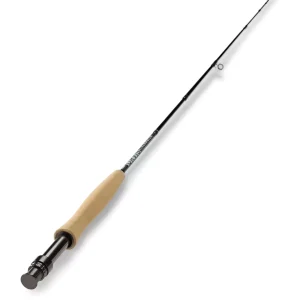
Orvis builds the Clearwater from mid-modulus graphite and lists the popular 9-foot 5-weight at approximately 3.5 ounces. The series uses nickel-aluminum reel seats, guides with ceramic inserts, and model-specific actions rather than forcing every rod length and line weight into the same generic taper. The 25-year guarantee is another important advantage for an angler learning to transport, assemble, and protect a fly rod.
The Clearwater is not as light or refined as the premium rods above it. Experienced casters may notice more swing weight and less immediate recovery. Beginners are unlikely to be limited by those differences, and the rod offers a better long-term foundation than the cheapest starter equipment.
5-weight
9 ft.
Medium-fast
4
Approx. 3.5 oz.
$298
Mid-modulus graphite
25-year guarantee
Reasons to Buy
- Beginner-friendly casting feedback
- Versatile 9-foot 5-weight format
- Model-specific rod actions
- 25-year Orvis guarantee
- Reasonable price for a long-term first rod
Reasons to Consider
- Heavier and less refined than premium rods
- Imported construction
- Rod-only purchase still requires reel, line, backing, and leader
Best Dry-Fly Rod
R.L. Winston AIR 2 9-Foot 4-Weight
Dry-fly fishing asks a rod to do several things at once. It must form an accurate loop, turn over a long leader, protect light tippet, and land the fly without unnecessary disturbance. The 9-foot 4-weight Winston AIR 2 is built around that balance rather than around maximum power alone.
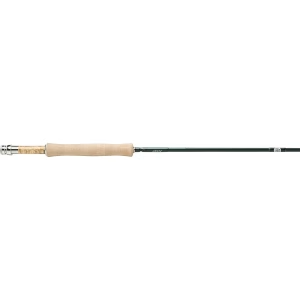
Winston classifies the AIR 2 as a fast-action freshwater series, but the rod retains the progressive, connected feel that has long defined the company. The 3- and 4-weight models are particularly well suited to dry flies and light nymphs. The 9-foot length adds line control and mending ability without moving into the heavier feel of a longer specialty rod.
The AIR 2 uses nanoparticle technology, light-wire guides, premium cork, and a figured wood reel seat. Each rod is designed and handcrafted in Twin Bridges, Montana. It is as much a refined fishing tool as a casting instrument, with enough lower-section power to manage larger trout while maintaining sensitivity during delicate presentations.
This is a specialized luxury purchase. Anglers who frequently throw weighted streamers, large indicators, or bass bugs will get more utility from a 5- or 6-weight all-around rod. For technical trout water, spring creeks, tailwaters, and anglers who live for rising fish, the AIR 2 provides a level of feel and presentation control that less expensive rods struggle to match.
4-weight
9 ft.
Fast / presentation
4
Dry flies and light nymphs
$1,195
6.5-in. cigar
Handcrafted in USA
Reasons to Buy
- Excellent presentation control
- Smooth, connected casting feel
- Protects light tippet
- Premium components
- Handcrafted in Montana
Reasons to Consider
- Very expensive
- Not the best choice for heavy streamers or large indicators
- A 4-weight is less versatile for bass and larger fish
Best for Small Streams
Redington Butter Stick v3 476-4
Small streams rarely reward the longest or fastest rod in the garage. Tight cover, short leaders, quick roll casts, and targets measured in feet rather than yards make a compact rod easier to use. The 7-foot 6-inch, 4-weight Redington Butter Stick is designed for that environment.
The T-glass blank uses a classic medium action that bends more deeply than modern fast graphite. That deeper loading helps the rod form useful casts with very little line outside the tip, which is exactly what anglers encounter beneath branches and along narrow creek channels. It also cushions light tippet and makes smaller trout feel lively instead of overpowered.
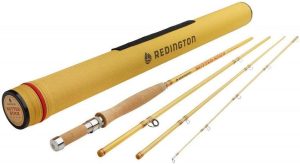
The third-generation Butter Stick is now a four-piece design, making it easier to store and travel with than many traditional fiberglass rods. Redington adds a half-wells grip, cork reel seat, threaded lock nut, alignment dots, and a Cordura rod case. The translucent yellow blank will appeal to anglers who appreciate its retro identity, although it is not visually subtle.
Fiberglass requires a slower, more deliberate casting tempo. Anglers accustomed to punching a fast graphite rod may need time to adjust, and the Butter Stick is not the tool for long casts in hard wind. On wooded creeks, small rivers, and ponds where presentation and enjoyment matter more than distance, it is an easy rod to love.
4-weight
7 ft. 6 in.
Medium fiberglass
4
T-glass
$329.99
Small streams
Lifetime warranty
Reasons to Buy
- Loads well at short range
- Compact in tight cover
- Excellent tippet protection
- Fun fish-fighting action
- Four-piece travel-friendly build
Reasons to Consider
- Requires a slower casting tempo
- Poor choice for strong wind and long casts
- Bright retro styling is not for everyone
Best Travel Rod
ECHO TRIP 590-8
The best travel rod is the one that is compact enough to come along and capable enough that you will actually want to fish it. The ECHO TRIP 590-8 breaks into eight 15-inch sections and stores in an approximately 18-inch case, making it far easier to fit inside luggage, a backpack, or a crowded vehicle than a standard four-piece rod.
ECHO designed the TRIP around a smooth blend of action and power rather than chasing maximum stiffness. The 9-foot 5-weight weighs approximately 3.2 ounces, which is impressively light for an eight-piece configuration. It is broad enough for common trout techniques and makes sense as a vehicle rod even when no airline ticket is involved.
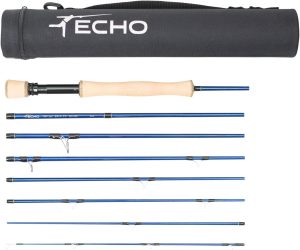
Extra ferrules inevitably create more connections to assemble and inspect. Anglers should take time to seat each section properly and check alignment during the day. The payoff is a rod tube short enough to disappear into places where a standard case becomes awkward or impossible.
A dedicated premium four-piece rod may feel slightly cleaner through the blank, especially to a highly experienced caster. The TRIP is not meant to replace every rod in an angler’s collection. It is built to eliminate the logistical excuse for leaving a fly rod at home, and it performs that job better than improvised telescoping or ultra-cheap travel options.
5-weight
9 ft.
Versatile medium-fast
8
3.2 oz.
$399.99
Approx. 15 in.
Approx. 18 in.
Reasons to Buy
- Very compact packed length
- Light listed rod weight
- Useful all-around 5-weight format
- Better travel solution than a full-length tube
- Available in 5-, 6-, and 8-weight models
Reasons to Consider
- More sections take longer to assemble
- More ferrules to monitor
- A premium four-piece rod may feel slightly more seamless
Best Euro-Nymphing Rod
Thomas & Thomas Contact III+ 1003
Euro nymphing places unusual demands on a fly rod. Length, balance, low swing weight, line control, damping, and strike transmission are often more important than conventional overhead-casting distance. The Thomas & Thomas Contact III+ is engineered around those requirements instead of adapting a standard trout taper after the fact.
The 10-foot 3-weight weighs approximately 2.96 ounces and is designed for 3X through 7X tippet. Thomas & Thomas uses a pure-carbon blank with a reduced diameter, faster recovery, and improved damping. The goal is to limit tip bounce and create immediate connection as the flies enter the drift.
Most Contact III+ models include two interchangeable tips. The solid carbon tip loads easily and emphasizes sensitivity, micro leaders, small flies, and light dry-dropper techniques. The tubular tip better supports heavier jig flies, streamer-style presentations, and conventional weight-forward fly line. That dual-tip system gives the rod more range than a highly specialized competition tool normally provides.
This is still a premium, technique-specific purchase. An angler who fishes conventional dry flies most of the time will be better served by a standard 9-foot rod. Dedicated nymph anglers will appreciate the Contact III+ balance, guide layout, strike detection, and in-house American craftsmanship every time they spend hours holding the rod extended over moving water.
3-weight
10 ft.
Technical nymphing
2.96 oz.
Solid and tubular
About $995
3X-7X
Handcrafted in USA
Reasons to Buy
- Extremely light for a 10-foot rod
- Two interchangeable tips
- High sensitivity and fast damping
- Strong light-tippet protection
- Handcrafted in Massachusetts
Reasons to Consider
- High price for a specialized technique
- Not ideal as a first or only fly rod
- Long rod requires careful transport and handling
Best Saltwater Rod
G. Loomis IMX-PRO V2S 890-4
Saltwater fly fishing exposes the weaknesses of a freshwater rod quickly. Wind, larger flies, abrupt shots, powerful fish, and corrosive conditions demand more line speed, stronger components, and greater lower-section authority. The G. Loomis IMX-PRO V2S 890-4 is built specifically around those problems.
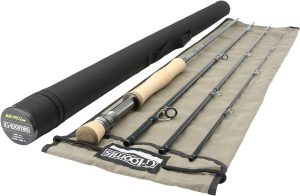
The 9-foot 8-weight uses a fast saltwater action with power through the lower half and a tighter tip intended to improve tracking, line pickup, and control. Conduit Core construction and the GL7 resin system are used to reduce unnecessary material while retaining strength and impact resistance. Fuji tangle-free stripping guides, chrome snake guides, a full-wells grip, aluminum reel seat, and fighting butt complete the salt-ready build.
An 8-weight is the most useful first saltwater size for many North American anglers. It can cover bonefish, redfish, smaller striped bass, snook, sea trout, and freshwater species such as largemouth and smallmouth bass. The rod is handcrafted in Woodland, Washington, and costs substantially less than many flagship saltwater rods.
Anglers pursuing large tarpon, oversized permit, heavy sinking lines, or open-ocean fish should move to a heavier line weight. The IMX-PRO V2S also lacks some of the ultra-light refinement of rods costing nearly twice as much. For practical inshore fishing, it offers the right balance of power, durability, and attainable pricing.
8-weight
9 ft.
Fast saltwater
4
Inshore saltwater
$595
Fuji K-frame / chrome snake
Handcrafted in USA
Reasons to Buy
- Purpose-built saltwater action
- Strong tracking and line pickup
- Corrosion-resistant component selection
- Useful 8-weight format
- Handcrafted in Washington
Reasons to Consider
- Heavier species require a 9- to 12-weight
- Not intended for delicate light-tippet trout fishing
- Less refined than flagship rods near $1,000
Fly Fishing Rod FAQs
Final Thoughts
The Sage R8 Core is our best overall fly fishing rod because it offers the widest useful range for a serious trout angler. The ECHO Carbon XL is the more practical recommendation for many buyers, delivering a forgiving action and true all-around capability at less than one-third of the premium-rod price. Beginners should strongly consider the Orvis Clearwater because it combines an approachable action with a versatile 9-foot 5-weight format and long warranty support.
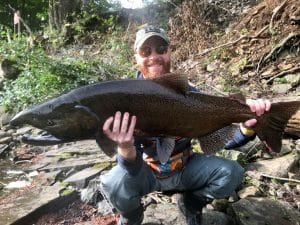
Specialized rods become worthwhile when an angler can clearly describe the problem being solved. Choose the Winston AIR 2 for technical dry-fly water, the Butter Stick for wooded creeks, the ECHO TRIP for compact travel, the Contact III+ for tight-line nymphing, and the G. Loomis IMX-PRO V2S when wind, salt, and powerful fish enter the equation.
Per our affiliate disclosure, we may earn revenue from the products available on this page. To learn more about how we test gear, click here.