



Coyotes thrive in my little slice of southeast Colorado heaven. The semi-open landscape, a mixture of grassy prairies and sage-dappled pastures, makes an ideal habitat for these toothy critters. Aside from man, the K-9s have no natural predators, and the landscape is home to rabbits, prairie dogs, mice, and other small animals.
Ten years ago, coyotes were easy to call and kill. It didn’t matter what time of day, and it didn’t matter what the weather was like. All a guy needed was a .223 Rem. topped with a decent scope, an electronic call, and a tank full of gas.
Times have changed. Predator hunting and predator management has exploded. Calling teeth and claws close has been popularized. These days, on a good-weather day when temps are cold, and song dogs are hungry, my son and I are having a great day if we make five stands and call in a single dog.
Thermals changed the game. We now hunt a lot at night. Our biggest thermal struggle early on was fatigue. It’s terribly hard to scan for nighttime coyotes with just a single rifle-mounted thermal optic. Then, I got my hands on Pulsar’s Axion XQ19 Compact Thermal Monocular.

Now, the shooter can stay on the sticks, and the scanner can use the wide, 19.5-degree field-of-view thermal monocular to continually scan the landscape. The XQ19 weighs less than 9 ounces, fits in the palm of your hand, and stores easily in any outer garment pocket. This monocular is the bee’s knees of wallet-friendly thermal monoculars. You don’t need a NASA pedigree to operate it; battery life is solid, and you can select from eight color palettes.
Overview: Pulsar Axion XQ19 Compact
The Pulsar Axion XQ19 Compact is a pocket‑sized thermal monocular engineered for portability and firm performance in outdoor, low‑light, and no‑light environments. At its core is an uncooled 384 × 288‑pixel microbolometer with a 17 µm pixel pitch and a system NETD (noise equivalent temperature difference) of < 18 mK, delivering reliable contrast and heat‑signature detection even under demanding conditions.
Optically, the unit uses a 19 mm f/1.0 lens (designation F19/1.0) and provides a field of view of about 19.5° horizontally (approx. 34.7 m width at 100 m), which makes it well‑suited for scanning terrain and spotting animals quickly. Digital zoom is available from 1.5× to 6×.
In terms of build and features, the Axion XQ19 Compact is lightweight (about 250–300 g, depending on configuration) and is housed in a durable magnesium or aluminum alloy. It carries a waterproof rating of IPX7 (submersible to 1 m for up to 30 minutes), making it rugged for field use in rain/snow. Battery life is promising using the APS3 rechargeable pack (3,200 mAh), users can expect up to 8 hours of continuous operation under moderate conditions.
Additional must-mentions include an AMOLED display (640 × 400 resolution) with fast response and clear image at low temperatures, built‑in WiFi (2.4 GHz/5 GHz) for smartphone connection via Pulsar’s Stream Vision 2 app (remote view, firmware updates, image/video transfer), USB‑C external power, and multiple thermal color palettes for different observation modes (White Hot, Black Hot, Red Hot, Rainbow, Ultramarine, Violet, Sepia).
Pulsar Axion XQ19: First Impressions
I couldn’t believe it when I unboxed Pulsar’s latest thermal imaging monocular. The XQ19 is ultra-compact and ultra-light. Considered an entry-level thermal, this model is designed for compactness, portability, and ease of use, with a 750-meter detection range. It captures 960×600 video and JPG images to an internal 64GB memory card.
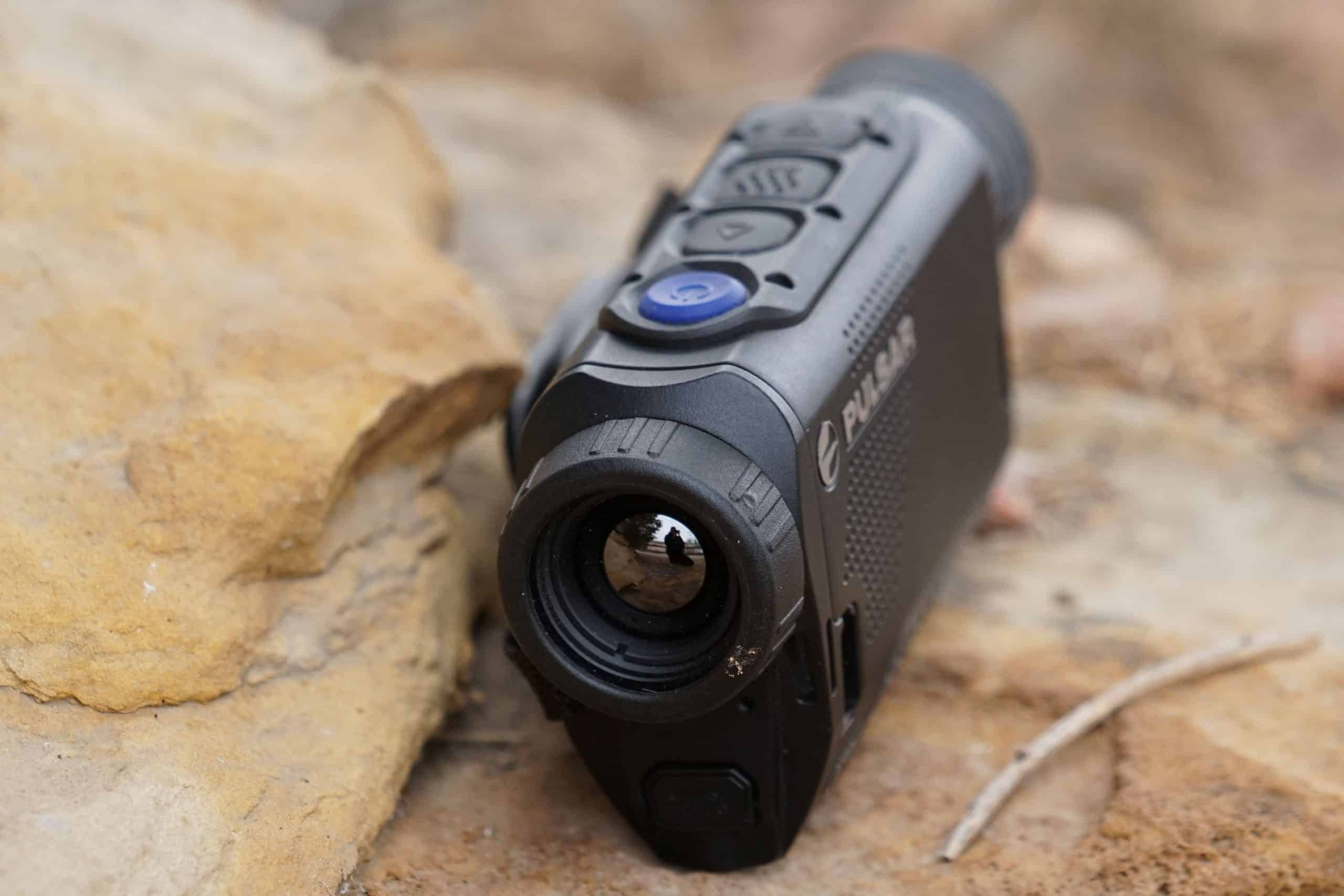
I appreciated the XQ19’s durable magnesium alloy housing, which fits in your pocket. The housing protects the valuable internal components from damage while not making the monocular feel bulky or heavy. According to Pulsar, the unit is 100 percent waterproof.
Remember: Charge the included battery before inserting it and powering the unit on.
The top of the XQ19 is where the magic happens. The large blue ON/OFF button is located at the front of the on-board control panel. A short press of the button turns the unit on, and a long press turns it off. To ensure the unit is off, keep your eye in the eye piece, and the XQ19 will perform a shut-off countdown.

With the unit on, access the internal Menu by clicking the square-labeled MENU button. Accessing the main Menu requires a long push. Inside the main Menu, you can select your desired calibration mode. The XQ19 offers Manual, Semi-automatic, and Automatic calibration options. I discovered I like the Automatic calibration. If you opt for Manual or Semi-automatic, you will need to calibrate the image by pressing the ON/OFF button briefly.
Pulsar’s XQ19 offers Normal, High, and Ultra amplification levels. I played with all of them, but I mostly kept the unit in High. All selections, no matter what you’re doing in the Menu, are simple. Use the Up/Down arrows to scroll to various Menu options, short-press the Menu button to select, and then short-press the Menu button again to choose the option you want.
Yes, the Pulsar XQ19 is an amazing thermal imaging monocular. More to come on this. However, what impressed me from the get-go and made me want to keep playing with and using the unit was its simple-to-activate and set-up nature.
The XQ19 offers 9 thermal imaging modes, and I highly recommend playing with each. I tested the imaging modes on my dogs under various lighting and temperature conditions to determine which I preferred. I also wanted to access other modes in the field when needed quickly.
I do recommend activating the smooth filter. This filter improves the thermal images as the amplification level increases.
Another small feature I love is the lens cover. I lose a lot of lens covers, which means I damage many lenses on my optics over time. The lens cover on the XQ19 is magnetic. Remove from the lens, then attach it to the outside of the handheld strap.
Just Play
I’m a firm believer, especially when a product is straightforward and you begin to get a feel for it, that the best way to learn all its ins and outs and build confidence with it is to play with it.
I spent a week in mid-October hunting deer on my buddy’s ranch in Oklahoma. Naturally, thermal imaging use is strictly taboo concerning deer hunting. However, it’s perfectly legal to pursue and call coyotes and feral hogs at night.
Because we didn’t want to invade known deer areas, much of my Oklahoma coyote/hog hunting was on the fringe of deer areas.
One of the things that initially turned me off to nighttime hunting with a thermal scope was the constant scanning required through the scope during these endeavors. What my buddy, Scott Sanderford, and I discovered is that with a handheld thermal monocular like Pulsar’s XQ19, only the person holding it needs to scan. With one person scanning with the lightweight, highly effective thermal, the shooter can rest and move into his scope only when the spotter locates a possible target.
Thermal images jump to life inside the monocular. I prefer the White Hot and Black Hot thermal color settings, and when you need to bring something into focus, use the diopter wheel and front focusing ring.
So Easy To Transport
Scott and I were having a ball. We weren’t killing a bunch of coyotes, but we were killing a few. This was enough to keep us going. We covered miles on foot, and as the spotter, I was super thankful for the XQ19’s ultra-light weight and ridiculously compact build. Most of the time, I carried the thermal monocular in my hand via the included hand strap. Other times, I stuck it in my pants and coat pocket. The XQ19 is so light and so compact, you don’t even know it’s there.
Deer & Cows
Over the course of our nighttime coyote calling, Scott and I saw lots of deer through the thermal. I detected a single deer moving across an alfalfa field at 890 meters, which is beyond Pulsar’s branded detection range. I love it when a product outperforms what the manufacturer expects.
The XQ19 also came in handy as a ranch hand. While calling for coyotes, I found a large calf that appeared to be hung up in some wire. Upon further inspection, the calf inadvertently wrapped barbed wire around its legs. We were able to catch the calf and remove the wire.
Photo & Video Recording
Part of the fun of nighttime hunting is capturing photos and videos, and when you’re using the XQ19, the built-in video recorder with 64GB of internal memory makes it a breeze.
To record photos and videos, all you need to do is press the Down arrow button. To swap between photo and video modes, long-press the Down arrow button.
Getting photos and videos off the XQ19 is easy. The XQ19 has its own WiFi. All you need to do is download the Stream Vision 2 app, turn on the XQ19’s WiFi in the Menu, and connect the XQ19 with the Stream Vision 2 app. The process is easy, even for a technology hack like me. I had zero trouble downloading my photos and videos directly to my smartphone.
Battery Life
Pulsar does sell a separate battery charger, but plugging the device into a C-charger is equally effective and will save you some pennies. After six hours of use, I’m still running on 62 percent battery life, which is exceptional.
Pulsar does note that colder weather will take its toll on battery life, as will the number of videos and photos you take. Keep this in mind.
Why Do I Need A Thermal Monocular?
If you’re serious about nighttime predator hunting, nothing will boost your success more than an excellent handheld thermal monocular like the XQ19. Pulsar’s Axion XQ19 Compact offers a wide field of view, allowing you to scan for hot objects.
FAQs
Is hunting big game animals with a thermal legal?
Though typically (but not always) kosher for varmints and feral hogs, thermal imaging devices are not legal for the pursuit and harvest of big-game animals.
How much does a thermal monocular cost?
You can find handheld thermals for under $500, but I’ve tested many of them and wouldn’t give you $50 for a truckload. Most quality handheld thermals will start at $1K and go up from there.
What advantages does a thermal monocular give the nighttime predator caller?
Trying to scan for coyotes with a thermal scope mounted on a rifle is extremely difficult. A compact thermal handheld unit lets you scan and then get into your scope once you locate a coyote.
Pulsar XQ19 Specifications
Main specifications
- Sensor: @ 17 µm 384×288
- Objective lens: F19 / 1.0
- Magnification: 1.5 – 6 (x4 digital zoom)
- FOV (HxV), degrees: 19.5 x 12.3
- FOV (HxV), m@100m: 34.7 x 21.5
- Diopter Adjustment: +4/-5
- Detection range: 750m
Sensor
- Type: uncooled
- Resolution, pixels: 384×288
- Pixel pitch, µm: 17
- Sensor NETD, mK: < 25
- System NETD, mK: < 18
- Frame rate, Hz: 50
Optics
- Objective lens: F19 / 1.0
- Magnification: 1.5 – 6 (x4 digital zoom)
- FOV (HxV), degrees: 19.5 x 12.3
- FOV (HxV), m@100m: 34.7 x 21.5
- Diopter Adjustment, D: +4/-5
- Eye relief, mm: 14
Final Thoughts
Pulsar’s Axion XQ19 was one of the funnest, best-performing products that I’ve tested thus far in 2025, and I can’t wait to bring it along on more predator pursuits, but those will have to wait until deer season is over.
Per our affiliate disclosure, we may earn revenue from the products available on this page. To learn more about how we test gear, click here.