





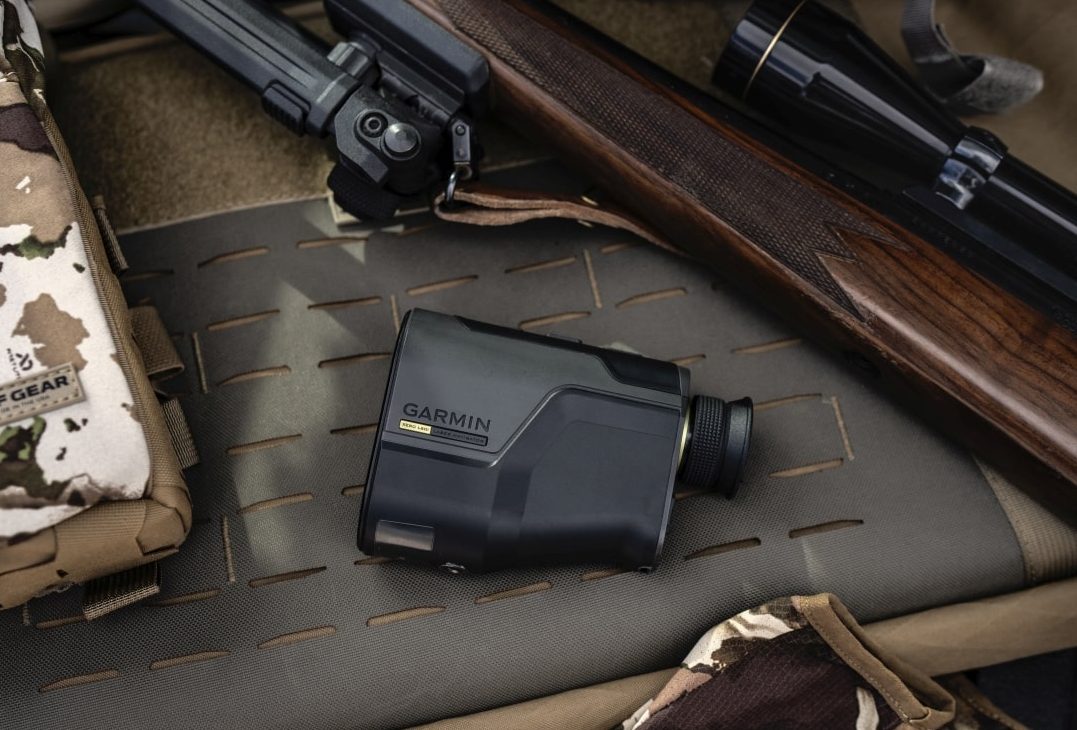
This Garmin Xero L60i rangefinder review has been field tested over three months.
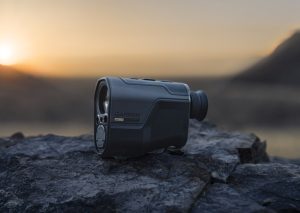
The Garmin Xero L60i is much more than a premium laser rangefinder. It combines accurate ranging, GPS navigation, onboard mapping, a color heads-up display and Applied Ballistics Elite in one handheld unit. After three months of testing, its biggest strength is integration. Its biggest drawback is equally clear: at a $2,500 USD MSRP, it offers far more technology than many hunters need.
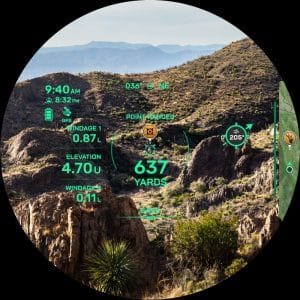
The Garmin Xero L60i’s heads-up display is unlike anything I’ve seen in a handheld rangefinder. Instead of the familiar red numbers found in most laser rangefinders, the L60i overlays vibrant color graphics directly onto the view. Distance, navigation and ballistic information are right where you need them without taking your eye away from the scene.
But the display is only the beginning. After three months of carrying the L60i in the field, I’ve come to think of it as something considerably different from a conventional rangefinder. It combines a precision laser rangefinder with GPS navigation, onboard mapping and Applied Ballistics Elite in a single handheld device.
I ranged hundreds of targets, tested ballistic solutions out to 500 meters, used the navigation system in the field and pushed its laser-ranging capability to approximately 2,500 meters.
The result is a rangefinder that does far more than tell you how far away something is. It can calculate a ballistic solution, save a ranged location, show that location on an onboard map and guide you back to it.
The more difficult question is whether all of that technology makes the L60i worth $2,500. For some hunters and shooters, I think it does. For others, it is unquestionably overkill.
Garmin Xero L60i Review Snapshot
Open-country hunters, long-range shooters, serious bowhunters and back country users
Ranging, ballistics, GPS mapping and navigation integrated into one device
More capability—and expense—than most casual hunters need
The short buying decision
Buy it if you will actually use its combination of long-range ranging, advanced ballistic calculations, onboard mapping, and navigation. If you simply need to know whether a deer is 150 or 200 yards away, the L60i is difficult to justify at this price.
How We Tested the Garmin Xero L60i
I carried and tested the L60i for three months, focusing on the functions that would actually matter to hunters and shooters in the field rather than simply repeating the manufacturer’s specifications.
I ranged hundreds of targets and pushed the laser to approximately 2,500 meters.
I built a custom rifle profile and validated Applied Ballistics solutions out to 500 meters.
I saved waypoints, used the onboard maps, and tested the navigation system in the field.
I tested estimated locations on landscape features out to approximately 5,500 meters.

Key Features and Benefits
The L60i’s appeal comes from how many normally separate hunting and shooting tools Garmin has integrated into one handheld device.
Heads-up display and optics
The optical view at 7X is useful enough that I frequently used the L60i as a monocular even when I wasn’t ranging.
The 7X magnification and 32mm objective produce a 4.6mm exit pupil and a useful view in lower-light conditions.
The HUD color can be changed based on personal preference and lighting conditions. I generally preferred green.
In dim conditions, the display automatically switches to red to reduce disruption to natural night vision.
Applied Ballistics Elite
The L60i combines the laser rangefinder, rifle profile, shot angle and onboard environmental sensors with Applied Ballistics Elite to calculate elevation and windage corrections directly in the rangefinder.
Custom rifle profiles, including information about specific firearms and bullet or ammunition combinations, are saved in the Applied Ballistics Quantum app and synced with the L60i.
The rangefinder combines that profile with information from its onboard GPS/GNSS positioning, compass, barometric pressure sensor, temperature sensor and inclinometer.
The resulting elevation and windage correction appears directly on the HUD and can be displayed in MIL, MOA or clicks.
Wind speed and direction can be entered manually or downloaded through the app from a nearby weather station. The system can also store two wind values to help bracket changing wind conditions.
The calculator is only as good as the information it receives. Accurate muzzle velocity, ballistic coefficients, rifle profiles and environmental information remain critical.
Hunters looking at premium ballistic-enabled optics may also want to read our Vortex Fury HD 5000 AB review. The Vortex takes a different approach by combining Applied Ballistics and laser ranging with a full-size binocular rather than a handheld rangefinder.
One rangefinder, three profiles
Designed for basic ranging, mapping and navigation. Range a point, save it, display it on the map and navigate back to it later.
Uses entered arrow velocity to provide line-of-sight distance, angle-compensated distance, shot angle, arrow-flight apex and projected impact angle.
Designed for rifle shooters, combining range, environmental information and shot angle to calculate elevation and windage corrections.
Archery and Crossbow capability
The L60i isn’t solely a rifle-shooting tool. Its dedicated Archery profile makes it useful as both a bowhunting and crossbow rangefinder.
After entering the appropriate arrow velocity, the L60i provides line-of-sight distance, angle-compensated distance, shot angle, projected arrow-flight apex and projected impact angle.
Instead of simply displaying an adjusted yardage, the L60i provides a visual representation of the projected arrow path and impact angle. I repeatedly referenced the graphic during testing to see how the shot would impact the target. This is especially helpful for longer-range, western hunting where you may have brush to contend with between the shooter and the target.
The L60i can also range targets as close as 1 meter, including decimal precision when selected, which makes it useful for close-range archery practice.
Onboard mapping and navigation
The mapping system is one of the features that most clearly separates the Xero L60i from a conventional laser rangefinder.
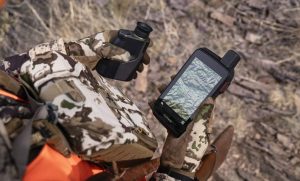
The L60i displays your current position and ranged locations on its onboard map. You can save a ranged point, navigate to it later, measure distances between points, and create courses.
I used the navigation functions in the field and found them similar to using a handheld GPS, with one major advantage: the map and navigation information are available while you’re looking through the rangefinder.
Visual Recall
Visual Recall was another feature I found extremely useful. After ranging and saving a location, you can move to another vantage point and use the L60i to reacquire that location visually.
It can also solve a common hunting problem. Instead of trying to explain that a buck is 50 meters to the left of a distant tree, you can mark its location, hand the rangefinder to a hunting partner, and let the display guide their view to the same point.
Sensor Locate
Sensor Locate extends the L60i’s usefulness beyond the effective range of its laser.
When a target is too far away for laser ranging, the device uses GPS, its compass, inclinometer and onboard mapping to estimate the distance and project the target’s location.
I tested Sensor Locate on large landscape features out to approximately 5,500 meters and compared the results with satellite imagery. The results were all within a few hundred meters.
At those distances, holding the rangefinder steadily and precisely positioning the reticle becomes a major limitation. The 7X magnification also limits how precisely a distant point can be identified. For large landscape features, however, Sensor Locate considerably extends the L60i’s practical usefulness.

Battery, controls and firmware
The L60i uses two AAA lithium batteries, and Garmin rates battery life at up to 1,400 ranges based on a one-second range followed by a 10-second display.
I used rechargeable AAA lithium batteries throughout my evaluation and had no complaints about runtime. Garmin’s support team also confirmed that rechargeable lithium batteries would not harm the device, although Garmin recommends standard lithium cells for its specified battery performance.
An external USB power bank also works, but the cable is inconvenient enough that I wouldn’t consider it practical for normal hunting use.
The controls are intuitive and ergonomic. Switching modes, entering data, changing settings, navigating maps and measuring distances are all straightforward.
Firmware updates also give Garmin the ability to add functions after purchase. During my testing, one update added Stealth Mode and wind-direction functionality along with other improvements at no additional cost.
Real-World Performance
Specifications are one thing. What impressed me most was how well the L60i’s major systems worked together during actual field use.
What we verified in testing
Laser ranging
Fast, repeatable readings on a distant willow bluff with the sun low on the horizon.
Applied Ballistics
I validated the calculated ballistic solutions with a custom hunting-rifle profile and found them extremely accurate.
Navigation
Saved locations, maps and navigation worked much like a handheld GPS while keeping information in the optical view.
Sensor Locate
Estimated locations on large landscape features were within a few hundred meters when compared with satellite imagery.
Ranging modes
The L60i offers three continuous scan modes: Recent, Maximum, and Minimum.
Shows the most recently ranged object. This was the mode I used most often for normal hunting and target shooting.
Prioritizes the farthest object detected. This helped when ranging through scattered brush in the foreground.
Prioritizes the nearest object and helped reduce the chance of ranging trees behind deer-sized targets.
Garmin lists animal ranging to 1,375 meters in full sun and 2,775 meters under optimal conditions, trees to 3,600 meters and retroreflective targets to 7,000 meters. Those are manufacturer specifications rather than distances I independently verified. My longest successful laser range was approximately 2,500 meters.
Laser beam performance
The L60i uses a 0.5 × 0.5 mrad laser beam divergence. A narrow beam can help isolate a target from objects behind it, although actual performance still depends on target size, distance, atmospheric conditions and how steadily the rangefinder can be held.
Garmin Xero L60i Specifications
The L60i is designed to use two AAA lithium batteries, and Garmin rates battery life at up to 1,400 ranges based on a one-second range followed by a 10-second display.
I didn’t attempt to establish an independent battery-life figure because actual runtime varies considerably depending on how the device is used. I used rechargeable AAA lithium batteries throughout my evaluation and had no complaints about their runtime.
I also confirmed with Garmin’s support team that rechargeable lithium batteries would not harm the device, although Garmin recommends standard lithium cells for the specified battery performance.
I tested the L60i with an external USB power bank. It works, but the cable is inconvenient enough that I wouldn’t consider an external battery a practical solution for normal hunting use. It makes more sense as a way to extend runtime when the rangefinder is being used in a stationary situation.
The rangefinder controls are intuitive, ergonomic and easy to use. It’s fast and easy to switch modes, input data, change settings, navigate the map, and of course measure distances.
The device carries an IPX7 water-resistance rating and operates from -4° F to 140° F. This means the L60i works in most environmental conditions hunters and adventurers will encounter.
| Magnification | 7X |
|---|---|
| Objective lens | 32mm |
| Exit pupil | 4.6mm |
| Minimum ranging distance | 1 meter |
| Animal range in full sun | 1,375 meters / 1,500 yards, manufacturer-listed |
| Animal range, optimal conditions | 2,775 meters / 3,000 yards, manufacturer-listed |
| Tree ranging | 3,600 meters / 4,000 yards, manufacturer-listed |
| Retroreflective target range | 7,000 meters / 7,500 yards, manufacturer-listed |
| Listed accuracy to 1,000 m | ±0.25 meter |
| Listed accuracy beyond 1,000 m | ±1 meter |
| Laser beam divergence | 0.5 × 0.5 mrad |
| Operating profiles | General, Archery and Applied Ballistics |
| Ballistic solver | Applied Ballistics Elite |
| Battery | Two AAA lithium batteries |
| Listed battery life | Up to 1,400 ranges |
| Water-resistance rating | IPX7 |
| Operating temperature | -4°F to 140°F |
| MSRP | $2,500 USD |
Garmin Xero L60i Pros and Cons
What We Liked
- Excellent color heads-up display
- Ranging, GPS mapping and navigation integrated into one device
- Applied Ballistics Elite is seamlessly integrated
- Extremely accurate ballistic solutions during our 500-meter testing
- Fast, repeatable long-distance ranging
- Dedicated General, Archery and Applied Ballistics modes
- Visual Recall is genuinely useful in the field
- Sensor Locate extends usefulness beyond laser range
- Bright 7X optical view is useful as a monocular
- AAA Lithium batteries offer a convenient and easy-to-find power solution.
Reasons to Consider Another Rangefinder
- $2,500 MSRP puts it firmly in premium territory
- More technology than many casual hunters will ever use
- Shooters who don’t need Applied Ballistics Elite’s advanced long-range ballistic solutions.
- 7X magnification limits precise targeting at extreme Sensor Locate distances
- External USB power works but is inconvenient for normal hunting use
Who Should Buy the Garmin Xero L60i?
The L60i makes the most sense for open-country hunters, long-range shooters, serious bowhunters, guides, and backcountry users who will actually take advantage of its advanced capabilities.
For someone who regularly shoots at extended distances, integrating range, environmental information and a ballistic solution into a single device eliminates several steps between ranging a target and obtaining a firing solution.
The navigation system adds another dimension. You can mark animal sightings, potential stand locations, landmarks, bullet point of impact, downed animals and other points of interest and then navigate back to them later.
Archery hunters also get a dedicated mode that converts arrow velocity and shot angle into practical information, including compensated distance, projected arrow-flight apex and projected impact angle.
Who should skip it?
At a $2,500 USD MSRP, the L60i is overkill for the casual deer hunter who rarely shoots beyond 100 yards or the range user who simply needs to know how far away a target is.
There is a tremendous amount of capability here, but its value depends on actually using those capabilities. If mapping, advanced ballistics, Visual Recall, and navigation are features you will rarely touch, a much simpler rangefinder makes more financial sense.
Final Verdict
A premium rangefinder that functions more like a field computer
After three months with the Garmin Xero L60i, its greatest advantage is integration. It combines a laser rangefinder, 7X optical viewer, GPS, digital mapping, navigation system and Applied Ballistics Elite solver into one handheld unit.
I verified Applied Ballistics solutions out to 500 meters, ranged deer around 900 meters, ranged trees at approximately 2,500 meters, and used Sensor Locate on a farmyard roughly 5,500 meters away. I also extensively tested its mapping and navigation functions. For scouting, this tool is outstanding.
For the hunter who only needs to know whether a deer is 150 or 200 yards away, it’s difficult to justify spending $2,500. But for the hunter or shooter who will use its ranging, ballistics and navigation capabilities, the Xero L60i is a different proposition.
At that point, it isn’t simply a premium laser rangefinder. It’s a field computer built around one. To view a list of rangefinders in a more friendly budget, check out the best rangefinders.
Per our affiliate disclosure, we may earn revenue from the products available on this page. To learn more about how we test gear, click here.